
History of The Musical Stage
1910-1919: Part II
by John Kenrick
(Copyright 1996; revised 2020)
(The images below are thumbnails – click on them to see larger versions.)
Ziegfeld: Setting Standards
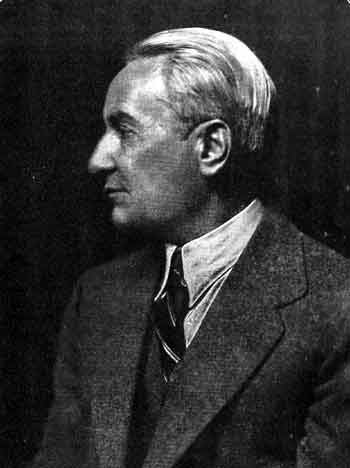 Ziegfeld
as he appeared at the height of his career.
Ziegfeld
as he appeared at the height of his career.
Having established the popularity of the revue format with his Follies, Florenz Ziegfeld continued to set new artistic standards with the series in the 1910s.
Ziegfeld personally approved every aspect of his productions, from writing to design to casting. He even insisted his chorus girls be provided with costly undergarments. When told the audience would never know the difference, Ziegfeld replied, "But the girls will!" Although this now-legendary showman used his unique personal taste to shape and define each edition of the Follies, several gifted directors and designers added signature elements to the series:
- Julian Mitchell re-affirmed his status as the first important director of Broadway musicals, an extraordinary distinction for a man who was deaf. His flair for staging creative ensemble numbers showed the Ziegfeld Girls to their best advantage.
- Gene Buck served as songwriter, occasional director, and Ziegfeld's right hand man.
- Joseph Urban's exquisite sets became the embodiment of the art nouveau style.
- When a bizarre New York law made it illegal for nude actors to move on stage (but o.k. if they stood still), visual artist Ben Ali Haggin placed naked Ziegfeld girls in a series of motionless but dazzling tableaux. These lavish "living pictures" sidestepped the law and delighted audiences.
- Ned Wayburn became Broadway's first noteworthy "dance director" -- no one on Broadway would use the term "choreographer" till decades later.
- Lady Duff-Gordon (a.k.a. "Lucille") and Erte raised stage costume design to the level of international high fashion
Over time, Ziegfeld's spare no expense approach made his Follies the costliest productions on Broadway. The 1907 edition was produced for $13,800 -- the 1919 edition came in at $150,000. Although the emphasis was increasingly on spectacle and pulchritude, the Follies introduced several memorable songs. Irving Berlin's "A Pretty Girl is Like a Melody" became the unofficial anthem for the series, which also introduced "My Man," "Shine On Harvest Moon," "Second Hand Rose" and "By the Light of the Silvery Moon."
The greatest artistic legacy of the Follies was its stellar line-up of comedy talent. Some of the funniest stars in show business achieved fame by appearing in the series, including W.C. Fields, Bert Williams, Ed Wynn, Will Rogers, Eddie Cantor and Fanny Brice. The Follies would remain a Broadway staple through the next decade, when Ziegfeld would also produce several important book musicals. (You'll find more on him in the pages ahead, or visit Ziegfeld 101.)
World War I
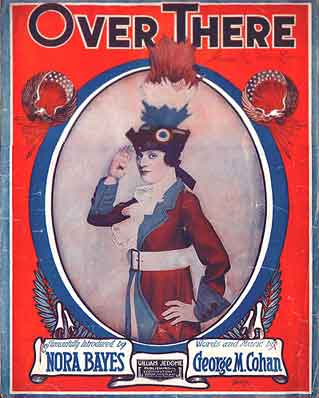 The
original sheet music for George M. Cohan's wartime hit "Over
There." The patriotic lady in the photo is vaudeville star Nora Bayes, who Cohan
selected to introduce the song.
The
original sheet music for George M. Cohan's wartime hit "Over
There." The patriotic lady in the photo is vaudeville star Nora Bayes, who Cohan
selected to introduce the song.
After three years of official neutrality, the United States entered World War I in 1917, joining with Britain and France in the struggle against Germany and Austria. While vaudevillians like Nora Bayes were among the first to entertain troops near the front lines, other Broadway luminaries played an active role on the home front.
George M. Cohan's anthem "Over There" was a popular wartime hit. Al Jolson distracted worried audiences with the tongue-twisting "Sister Suzie's Sewing Shirts for Soldiers," and joined other stars to raise millions of dollars through war bond drives. Dancer Vernon Castle served in the Canadian air force and was killed while training cadets in Texas.
Although America's involvement in the war was relatively brief, many topical stage revues included war-themed routines. Florenz Ziegfeld dressed his Follies chorines in tailored military uniforms, and had one of his girls appear bare breasted to personify "liberty" – thanks to the patriotic context, no one complained. Not to be outdone, the Shuberts stripped their already under-dressed Passing Show chorines, all in the name of patriotism. In a slightly classier gesture, they also introduced the hit song "Goodbye Broadway, Hello France" in the 1917 edition.
Things took a dark and unexpected turn in the autumn of 1918 when a devastating flu pandemic reached the United States. Victims in seemingly perfect health would be dead within days, sometimes hours. As 25 million Americans fell ill and an estimated 550,000 perished, many cities closed their theatres. New York City allowed theatres to stay open, but audiences were so sparse that several Broadway productions were forced to close. A core group of shows kept running at a loss, including Ziegfeld's Follies. Within a few weeks, the commercial theater reached the brink of economic ruin.
Then, for no clear reason, the pandemic subsided. Audiences soon reappeared, and one of the deadliest chapters in history became a buried footnote. It is estimated that the epidemic killed more than 20 million people worldwide, approximately twice the number of people killed in battle during "The War to End All Wars." Most historians ignored this frightening epidemic until the beginning of the next century.
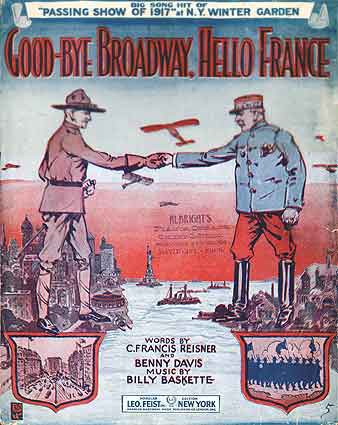 The
sheet music for "Goodbye Broadway, Hello France," a popular
wartime march introduced in The Passing Show of 1917.
The
sheet music for "Goodbye Broadway, Hello France," a popular
wartime march introduced in The Passing Show of 1917.
Post-war America embraced isolationism in a desperate attempt to deny its new role as a leader in world affairs. It also shifted from being a debtor nation to being a lender to war-torn nations. This subtle change had a profound effect on American business and everyday live -- particularly in New York City.
"By 1919, New York had displaced its last and greatest rival, London, as the investment capital of the world, and money was flowing into the city, one British observer remarked, "as water flows downhill." "Only by careful and constant extravagance," one New Yorker replied impertinently, 'can we keep it from bursting the banks!'"
- Burns, Ric and James Sanders, New York: An Illustrated History. New York: Alfred A. Knopf, 2003, p. 315.
Despite a constitutional amendment prohibiting the sale and transport of liquor, America was in the mood to party. As saloons were forced to close, every community in country -- and every block in Manhattan -- soon had one or more illegal speakeasies serving illicit alcohol. Broadway offered giddy new editions of George White's Scandals, Florenz Ziegfeld's Follies and numerous now-forgotten musicals. As a new energy began to make itself felt in all aspects of American popular culture, Broadway ticket sales soared, and the theatre prepared to reap the benefits of a post-war economic boom.
Actors Strike of 1919
Broadway's postwar jubilation was interrupted when the Actor's Equity Association demanded better working conditions for its members. This union had formed years earlier in response to abusive treatment by the Shuberts and other producers. It was common practice for producers to make actors pay for their own costumes, rehearse for weeks without compensation, and face salary cuts and termination without notice. In a patriotic gesture, Equity agreed to wait until after the war to press its demands. In August of 1919, when producers ended months of half-hearted negotiations by refusing to recognize the union, Equity president Francis Wilson called the first labor strike in the history of the American theatre.
Actor-producer George M. Cohan had always treated performers well. Taking the strike as a personal insult, he led a spirited effort to quash Equity, forming a counter union that called itself "Actor's Fidelity." Most actors felt Cohan had forgotten what it was like to be a struggling performer. Angry rhetoric poured forth from both sides. When Cohan proclaimed that he would quit the theater and run an elevator before giving in to Equity, longtime friend Eddie Cantor publicly pointed out that that elevator operators in New York City had to belong to a union.
Desperate producers put together non-union casts to keep their shows running. Then the stagehands union agreed to honor the strike, shutting down almost every professional production in the United States. Coming just months after the flu epidemic, the strike hit producers like a one-two punch. Faced with crippling losses, producers were forced to recognize Actors Equity and accept its demands. An embittered Cohan never accepted Equity's existence, but actors finally had some professional leverage.
Irene
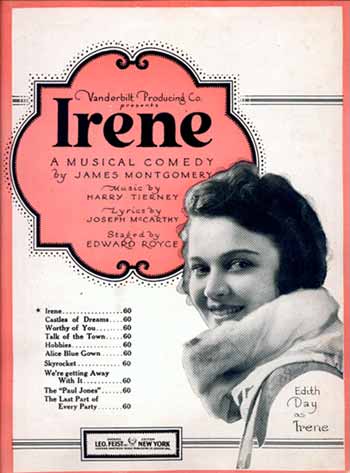 Edith
Day on the sheet music for Irene. She traveled with the show to London, where she reigned as a top musical star
until her retirement in the 1960s.
Edith
Day on the sheet music for Irene. She traveled with the show to London, where she reigned as a top musical star
until her retirement in the 1960s.
The first memorable post-World War I hit was the Cinderella-like story of a Manhattan shop girl (played by Edith Day) who becomes a high fashion model and wins the love of a Long Island millionaire. The twist is that the millionaire has to win over the girl's impoverished mother who is prejudiced against wealth! Following the Princess Theatre model with believable characters facing realistic problems, Irene (1919 - 670 performances) set a new long-run record for Broadway by giving audiences sentimental, easy going fun with a fresh "modern" energy. Composer Harry Tierney and lyricist Joseph McCarthy's score included the nostalgic "Alice Blue Gown," which fed a craze for "Alice blue" fashions (a bluish-gray tint named for Theodore Roosevelt's famed socialite daughter). A heavily revised version of Irene would be revived on Broadway in the 1970s.
As Broadway moved into a new decade, a record number of musical productions would help keep the 1920s "roaring" . . .