
History of Musical Film
1930s Part IV - More at MGM
by John Kenrick
(Copyright 1996; revised 2020)
(The images below are thumbnails – click on them to see larger versions.)
Nelson and Jeanette
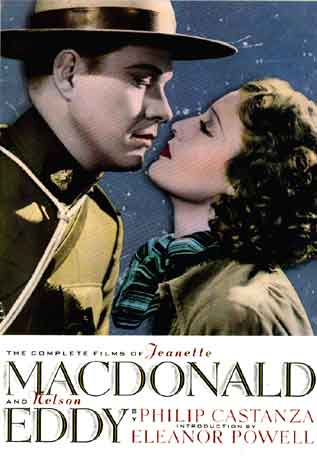 Nelson
Eddy and Jeanette MacDonald have inspired several books, including this tribute
to their film careers. The cover shows a colorized shot of them singing
"Indian Love Call" in Rose Marie (1936).
Nelson
Eddy and Jeanette MacDonald have inspired several books, including this tribute
to their film careers. The cover shows a colorized shot of them singing
"Indian Love Call" in Rose Marie (1936).
Jeanette MacDonald's most memorable screen partnership began when MGM paired her with unknown baritone Nelson Eddy in Naughty Marietta (1935). The duo brought fresh life to this quarter century old operetta, and the studio soon arranged a follow-up. MacDonald and Eddy's heartfelt rendition of "Indian Love Call" ("When I’m calling you-oo-oo-oo") in Rose Marie (1936) cemented their place in popular culture.
Some critics complained that the duo was too sweet, their acting limited and their singing less than perfect. None of this mattered to the movie-going public. Eddy and MacDonald had on-screen chemistry, and some films historians now suggest that the old critical complaints were off the mark.
"On the contrary, in a cycle of films where physicality is repressed, the erotic often ends up all the more insistent – which just may account for the hypnotic pull these films continue to exert on so many viewers. In Astaire-Rogers musicals, overt physical playfulness is essential to courtship. In MacDonald-Eddy pictures, sex behaves differently. Channeled through song, it becomes as disembodied as Indian spirits echoing sweet love calls throughout the Canadian Rockies."
- Edward Baron Turk, Hollywood Diva: A Biography of Jeanette MacDonald (Berkley: Univ. of California Press, 1998), p. 174.
Eddy and MacDonald's screen hits included adaptations of the stage hits Maytime (1937) and The New Moon (1940). The romantic plots can seem corny today, but the two stars give a warm believability to emotions that could easily have come across as ridiculous on the big screen. If you watch Sweethearts (1938) with its witty Dorothy Parker script, you can understand why Nelson and Jeanette became such favorites.
After co-starring on screen for the last time in Rodgers and Hart’s I Married An Angel (1941), the team made occasional joint appearances on radio. For all their on-screen passion, the two stars were just friends in real life. The suggestion that they had an off-screen affair (promoted in the ludicrous book Sweethearts) has been justifiably dismissed as nonsense by all responsible sources.
Both stars made noteworthy films with other partners. MacDonald was memorable as a nightclub singer who pursues Clark Gable and survives a devastating earthquake in San Francisco (1936), and Eddy had fun opposite Metropolitan Opera diva Rise Stevens in The Chocolate Soldier (1941). However, the pairing of "Nelson and Jeanette" became the stuff of show business legend, spawning fan clubs that would outlast both stars by several decades.
Biographical Musicals
MGM outdid itself when it brought the story of Broadway's greatest showman to the screen. The Great Ziegfeld (1936) took major liberties with the facts, but offered a lavish and entertaining version of Florenz Ziegfeld's colorful life and career. There are several memorable musical numbers, including an eye-popping version of the Follies unofficial theme song, Irving Berlin's "A Pretty Girl is Like a Melody." Veteran Follies set designer Jonathan Harkrider built a massive rotating spiral staircase far too large for any Broadway stage, which Broadway choreographer Seymour Felix filled with hundreds of opulently costumed showgirls. A spectacular pageant of beauty is revealed as this massive tower twists by, creating one of Hollywood's most distinctive production numbers. It helped The Great Ziegfeld earn Academy Awards for Best Dance Direction and Best Picture.
This inspired a new sub-genre, the biographical musical film. Many studios would contribute to this trend, but none could match MGM for sheer spectacle. The Great Waltz (1938) tackled the life story of Viennese composer Johann Strauss II with lavish production values and innovative cinematography. The film dramatized a few key events from the composer's life but otherwise invented freely, and the results delighted the moviegoing public -- in large part thanks to a powerful non-singing performance by Luise Rainer as Mrs. Strauss. Bio musicals would remain a Hollywood staple into the 1960's, so you will find more on these projects in the pages ahead.
The Wizard of Oz
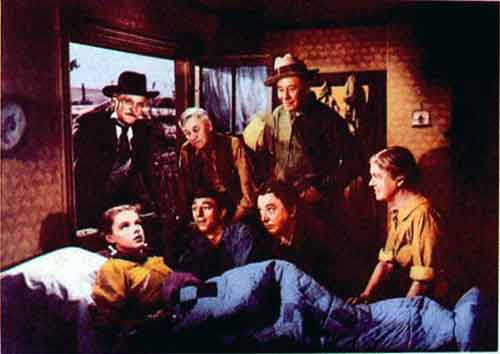 The final scene
("There's no place like home") of MGM's classic The Wizard of Oz,
colorized for a 1939 lobby card.
The final scene
("There's no place like home") of MGM's classic The Wizard of Oz,
colorized for a 1939 lobby card.
Following Irving Thalberg's death in 1936, Louis B. Mayer developed a system of separate production units (each headed by a different producer) kept MGM on top. MGM's profits for 1937 equaled those of all other Hollywood studios combined, and musicals were a crucial element in that triumph. And one of Mayer's top songwriters managed to put together the most celebrated musical film team in Hollywood history.
After composing hit songs like "Singing in the Rain," "Broadway Rhythm" and "You Are My Lucky Star" for the MGM's early musicals, Arthur Freed began campaigning for Mayer to give him a unit that would be dedicated to producing musicals. Freed saw several underused talents on the MGM roster, including producer/arranger Roger Edens and child singer Judy Garland. The studio saw limited potential in the girl until Freed and Edens arranged for her to sing "Dear Mr. Gable/You Made Me Love You" in Broadway Melody of 1938.
Audience response was tremendous, and Freed began searching for a project that would make Garland a full-fledged star. He decided to go with a full color version of Frank L. Baum's children's novel The Wizard of Oz (1939). The studio had veteran producer Mervyn Leroy on hand to counter Freed's inexperience, but Freed was the primary mover behind this project.
Louis B. Mayer wanted to borrow Fox superstar Shirley Temple for the role of Dorothy. When Fox executives rejected the idea, Freed secured the role for Garland and surrounded her with a cast packed with vaudeville and Broadway veterans. To this day, when most people think of Baum's Oz characters, they picture the MGM cast -- Frank Morgan as the Wizard, Ray Bolger as the Scarecrow, Jack Haley as the Tin Man, Bert Lahr as the Cowardly Lion, Billie Burke as Glinda, and Margaret Hamilton as the Wicked Witch. And does anyone think of Dorothy Gale without envisioning Judy Garland in her blue gingham dress and sparkling ruby slippers?
After an advance screening, some MGM executives insisted that "Somewhere Over the Rainbow" be cut, claiming the lyric was too sophisticated for a simple farm girl. After a prolonged battle, Arthur Freed won out and the song stayed in. When it became a top hit and made Garland a household name, Freed scored major points with Mayer.
The film was well received, but because of its three million dollar Technicolor budget, it made only a minimal profit in its first release. It was not until television began annual broadcasts in the 1950s that the film gained recognition as a treasure. The score by composer Harold Arlen and lyricist E.Y. "Yip" Harburg, has become part of the world's basic musical vocabulary. It also has one of the few scores of the 1930s that is fully integrated into the action of the film, with every song taking part in the development of plot and/or characterization.
Thanks to cable and a best-selling home video releases, each year brings a new crop of children into this film's lifetime fan club. And why not? With its warm insistence that "there's no place like home," The Wizard of Oz stands as a pop culture landmark.
"It has been suggested that part of the movie's appeal . . . lies in the fact that in it one sees Judy Garland restored. It is more likely the deeper revelation of seeing one's own innocence restored, the innocence that allows one to return home."
- Aljean Harmetz, The Making of The Wizard of Oz (New York: Limelight Editions, 1977), p. 298.
Mickey and Judy
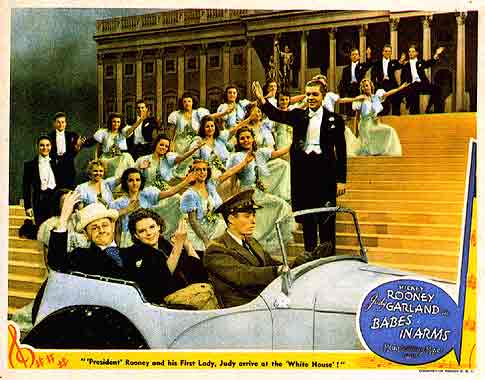 Mickey
Rooney and Judy Garland spoof Franklin and Eleanor Roosevelt in Babes on Broadway (1940), seen here
on a colorized lobby card.
Mickey
Rooney and Judy Garland spoof Franklin and Eleanor Roosevelt in Babes on Broadway (1940), seen here
on a colorized lobby card.
Mickey Rooney was a major star thanks to MGM's Andy Hardy comedy films, and Judy Garland had just completed The Wizard of Oz. Still, MGM had no special expectations when producer Arthur Freed paired the two juveniles for the film version of Rodgers and Hart's Babes in Arms (1939). It was a shock to everyone except Freed when his relatively low-budget Babes racked up millions in profits.
This story of teenagers who save their vaudevillian families from ruin by putting on a show was a perfect choice for two actors who had been real-life vaudevillians, and Mickey and Judy's off screen friendship added genuine warmth to their performances. Singing, dancing and mugging up a storm, they were the freshest, most energetic team the musical film had yet seen. Rooney discussed their partnership in his autobiography –
"With other actresses, I had to play everything straight. If I tried to clown around with a novice, fiddle with the timing, or ad-lib, I'd rattle her and ruin the scene. With Judy, it was the exact opposite. We actually tried to throw each other off track, tried to get the other one to mess up a scene. . . I couldn't rattle Judy, She couldn't rattle me. In a dance number, I'd step on her foot. Then she's step on mine. That wasn't in the script. But, often enough, Berkeley would like it, and shout out, 'Good! Great! Print it!'"
- Mickey Rooney, Life is Too Short (Villard Books, NY, 1991), pp. 143-144.
MGM showcased Rooney and Garland in three more musicals, re-working the "hey kids, let’s put on a show" theme in Strike Up the Band (1940), Babes On Broadway (1940) and Girl Crazy (1943) as well as several Andy Hardy comedies. The series made millions and Garland became a top-rank star. Veteran director Busby Berkeley staged many of the musical sequences for these films. His harsh directorial style drove Garland into nervous collapse, but the studio was too pleased with the on screen results to complain.
With the success of the Rooney-Garland series, Arthur Freed's position at MGM was secured. For the next two decades, he was given a more or less free hand, building a production unit that brought the screen musical to new creative S. Songwriter Irving Berlin described Freed as follows –
"His greatest talent was to know talent, to recognize talent and surround himself with it . . . He knew how to handle men; he knew when to say "yes" and when to say "no." But he never bothered people if he had confidence in them. You don't think he'd dictate to Alan Lerner and Frederick Loewe? And he certainly couldn't dictate to me. I would welcome it if I agreed with him, but I could tell by his face whether it was good or bad and what he thought . . . He discovered a lot of people and he would take much more pride in that than in writing 'Singin' in the Rain.' . . . And he knew style – he didn't do it, but he had an eye for it."
- as quoted in Hugh Fordin's The World of Entertainment: Hollywood's Greatest Musicals (Garden City, NY: Doubleday and Company, 1975), pp. 525-526.
Rooney went on to star in mostly non-musical projects while Garland starred in some of MGM’s finest 1940’s musicals. (This will be discussed in the pages to come.) In Words and Music (1948), the duo reunited to sing "I Wish I Were In Love Again." How appropriate that their screen partnership should end with a number cut from Babes in Arms, the film that made them a musical team.
To an era plagued by depression and war, Garland and Rooney embodied boundless, naive optimism. Is the mortgage due? The school in danger? The family business wiped out? Hey, let's put on a show! This is a fantasy that some fans will never fully abandon.
As the next decade began, it did not take long for the horrifying realities of a world at war to set in. Hollywood musicals reacted by waving the flag, drowning out the bombs and tanks with ballads . . . and the nostalgic "clang, clang, clang" of a trolley.