
Our Love Is Here To Stay IV
1900-1940: On Screen
by John Kenrick
(Copyright 1996, last revised 2011)
- Silent Times
- First Queers in Talking Films
- The Great Depression
- The Production Code
- Over the Rainbow
(The images below are thumbnails – click on them to see larger versions.)
Silent Times
One of inventor Thomas Edison's first experimental films depicted two men dancing. There is no reason to believe that Edison intended this as a depiction of homosexual behavior, but it has given gay film scholars an amusing and early starting point for their studies. As silent film became a major industry, there were numerous intentional depictions of homosexual stereotypes, usually for comic effect -- effeminate cowboys, mincing neighbors, etc. However, few filmgoers of the early 20th Century were aware of the tremendous contribution gay talent made to early Hollywood.
Gays played a prominent role in the American film industry from the days of the silent screen onwards, and the fact that so many of them escaped press scrutiny suggests that they knew the value of discretion. While straight stars like Charlie Chaplin, Fatty Arbuckle and Clara Bow got into devastating sexual scandals, gay stars managed to keep their sexual preferences out of the headlines. The only thing that mattered to anxious studio executives was the bottom line. As film historian William J. Mann explains –
The studios were called dream factories, after all – the makers of myths. That was their commodity, the goods they sold: the image translated into dollars. So long as you held up the image, so long as you made the dollars, there was indeed no problem . . . "It was the best of times and the worst of times," said the costume designer Miles White of the gay experience during the studio era. "On the one hand, they didn't care, and you had extraordinary freedom, but on the other, of course they did, and you weren't free at all."
- Behind the Screen, How Gays and Lesbians Shaped Hollywood, 1919-1969 (New York: Viking, 2001), p. xi.
Top silent stars Ramon Novarro and William Haines had legions of female fans who never suspected that these handsome hunks were homosexuals, but damn near everyone in the film industry knew. Directors George Cukor and James Whale were prominent (and often at odds with each other) in Hollywood's gay social circles, and screen divas Greta Garbo and Marlene Dietrich were known to enjoy liaisons with members of both sexes. There were occasional whispers in the press, but open attacks were rare -- as when bisexual superstar Rudolph Valentino was described by one disgruntled columnist as a "pink powder puff."
The First Queers in Talking Films
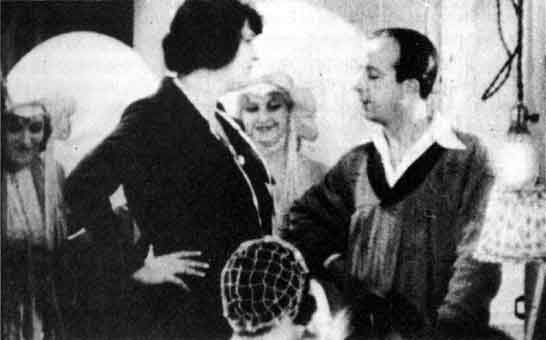 "Dyke" vs. "Fag"?
A snippy dressing room confrontation featured in
Broadway Melody (1928).
"Dyke" vs. "Fag"?
A snippy dressing room confrontation featured in
Broadway Melody (1928).
Homosexual stereotypes were common in silent films. It is perhaps appropriate that the first depiction of a blatantly homosexual character in a sound film was in the first all-sound movie musical, MGM's The Broadway Melody (1929). Granted, this nameless character (portrayed by character actor Drew Demarest) is a mean spirited gay caricature, but he's there. Broadway Melody depicted the backstage drama surrounding the production of a lavish Ziegfeld-style revue. The effeminate male costume designer is seen fussing, prancing and going into girlish raptures over women's accessories. When this designer complains that he didn't design the narrow dressing room doorways that endanger the voluminous chorus hats, a painfully butch costume mistress responds, "Yeah, if you had designed them, they would have been lavender!" In a later scene, the designer begs the show's producer ("Mr. Zanfield") to cover the cost of an expensive fur for the leading lady, inspiring one of the producer's nastier flunkies to mockingly lisp as he rhapsodizes over the "gorgeousnessssssss" of the fur before derisively pinching the designer's cheek.
Hollywood was and is a product/tool of popular culture, reserving its comic barbs for targets that the largest possible audience will recognize. Broadway Melody verifies that the stereotype of the backstage theatre queen was recognizable to a nationwide audience in the 1920s.
There were many other examples of obvious homosexual characters in early musical films. The first screen version of the stage hit The Desert Song (1929) turned the comic character of Benny into a blatantly limp-wristed caricature. Confronted by a burly Arab freedom fighter, Benny asks, "How's everything, big boy?" Later, when asked what he's doing in Morocco, Benny responds, "Make me an offer."
The Great Depression
Hard times often bring repression of minorities. In the United States, behavior tolerated during the "Roaring" 20s was no longer accepted during the Great Depression of the 1930s, and anti-gay legislation proliferated nationwide. For example, New York State denied liquor licenses to bars and restaurants that served homosexuals. But the beginnings of a community were already in place, and gays learned to live in a more covert manner.
Gay stars were relatively few in number on the musical screen, but one of director George Cukor's biographers writes that the gay experience was a bit different in 1930s Hollywood –
Many film people, however, especially those with theatre backgrounds, recognized and accepted homosexuality. There was a continuation of the tradition of show business as an open door for all types of humanity.
- Patrick McGilligan, George Cukor: A Double Life (New York: St. Martin's Press, 1991), p. 115
The Production Code
The contents of Hollywood films changed with the rise of the Production Code. Officially instituted in 1930, these self-enforced regulations were ignored for several years. Gay characters and situations continued to appear as part of the accepted cultural landscape in many Hollywood films. Musical examples include –
In Morocco (1930), Marlene Dietrich plays a tuxedoed cabaret singer who thanks a female fan with a full mouthed kiss.
Mae West refers to two affectionate prison inmates as "The Cherry Sisters" in She Done Him Wrong (1933).
As Bing Crosby croons "Temptation" in Going Hollywood (1933), two women share an intimate barroom dance.
Bobby Watson played an effeminate costume designer in Moonlight and Pretzels (1933), and an effeminate dance director in Hips Hips Hooray (1934).
The Roman Catholic Church raised a nationwide protest in 1934, establishing a nationwide Legion of Decency. To appease this movement, studio executives selected Joseph Breen to enforce the production code. A devout Catholic, blatant anti-Semite and homophobe, Breen set out to reform the content of Hollywood films with unflinching zeal. By late 1934, all American studios conformed to the code. Along with nudity, flimsy costumes and kisses lasting longer than six seconds, the code prohibited any cinematic depiction of "sexual perversion" – a term which was used to drive clear depictions of homosexuality from the screen.
But homosexuals were an indispensable presence in Hollywood, and they were not about to disappear entirely. As film historian Richard Barrios notes –
The film industry was perhaps the country's biggest secret haven for gay men and lesbians, who were under contract to all studios as creative personnel, staff, and talent. Although an official code of silence protected their personal lives from public scrutiny, they were often able to impart glimmers of secret selves to the films they helped to create . . . Gays onscreen in that era were exactly like gays in real life: constantly present, fully integrated into the dominant hetero world, yet knowable only to those who would know them.
- Screened Out: Playing Gay in Hollywood From Edison to Stonewall (New York: Routledge, 2003) p. 146.
On screen, homosexual characters were toned down – you might say "decaffeinated." Effeminate male and butch female characters could still be used for comic effect, but they were either sexually neutral or (following the example of Gilbert & Sullivan's Bunthorne) displayed an incongruous but overt interest in the opposite sex. Often played by gay actors, these roles also went to straight performers looking for guaranteed laughs. Some popular examples from the musical screen –
Character actors Edward Everett Horton, Franklin Pangborn, Eric Blore and Billy DeWolfe had extensive careers playing effeminate roles in comedies and musicals – depicting such self important prigs as department store floorwalkers, petty bureaucrats, valets, designers, etc. Although proof is primarily circumstantial, many film historians suggest that that all four were actually gay. If so, one hopes they found some satisfaction in tweaking society's nose.
Broadway's gay musical star Clifton Webb stuck to waspish non-singing roles in Hollywood, where there was never any scandal connected with his homosexuality. Star of the popular Mr. Belvedere film series, he also had memorable roles in such hits as Laura (1944). His only musical screen appearance was as the non-singing march king John Phillip Sousa in Stars and Stripes Forever (1952).
Because Danny Kaye portrayed the title role in The Secret Life of Walter Mitty (1947) as a heterosexual, he got away with performing "Anatol of Paris," depicting a queeny hat designer who proclaims, "I hate women!"
Heterosexual actor Bert Lahr minces and camps as The Cowardly Lion in The Wizard of Oz (MGM 1939), protesting he should see the Wizard because he "got a permanent just for the occasion." Since Lahr's limp-wristed feline showed no hint of attraction to other male characters, code administrators viewed his behavior as a non-issue. While we're on the subject of MGM and Oz . . .
"Over the Rainbow"
Producer Arthur Freed's unit at MGM was responsible for some of the finest musical films of all time. A successful songwriter, Freed moved into production and surrounded himself with the finest musical performers and writers to be found at any studio. This stellar group included many homosexuals. Historian William J. Mann notes that industry insiders often referred to the "Freed unit" as "Freed's Fairies." The key factor was Freed's gifted assistant, musician Roger Edens –
Freed himself wasn't gay, but neither was he the true creative heart of the unit. The real maestro was Roger Edens – arranger, songwriter, and eventually associate producer. Edens was genial, cultured and brilliant – and a gay man who brought in other brilliant gay men as collaborators; hence, "Freed's Fairies." Like (film director George) Cukor and (MGM prop master) Edwin Willis, Edens wasn't assembling his team based on sexuality, but it remains true that those he considered the best also often happened to be gay.
- Mann, Behind the Screen, pp. 270-271.
Why did MGM's The Wizard of Oz become a lasting focal point of gay culture? Consider the core plot: a misunderstood child yearns to escape a boring middle-American upbringing and learns that one must face life's challenges with brains, heart and courage – a blueprint that carries special resonance for many gays and lesbians. And although L. Frank Baum's story had been in print since 1900, there is no suggestion that homosexuals felt any special connection to it until the 1939 screen version came along. The endearing euphemism for gay men, "friends of Dorothy," caught on as early as World War II, when rumor has it that U.S. Army Intelligence had to be reassured that the phrase did not refer to a German spy ring.
However, it was not until the 1950s, when television made broadcasts of MGM's The Wizard of Oz an annual event, that the film's iconography became a widespread part of the American gay mindset. It provided a treasure trove of gay-friendly statements and images, ranging from the sentimental to the campy –
The Scarecrow's sly observation that "some people do go both ways."
Judy Garland's sparkling red pumps that could take you anywhere with a triple click of the heels.
Glinda's musical invocation to “come out, come out.”
The "horse of a different color" that could change it's Technicolor appearance in a flash.
Glinda's spirited "and Toto too!"
The song “Somewhere Over the Rainbow” became an unofficial gay anthem and later inspired the creation of the gay community's iconic Rainbow Pride Flag.
In the 1970s, when Anita Bryant joined the long line of hypocrites who have wrapped their personal bigotries in the Christian cross, some critics noted her striking attitudinal resemblance to the Wicked Witch of the West. (What a pity orange juice didn't have the same effect as water.)
How did the many gays who worked in musical theatre and film survive in the mid-20th Century? In the next section, we will consider three gay songwriters who thrived during the 1930s. Their songs have long been popular, but the more private details of their lives could only be discussed in print after their deaths. Of course, those details had been the subject of knowing whispers for decades on end.