
Making a Broadway Musical: Part VI
by John Kenrick
(Copyright 2000, Revised 2020)
(All the images below are thumbnails – click on them to see larger versions.)
Opening on Broadway
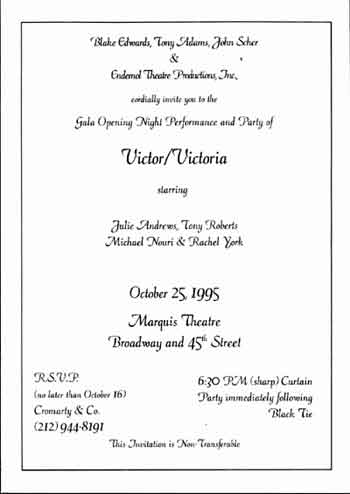 An
invitation to the opening night party for Victor/Victoria.
An
invitation to the opening night party for Victor/Victoria.
Broadway shows still have official opening nights, but the critics are nowhere in sight. Since the 1980s, New York critics have opted to attend previews, experiencing a show with something closer to a normal audience and allowing them time to polish their reviews. These reviews are not made public until the official opening night.
Openings are still terribly exciting for the cast and production team. Flowers, gifts and congratulatory telegrams are received. Spirits run high, and good wishes of the traditional "break a leg" variety are exchanged. Just before curtain time, directors give the cast a final pep talk.
After this talk, the "Legacy Robe" ritual takes place. These robes are oversize coats made of plain canvas material, which are passed on from one Broadway musical production to the next. The most senior dancer in the chorus parades the current robe around the stage to bring good luck. Before passing it on to the next production, the cast embroiders a memento that is added to the robe. When all the space on a robe is used up, it is retired and a new one starts from scratch. Several of these robes are preserved by the Museum of the City of New York's Theater Collection. (These were once called "Gypsy Robes," but were renamed out of respect for those who found the phrase insensitive.)
For the opening week, Playbill adds a top line to the main credit page that announces "OPENING NIGHT" and the opening date. (These Playbills are coveted by collectors.) The producers and a mostly invited audience (some seats are usually sold to the public) dress in their finest and give the show (no matter how good or bad) a wild reception. In recent years, practically every Broadway performance (opening or otherwise) gets a standing ovation. However, it is not too hard to tell the difference between an audience that leaps to its feet in delight and people who are just standing up to slip into their coats.
For publicity purposes, the producers make the opening night party as lavish and star-studded as possible. Everyone involved with the show is invited for food and (usually) an open bar. The venue can be a large restaurant, a hotel ballroom, or perhaps a more exotic venue. The opening night party for Rent was held on the covered ice rink at the Chelsea Piers athletic center – despite the carpeted flooring, people kept complaining about freezing cold feet!
The climax of the party comes when the reviews arrive, especially the all-important New York Times review. When the reviews are enthusiastic, the producers find a microphone and read out the raves to delighted cheers. The better the reviews, the better the remainder of the party. If the reviews are less than glowing, they may be quoted selectively. Outright bad reviews cause all microphones to disappear. Those papers are either quietly passed around or blatantly ignored while most guests figure out how to make inconspicuous exits. Die-hards mob the bar and drown their sorrows as they loudly proclaim, "Well, screw the critics, I loved it!"
Making It Run
The morning after the premiere, the main producers, press rep and advertising team meet to plan their marketing strategy. (All are exhausted from the night before, but time is of the essence.) If the reviews were raves and advance ticket sales are healthy, the participants have the pleasant task of planning ads that can herald their triumph.
When reviews are mixed, the post-opening ad campaign can be a vital tool in keeping ticket sales alive. Most reviews can be mined for one or two positive quotes. When a show is an obvious pre-sold hit, even the most negative reviews usually include a good line – it means their quote can appear on the front of the theatre for years to come. For example, New York Time critic Ben Brantley disliked The Lion King, but his review began with a rapturous description of the opening number that has been quoted in their publicity ever afterwards.
If the reviews are unanimously merciless and a production has little advance ticket sale, sensible producers decide to close. After savage critiques, Kelly and Dance a Little Closer did not even bother having a second performance. But most producers try to give a show some kind of a chance. A few major musicals have successfully bucked the critics. Every reviewer in New York lambasted the 1994 revival of Grease, but it went on to run 1,503 profitable performances. However, most new musicals find it impossible to turn a profit after ghastly reviews. Dance of the Vampires (2002) was ripped to pieces by every critic, but held on for several weeks – which only succeeded in wasting another million dollars or so.
It can take a year or more for a multi-million dollar Broadway production to return its investment, let alone turn a profit. So it is essential to keep a successful show at its best once it has opened. The stage manager makes sure that the cast keeps their performances freshand directors often make unannounced visits to keep productions fine tuned. Producers and press agents must continually find ways to keep the public aware and interested. Hiring popular replacement stars, cast appearances on talk shows and parades, the all-important highlights on the annual Tony telecast – all help keep a show's name in people's minds.
A successful musical spawns one or more road companies that use simplified sets, slightly smaller ensembles, and smaller orchestras. (I saw a tour of Disney's Beauty and the Beast that had a measly five pieces in the pit – in Boston's 3,000 seat Wang Center!) Cast replacement for the Broadway company often come from the road company. Before Brooke Shields stepped into the revival of Grease, she spent several weeks in the road company to polish her performance, which delighted critics and fans. All producers and authors hope that someone will want to purchase the screen rights to their musicals, bringing millions in additional income. However, thanks to Hollywood's ongoing disinterest in musicals, the sale of screen rights is now rare.
Fame and fortune are possible in the musical theatre, but so unlikely that no one can realistically expect to achieve them. Of the 20,000+ members of Actors Equity, less than 2,000 make a fulltime living as actors. The only way that producers, designers, writers, actors and crew can work in the musical theatre today is if they love it. In a way, that's how it has always been. To make musicals, you have to love 'em.