
History of The Musical Stage
1920s V: Al Jolson & Two Landmark Hits
by John Kenrick
(Copyright 1996, Revised 2020)
(The images below are thumbnails – click on them to see larger versions.)
Good News: "Do the Varsity Drag"
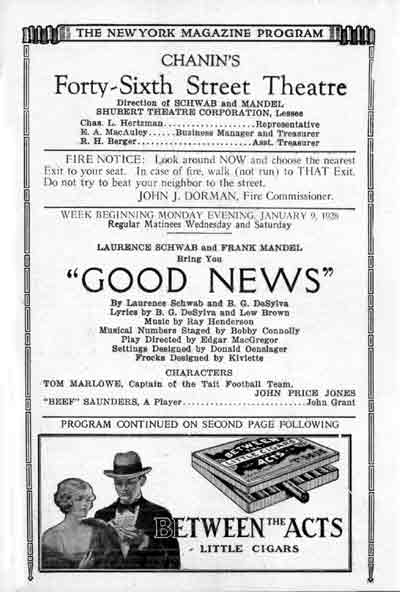 The
program title page for the original Broadway production of
Good News.
The
program title page for the original Broadway production of
Good News.
Good News (1927 - 557 performances) was not the first musical comedy about college life, but it became the definitive example of this lighthearted sub-genre. The plot about a wealthy football hero who has to pass an exam so he can play in the big game and win the impoverished girl he loves inspired a slew of imitations on stage and screen, but none could match the infectious score composed by Ray Henderson with lyrics by Buddy DeSylva and Lew Brown. Their dance-happy songs included "The Best Things in Life Are Free," "Lucky in Love" and "The Varsity Drag," a Charleston-style number that became an international dance craze.
The libretto was a loose affair, allowing members of the cast to offer audiences pleasing specialty numbers without relying too heavily on the plot for motivation. Produced for approximately $75,000 (typical for a Broadway musical at that time), Good News made millions and remained popular for decades, with a film version in 1932, and a hit Technicolor remake in 1947. A stage revival toured with Alice Faye in the 1970s. Depicting the "roaring 20s" as many would like to remember it, this show remains one of the definitive theatrical events of that era.
Al Jolson: "The World's Greatest Entertainer"
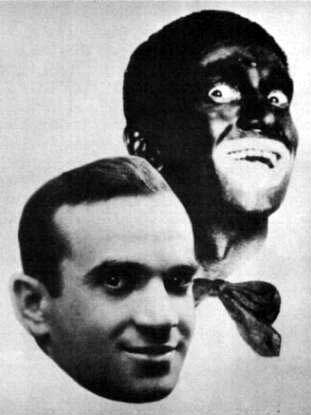 This composite photo compares the
unadorned Al Jolson with his black-face alter ego "Gus."
This composite photo compares the
unadorned Al Jolson with his black-face alter ego "Gus."
America's top musical stage star of the 1920s was born in a Russian shtetl (a legally segregated Jewish ghetto) in Lithuania sometime during the late 1880s. Soon after his family emigrated to the United States in 1894, young Asa Yoelson decided to become a variety entertainer and changed his name to Al Jolson.
After winning fame in minstrel shows and vaudeville as a black-face crooner, Jolson made his Broadway debut at The Winter Garden Theatre in the Shubert Brothers production, La Belle Paree (1911). The show was little more than a series of variety acts held together by a thread of plot involving American tourists visiting Paris. Jolson easily stole the show and became the toast of New York. He remained so for the next two decades.
When audiences responded with enthusiasm to Jolson's charismatic singing, the Shuberts made the most of their new star. They tailored a series of stage musicals for Jolson's outsized talents, and even built a runway across the Winter Garden's main floor so Jolson could perform right in the midst of his fans. His shows toured the country for years at a time, making him a star from coast to coast.
Jolson's charismatic blend of comedy, pathos and powerhouse singing had an almost sexual effect on audiences. His booming voice could fill any theater, a major asset at a time when electrical amplification was reserved for political rallies. With an ego that matched his talents, Jolson expressed no surprise when the Shuberts began billing him as "the world's greatest entertainer."
Three of Jolson's biggest hit musicals were built around "Gus," a likeable blackface character Jolson had been using since his years in minstrelsy –
Sinbad (1920 - 164 performances) had Gus as a porter who lands in a variety of historic settings. Jolson interpolated "Rock-a-bye Your Baby with a Dixie Melody," "Swanee" and "My Mammy" into the otherwise disposable score.
Bombo (1921 - 219 performances) turned Gus into a deckhand for no less than Christopher Columbus. As the months rolled by, Jolson kept audiences cheering by adding "Toot, Toot Tootsie," "April Showers" and "California Here I Come" to the show. None had anything to do with the plot.
Big Boy (1924 - 180 performances) had Gus as a jockey, featuring live horses racing on treadmills. Jolson interpolated "Keep Smiling at Trouble" and reprised many of his past hits -- no one cared that these songs had nothing to do with the plot. With occasional interruptions, Jolson toured Big Boy for more than three years.
When Jolson felt an audience was enthusiastic, he would dismiss the supporting cast and sing solo for an hour or more. If an audience was unresponsive, he would give a half-hearted performance and skip refrains to get the curtain down early.
As offensive as Jolson's use of blackface seems today, it was an accepted theatrical device used by many white and black performers in the first half of the 20th Century. Behind a mask of burnt cork, one theoretically became an "everyman" facing trials and heartaches. Jolson claimed that blackface makeup gave him the emotional distance he needed to unleash himself as a performer. Since many of his most effective filmed moments capture him singing in blackface, it is impossible to dismiss the role this makeup played in his success. And Jolson's use of blackface was not an expression of any personal racism. According to friends and colleagues, he championed the rights of black performers on several occasions.
Al Jolson's fame has dimmed somewhat with time, but no review of the popular culture of the 20th Century can afford to overlook him. He was a star of minstrelsy, vaudeville, Broadway, Hollywood and radio, riding high through each evolution of popular entertainment in his lifetime. One of the greatest stars show biz will ever know, he would have been the first to insist that history should remember him as such. (For more, please see our website's special feature, Al Jolson 101.)
Show Boat: Musical Epic
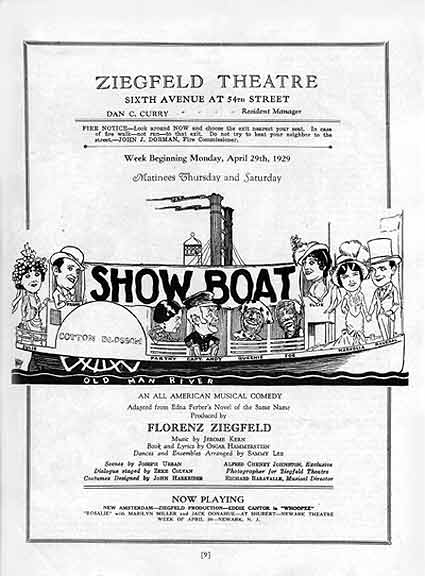 A caricature of Show Boat's
original stars, taken from the title page of the program.
A caricature of Show Boat's
original stars, taken from the title page of the program.
One of the most moving and perennially popular musicals ever written, Show Boat (1927 - 572 performances) was the collaborative effort of three theatrical giants -- producer Florenz Ziegfeld, composer Jerome Kern and lyricist-librettist Oscar Hammerstein II. Telling the epic story of how the inhabitants of a Mississippi show boat survive from the 1880's to the 1920s, this show deals with racism, interracial romance, marital heartbreak and alcoholism – subjects that had previously been considered taboo in musical theatre.
The ground-breaking libretto was matched by an innovative, character-driven score with such hits as "Make Believe," "Old Man River" and "You Are Love." Saloon singer Helen Morgan had the greatest success of her career depicting the mulatto actress Julie LaVerne, introducing "Can't Help Lovin' That Man" and "Bill," performing the latter while sitting atop an upright piano. Although many identify "Old Man River" with Paul Robeson, he was not in the original production. The song was actually introduced on Broadway by Jules Bledsoe. Robeson later performed the song in the 1928 London production and the 1936 film version.
Show Boat was a tremendous commercial gamble. Nothing like it had ever been tried on Broadway before, and Ziegfeld had serious doubts about the show's chances of making a profit. Even so, he mounted a lavish production, giving this sweeping saga the visual grandeur it required. When the opening night audience filed out of the Ziegfeld Theatre in near silence, Ziegfeld thought his worst fears had been confirmed. He was pleasantly surprised when the next morning brought ecstatic reviews and long lines at the box office. In fact, Show Boat proved to be the most lasting accomplishment of Ziegfeld's career, the only one of his shows that is still performed today.
Show Boat can be appreciated at various levels. To many, it is an epic tale of undying love, but it also demonstrates how human sufferings and triumphs fade away as time, embodied by the ever flowing Mississippi, "just keeps rolling along." This innovative masterpiece spawned no trends, but it showed what musical theater could aspire to -- aspirations that Hammerstein would re-ignite sixteen year later when he and Richard Rodgers gave birth to Oklahoma!. With three film versions and four acclaimed Broadway revivals, Show Boat's appeal has survived the test of time. With each generation emphasizing different aspects of the story, no two productions have been exactly the same.
By late 1929, some things were not "rolling along" as they had before. The disastrous stock market crash in October of that year effectively ended "the roaring 20s." But the real blow came that December, when poor management forced the Bank of the United States to shut its doors, wiping out the life savings of more than 400,000 American families. More banks followed suit over the next few years as the world plunged into the worst and most lasting economic depression ever known. Companies failed, jobs disappeared, and with no unemployment insurance or public assistance to provide a safety net, over one third of American adults found themselves unable to find work -- not just for a few months, but for years to come. Despite the hard times (and, in part, because of them), musical theatre managed to grow and develop. People needed the emotional satisfaction of good entertainment more than ever. And how did the musical theater oblige?