
Cabaret 101
A History of Cabaret
by John Kenrick
(Copyright 1996-2003)
(The images below are thumbnails – click on them to see larger versions.)
While the contemporary American cabaret came into being in the 1970s, its traditions reach back more than a hundred years. A quick look at that tradition reveals a great deal about the social and cultural changes that marked the 20th Century. Since our primary focus is on cabaret's connection to musical theatre, film and television, we will concentrate on cabaret as it developed in New York City -- becoming a crucial training ground for writers and performers.
Roots in Europe
In France, the word "cabaret" initially referred to any business serving liquor. However, the history of cabaret culture began in 1881 with the opening of Le Chat Noir in the Monmartre district of Paris. It was an informal saloon where poets, artists and composers could share ideas and compositions. Performers got to test new material, audiences enjoyed a stimulating evening for the price of a few drinks, and owners could count on a steady flow of regular customers – a win-win-win proposition. Le Chat Noir attracted such notables as Maupassant, Debussy and Satie.
Other cabarets soon sprang up all over Paris, and by 1900 similar establishments appeared in several French and German cities. As time went by, many of these rooms featured scheduled entertainment, ranging in size from a few musicians to full floorshows. Cabarets brought a new intimacy and informal spirit to public performances. Audiences sat at cozy tables consuming food and drink while performers worked right in their midst. Inevitably, audience members became part of the show, interacting with performers -- and even each other.
After World War I, cabaret enjoyed even greater popularity all across Europe, but particularly in Germany, where the Weimar government essentially ended all forms of censorship.
The overthrow of the kaiser, the revolutionary tumult that resulted in the establishment of a Social-Democratic republic, and the hardships of the inflation period were the troubled waters in which cabaretists could fish with spectacular success. Berlin became a maelstrom, sucking in the energies and talents of the rest of Germany. . . What New York in the 1920s was to jazz and speakeasies, Berlin was to cabaret.
-Laurence Senelick, Cabaret Performance, Volume II: Europe 1920-1940 (Baltimore: John Hopkins University Press, 1993), p. 25.
Bob Fosse's acclaimed film version of Cabaret (1972) gives a stylized but essentially accurate view of what cabaret entertainment was like in 1932 Berlin, with satiric sketches, torch songs, transvestitism and more. These shows had an intellectual punch which, with a few drinks, helped audiences push the harsh realities of life aside for a few hours. The classic German film The Blue Angel with Marlene Dietrich gives us a reputedly accurate sense of what Weimar-era cabaret performances looked like. Within a few years of Hitler's rise to power in 1933, the Nazi's effectively suppressed all hints of cabaret subculture in Germany.
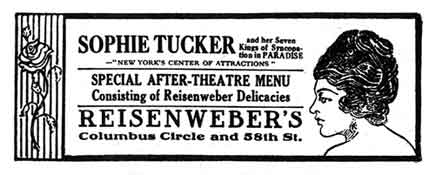 An
advertisement for Reisenweber's, boasting an engagement by singer Sophie
Tucker. This was one of the first noteworthy cabaret-style engagements in
New York City.
An
advertisement for Reisenweber's, boasting an engagement by singer Sophie
Tucker. This was one of the first noteworthy cabaret-style engagements in
New York City.
In the United States, cabaret had developed along more glamorous and less intellectually ambitious lines. In New York during the 1910s, several large cafes provided singers and came to be known as "cabarets." Delmonico's, Reisenweber's, Palaise Royale and Shanley's all became legendary night spots. Within a few years, dance floors became a required part of the cabaret environment. When a 1913 ordinance forced Manhattan's cabarets to close by 2:00 AM, members-only clubs sprang up and stayed open for dancing till all hours -- the first "night clubs."
America's first Parisian-style cabaret was Sans-Souci (1915), a 42nd Street establishment owned by the popular dance team of Vernon and Irene Castle. The earliest American cabarets were not exact copies of their European ancestors. Political and social satire were nowhere in sight, but late hours and sophisticated audiences meant all sorts of boundaries could be stretched. New York's cabaret goers sought an alternative to other popular forms of diversion.
Unlike vaudeville, which welcomed women and children to a family atmosphere, the cabaret made few pretenses about being for a family trade; rather, it would service the adult fantasies and desires of adult men and women. . . Women and men could stretch the night into hours of pleasure for themselves, away from home, business, children, and other obstructions to their own mutual enjoyment.
- Lewis A. Erenberg, Steppin' Out: New York Nightlife and the Transformation of American Culture 1890-1930 (Chicago: University of Chicago Press, 1991), p. 114.
Dancing was a key attraction. The easy public mixing of sexes, social classes (and races) on cabaret dance floors led many preachers and journalists to condemn these establishments as centers of moral degradation.
Speakeasies: Cabaret Mobster-Style
America's cabarets were effectively forced out of business when the Volstead Act made the sale of liquor illegal in late 1918. But "the great experiment" of Prohibition did not wipe out America's taste for alcoholic refreshment, and there was an immediate demand for secretive, intimate places where people could consume booze. This kind of ambiance practically demanded music, so the stage was set for cabaret to conquer America, albeit in an illegal format.
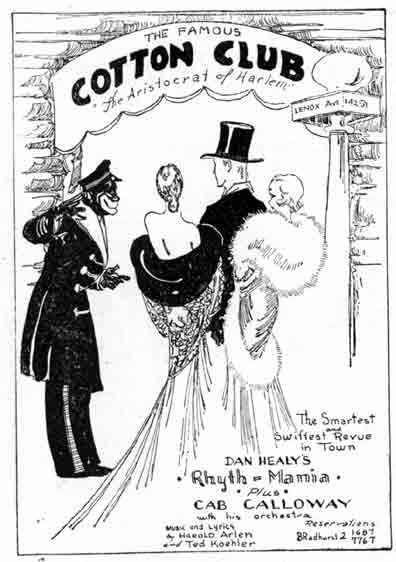 Many
nightspots served liquor illegally during the Prohibition Era, but only a
few glamour spots like the legendary Cotton Club continued to thrive after
the ban on booze was lifted. Although it was located in Harlem and
featured all-black entertainment, blacks were not permitted in the
audience – a fact this 1930s ad indicates by depicting the doorman as a
minstrel-like parody.
Many
nightspots served liquor illegally during the Prohibition Era, but only a
few glamour spots like the legendary Cotton Club continued to thrive after
the ban on booze was lifted. Although it was located in Harlem and
featured all-black entertainment, blacks were not permitted in the
audience – a fact this 1930s ad indicates by depicting the doorman as a
minstrel-like parody.
All across the USA, illegal bars known as "speakeasies" proliferated in basements and backrooms. In a vague bow to the law, owners called these establishments "clubs" and claiming they only served drinks to card-carrying members. In reality, anyone who looked like they could pay the price of some bootleg hooch was admitted. If prospective customers simply knocked and told the doorman the universally accepted "Joe sent me," they were in.
Most speakeasies were controlled by the gangsters who supplied the booze. Live entertainment supposedly made things look more legitimate, and owners found that women singing sad ballads did wonders for drink sales. These "saloon singers" became a standard part of American nightlife for decades to come, with future Show Boat star Helen Morgan the first in an endless line of long-suffering ladies. In some larger clubs, you could also cheer on floorshows. Future Warner Brothers star Ruby Keeler got her start as a speakeasy chorine, working for the outrageous hostess Texas Guinan.
Women were not only present as performers, but as a key part of the audience.
Miss Morgan, Tex Guinan, Belle Livingston were among the more notable women who dominated the nightclubs and other rendezvous of revelry in the twenties. But the pattern persisted all over the country -- speakeasies and "intimate" spots featured women torch singers and piano players. That is what the night-life public wanted.. And in the Lawless Decade the nightlife public was no longer predominantly male. The women wanted their fun too, their share of the whoopee -- a word that's almost obsolete probably because the wild, hectic and abandoned sort of gaiety it described is also almost obsolete now.
- Paul Sann, The Lawless Decade (New York: Bonanza Books, 1957), p. 190
By the mid-1920's, resentment of Prohibition laws was so overwhelming that New Yorkers voted to suspend enforcement by local officials. This left only a meager federal force that could not hope to shut down more than a small fraction of the city's speakeasies. Some states and cities clung tenaciously to Prohibition long after the rest of the country had woken up.
Supper Clubs
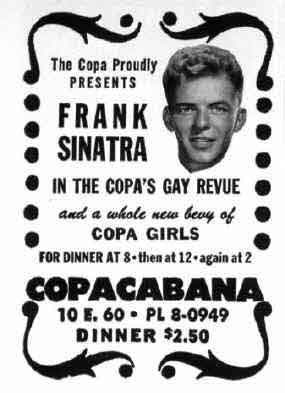 Frank
Sinatra once said, "You're a show business nobody until you make the
Copa and do three shows nightly under its tremendous pastel roof." This
is a 1948 ad for one of his frequent appearances there.
Frank
Sinatra once said, "You're a show business nobody until you make the
Copa and do three shows nightly under its tremendous pastel roof." This
is a 1948 ad for one of his frequent appearances there.
When Prohibition ended in the 1933, American drinkers were in the mood to celebrate. Although the Great Depression was at its worst, large nightclubs became the order of the day. Places like The Copacabana, The Diamond Horseshoe or The Cotillion Room featured such former vaudeville headliners as Jimmy Durante or Sophie Tucker with several supporting acts.
Candlelight, tuxedoed servers and a formal dress code added to the sense of glamour. These elegant showplaces held hundreds of high paying customers at a time, and were more like Las Vegas showrooms than classic cabarets. However, the material and performance style were very much in the cabaret tradition – torch songs, innovative comedy etc.
Starting just before World War II, smaller rooms became fashionable in most large American cities, providing intimate entertainment and pricey cocktails. Because New York law required establishments serving liquor to provide food, these rooms called themselves "supper clubs" – even if there was nothing more than a token sandwich kept in a refrigerator to earn the title.
Since many of these supper clubs looked downright seedy, they depended on low lighting, cigarette smoke and strong performers for ambiance. The tables were small, jamming fifty or more people into a space meant for half that number. A singer was perched on a tiny stage with one or two pianos, a single spotlight and (if lucky) a microphone. The unknown performers were often stars in the making, and the music was mostly jazz and Broadway-style, with some raunchier material reserved for late-night performances. In short, cabarets became the perfect place to impress -- or seduce -- a date.
In the 1940s and 50s, New York was home to several clubs that achieved legendary status –
- Tony's had Italian food and the legendary song stylings of Mabel Mercer.
- Cafe Society was the first club to welcome integrated audiences for performers like Billie Holliday.
- Spivy's Roof had the outrageous lesbian headliner/owner Spivy.
- The Blue Angel featured future stars Pearl Bailey, Bobby Short, Eartha Kitt, and guitar-strumming Russian folksinger Yul Brynner.
Many more familiar names found their first important showcase in New York cabarets . . .