
History of Musical Film
1927-30: Part II
by John Kenrick
(Copyright 1996 & 2004)
(The images below are thumbnails – click on them to see larger versions.)
Sound + Hollywood = Panic!
By 1928, chaos reigned in Hollywood. Most major studios had been caught unprepared by the overwhelming demand for talking films. The public knew what it wanted, and voted with its dollars. Critically acclaimed silent films were suddenly playing to near-empty theatres, while even the tackiest part-talkies were drawing crowds. Small town theatre owners watched locals drive off to the nearest city with a sound theatre -- and realized that sound was no longer an option. Silent film, the most popular form of entertainment the world had ever known, was suddenly yesterday's news, and no one in the industry was sure what lay ahead. MGM silent star William Haines later recalled –
"It was like the night of The Titanic all over again, with women grabbing the wrong children and Louis B. (Mayer) singing 'Nearer My God To Thee.'"
- as quoted in Bob Thomas, Thalberg: Life and Legend (New York: Doubleday, 1969), p. 146.
As theaters scrambled to install sound equipment, the studios raced to build soundproof facilities, come up with sound projects, and find ways to master a very different way of making films. Desperate executives purchased the rights to hundreds of existing plays and songs, and every major studio hired Broadway composers to write new screen musicals.
For all their enthusiasm, audiences were also caught off guard. In The Speed of Sound: Hollywood and the Talkie Revolution 1926-1930 (New York: Simon & Schuster, 1997), historian Scott Eyman tells us that moviegoers were so overwhelmed by the first "talkies" that they did not mind "that what was being recorded was of no real dramatic interest."
Top vaudeville stars filmed their acts for Vitaphone in return for one-time pay-offs, inadvertently helping to speed the death of vaudeville. After all, when "small time" theatres could offer "big time" performers on screen at a nickel a seat, who could ask audiences to pay higher amounts for less impressive live talent? The newly-formed RKO studios took over the famed Orpheum vaudeville circuit and swiftly turned it into a chain of fulltime movie theaters. The half-century tradition of vaudeville was effectively wiped out within less than four years.
Sound completely supplanted silent film by 1929. As a visual medium gave way to an audio-visual one, cinematic professionalism gave way to a spirit of desperate improvisation. Inexperienced bozos with self-confidence could talk their way into major production jobs. And the new technology involved serious drawbacks. Cameras and their motors had to be muffled in immobile booths, giving talkies a static appearance. Almost all of Hollywood's early sound films interpolated a few songs.
Silent stars with thick accents or voices that could not overcome early recording techniques slipped into quick obscurity, and the public did not seem to mind one bit. In several cases, studio executives used sound as an excuse to dispose of "difficult" stars. Latin heart-throb Ramon Novarro had a fine voice, but he refused studio demands that he marry to cover up his homosexuality. Although his one musical was well-received, MGM sent him into semi-retirement. The high-priced and emotionally explosive silent star John Gilbert didn't sound quite as sexy as he looked, so MGM executives were not too upset when his career sank in a series of inferior sound vehicles.
Two films in particular provide contrasting illustrations of what Hollywood studios were doing with early musical features. One is a mediocrity that achieved landmark status -- the other is a delight that few people today have heard of.
Oscar-Winning Clunker
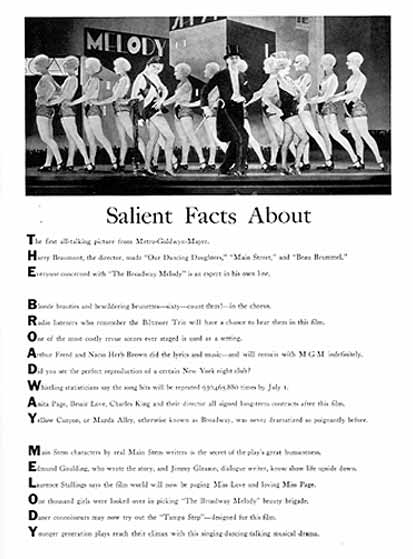 Charles
King and his clod-hopping chorines appear on
this page from the souvenir program for Broadway Melody
(1929).
Charles
King and his clod-hopping chorines appear on
this page from the souvenir program for Broadway Melody
(1929).
Most early sound films were melodramas. In the summer of 1929, the manager of New York's Capitol Theater told MGM production chief Irving Thalberg that a decent, all-sound romantic comedy would guarantee sell-out business. Thalberg promised to make just such a film. He quickly assembled a production team, shot the film in just 28 days and had it ready for release that October -- an unthinkably quick accomplishment today, but not all that unusual at a producer-driven studio like MGM. The backstage show biz plot centered on two sisters battling for over their shared passion for a charming song and dance man. The film turned out so well that MGM passed over the Capitol and opened Broadway Melody (MGM -1929) across Times Square at the company's own Astor Theater. Audiences and critics were delighted, and Thalberg was credited with bringing MGM the first in what would become a long line of musical triumphs.
MGM was the last major studio to switch to sound production, but once it got on the bandwagon, it went first class all the way. The studio's sound team invented two vital technologies for Broadway Melody – sound editing and pre-recorded soundtracks. When studio executives decided that the elaborate "Wedding of the Painted Doll" sequence should be re-shot, sound technician Douglas Shearer suggested they save some money by using the existing soundtrack and just filming new visuals. Since the use of pre-recorded sound allowed for more creative camera angles with better sound quality, it quickly became standard procedure for all musical films.
Although Broadway Melody cost a moderately steep $379,000 to produce, it grossed $4.3 million in its worldwide release, and MGM saw a clear profit of more than $1.6 million. Advertised as the first "All-Talking, All-Singing, All-Dancing" feature, it became the first sound film to win the Academy Award for Best Picture. The score by Nacio Herb Brown and Arthur Freed included seven songs, including the title tune and "You Were Meant For Me."
Time has not been kind to Broadway Melody. In fact, you might find it difficult to sit through it all and stay awake. The talking stinks, the singing hurts and the dancing is lead-footed. However, most viewers in 1929 considered Broadway Melody a technical miracle, with content and sound technology superior to every "talkie" that had come before. Although Bessie Love (as one of the sisters) and Charles King (as the love interest) overacted, their work seemed naturalistic compared to Al Jolson's histrionics. Whatever its flaws, Broadway Melody was a critically acclaimed box office hit, and its success widened the path for the movie musical genre.
Forgotten Gem
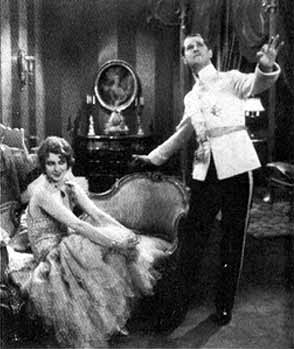 The souvenir book for Love Parade (1929) includes this photo of
Jeanette MacDonald and Maurice Chevalier performing "Anything to Please the
Queen."
The souvenir book for Love Parade (1929) includes this photo of
Jeanette MacDonald and Maurice Chevalier performing "Anything to Please the
Queen."
Paramount Pictures was founded by mogul Adolph Zukor in 1912 as Famous Players Film Company, a studio that promising audiences "famous players in famous plays." Within a few years, Zukor merged with a smaller studio called "Paramount," and gradually put his entire operation under that attractive title. Paramount had the largest nationwide chain of theatres, guaranteeing its films wide distribution. Zukor handled the business end, leaving most creative decisions in the hands of directors. Since these directors were some of the best innovators in early cinema, Paramount attracted an unusual number of extraordinary performers and writers.
The same year as MGM's Broadway Melody, veteran silent screen director Ernst Lubitch put together an original screen operetta for Paramount that outclassed all other early Hollywood musicals. Lubitsch realized that finding musical stars for this new medium was tricky. Broadway veterans Fanny Brice (My Man 1928), and Helen Morgan (Applause 1929) had landed in weak musical melodramas that even their legendary talents could not save. And stage-based performance techniques often seemed outsized and artificial on screen. Lubitch sought out younger singing newcomers with stage credentials whose personalities would respond well to the intimate scrutiny of the camera. He also found ways to get around clumsy equipment, achieving the same sexy but classy sense of fun that marked his best silent films.
As a result, the famed "Lubitch touch" is evident in Love Parade (Paramount 1929), a lighthearted romantic fantasy worthy of Broadway but custom-tailored for the screen. Broadway soprano Jeanette MacDonald plays the young queen of a fictional European country who summons home a scandalous playboy diplomat played by French cabaret star Maurice Chevalier. They fall in love and marry, but Chevalier must fight to become more than a puppet consort. Love and male chauvinism win out, with plenty of laughs along the way. Chevalier is charming and hilarious, and the lovely MacDonald makes a poised screen debut. The melodic and witty score includes the hit ballad "Dream Lover" and the playful duet "Anything to Please the Queen." A memorable sequence has the upper-crust Chevalier serenading the courtesans of Paris from a window with "Paree, Stay the Same" while his valet sings the same to the local housemaids and Chevalier's dog "woofs" the tune to the local female pooches.
Success breeds copycats. The 1930s would start off with an avalanche of bad screen musicals. When the public turned away from movie musicals in disgust, Hollywood managed to redefine the genre, urging audiences to "Come and meet those dancing feet . . ."