
History of The Musical Stage
1930s: Part IV - Kern & Porter
by John Kenrick
(Copyright 1996; revised 2020)
(The images below are thumbnails – click on them to see larger versions.)
Jerome Kern in the 1930s
 Art
deco reigns supreme on the original sheet music cover for Jerome Kern & Otto Harbach's
"She Didn't Say Yes" from The Cat and the
Fiddle.
Art
deco reigns supreme on the original sheet music cover for Jerome Kern & Otto Harbach's
"She Didn't Say Yes" from The Cat and the
Fiddle.
Jerome Kern had several hits over the course of the 1930s. Still an innovator, he loved to put existing theatrical forms to new uses. Otto Harbach provided the book and lyrics for The Cat and the Fiddle (1931 - 395 performances), a romantic operetta with a contemporary setting and score. The story involved two music students (one into classical, the other into jazz) who love each other but cannot abide each other's compositions. Reflecting this, the score alternated the sweeping passion of "The Night Was Made for Love" with jazzier numbers like "She Didn't Say Yes."
Several months later, Kern and Oscar Hammerstein II came up with yet another modern operetta, Music in the Air (1932 - 342 performances). An idealistic small town school teacher confronts the cynical ways of modern show business when he writes the hit song "I've Told Ev'ry Little Star."
The following season, Kern collaborated with Harbach on the musical comedy Roberta (1933 - 295 performances), which told the unlikely tale of an all-American football fullback who finds love and success when he inherits his aunt's dress shop in Paris. Most critics dismissed Roberta as a bore, but fueled by the success of "Smoke Gets in Your Eyes," the show managed a profitable run. Beloved comedienne Fay Templeton made her final Broadway appearance as the aging aunt, introducing the haunting "Yesterdays."
Kern and Hammerstein spent most of the 1930s in Hollywood, working on a series of profitable but artistically uneven films. Their last Broadway collaboration was Very Warm for May (1939 - 59 performances), a backstage love story featuring the rapturous "All the Things You Are." When the show failed, Kern and Hammerstein resumed their screen efforts out West. By the time Kern died in 1946, Hammerstein would be part of an even more innovative collaboration. More on that in our coverage of the next decade . . .
Cole Porter: '30s Hit Maker
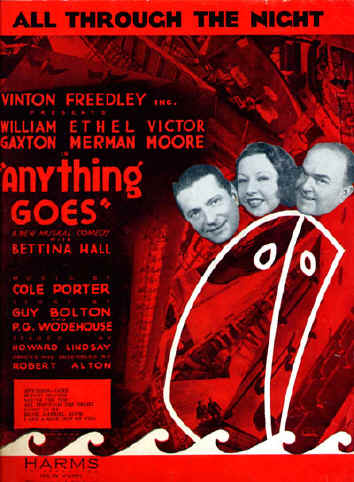 William Gaxton,
Ethel Merman and Victor Moore on the sheet music for "All Through the Night"
from Anything Goes.
William Gaxton,
Ethel Merman and Victor Moore on the sheet music for "All Through the Night"
from Anything Goes.
Cole Porter had more hit Broadway musicals in the 1930s than any other songwriter. His wry insider's perspective on high society delighted theatergoers, feeding their fantasies of a carefree life in the midst of the Great Depression -- and his frank attitude towards sex delighted many. Porter also composed scores for several musical films, but his stage hits were the "state of the art" musical comedies of this decade.
The New Yorkers (1930 - 168 performances) had Jimmy Durante as a bootlegger and nightclub owner romancing a wealthy socialite. the score included the controversial "Love for Sale," in which a prostitute sings of walking the streets and selling herself. Although banned from airplay, the song became a popular hit.
-
Gay Divorce (1932 - 248 performances) featured Fred Astaire as a novelist who accidentally gets mixed up in a acrimonious divorce case. Always acclaimed for his dancing, Astaire's straightforward singing showed off Porter's songs to extraordinary advantage. Despite a limited vocal range, Astaire had a flawless instinct for delivering a lyric. Radio made his recording of Porter's throbbing, sensual "Night and Day" a hit, and helped the show overcome tepid reviews. It was Astaire's last appearance on Broadway; his legendary Hollywood years are discussed elsewhere on this website.
Anything Goes (1934 - 420 performances) was the definitive 1930s musical comedy, but it had a rocky gestation period. Although financially wiped out by the Depression, veteran producer Vinton Freedley managed to sign up William Gaxton, Victor Moore and Ethel Merman for the cast, and convinced Porter to write the score. With that powerhouse line-up, Freedley was able to raise money for this tale of mistaken identities and unlikely romance aboard a luxury liner. The show required ongoing revisions, with former stenographer Merman taking down the changes in shorthand during rehearsals and typing them up for the rest of the team. Anything Goes restored Freedley's finances, cemented Porter's place in the front rank of Broadway composers, and became the most frequently revived musical comedy of the 1930s. The score included "I Get A Kick Out Of You," "You're The Top," "Blow Gabriel Blow" and the vibrant title tune.
Jubilee (1935 - 169 performances) was an affectionate send-up of British royalty that introduced Porter's memorable "Begin the Beguine," one of many Porter songs that featured his trademark transitions between major and minor keys.
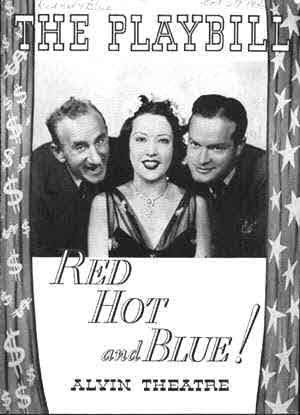 Jimmy
Durante, Ethel Merman and Bob Hope appear together on the
Playbill for Red, Hot and Blue. When agents argued about
who would get top billing, Porter settled the controversy by suggesting criss-cross billing. Hope
was a newcomer, and happy to accept lesser billing
-- within a few years, his star would eclipse theirs on radio and in
Hollywood.
Jimmy
Durante, Ethel Merman and Bob Hope appear together on the
Playbill for Red, Hot and Blue. When agents argued about
who would get top billing, Porter settled the controversy by suggesting criss-cross billing. Hope
was a newcomer, and happy to accept lesser billing
-- within a few years, his star would eclipse theirs on radio and in
Hollywood.
Red Hot and Blue (1936 -183 performances) involved one of the most idiotic plots in theatrical history -- a nationwide search for a woman who sat on a waffle iron when she was four. (Seriously.) Ethel Merman introduced Porter's "Down in the Depths on the 90th Floor," and sang the show-stopping "Delovely" with newcomer Bob Hope.
Leave It To Me (1938 - 291 performances) spoofed international diplomacy, with Victor Moore as a bumbling American ambassador trying to get recalled from Soviet Russia. Mary Martin made her Broadway debut singing the coquettish "My Heart Belongs to Daddy."
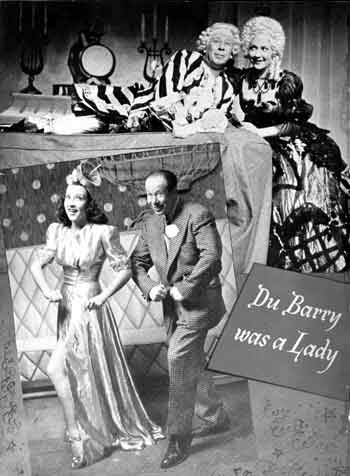 Merman and Lahr appear on the cover
of the souvenir program for Cole Porter's DuBarry Was a Lady (1939).
Merman and Lahr appear on the cover
of the souvenir program for Cole Porter's DuBarry Was a Lady (1939).
DuBarry Was A Lady (1939 - 408 performances) told the story of a nightclub men's room attendant (Bert Lahr) who pines for the club's sultry vocalist (Ethel Merman). Knocked out by a drugged cocktail, Lahr dreams that he is King Louis XV of France and that Merman is his infamous but disinterested mistress, Madame DuBarry. The two stars stopped the show with "Friendship" and the bawdy "But In The Morning No," helping theatergoers see out the unsettling 1930s with a few belly laughs.
Laughs? Considering the dramatic changes that the world – and the musical theatre – would face in the 1940s, theatergoers might have done better to catch their breath.