
History of Musical Film
1940s III: MGM Reigns Supreme
by John Kenrick
(Copyright 1996; revised 2020)
(The images below are thumbnails – click on them to see larger versions.)
Throughout the 1940s, songwriter Arthur Freed headed MGM's main musical production unit. There were other fine musical producers at that studio (including Joe Pasternak), but Freed's team set the industry standard. After proving himself as associate producer of The Wizard of Oz (1939), Freed supervised forty musicals over the next twenty years.
Studio chief Louis B. Mayer gave the unassuming Freed an unusual degree of creative freedom. With associate producer Roger Edens, Freed assembled a dazzling line up of creative talents, including Gene Kelly, Stanley Donen, Fred Astaire, Betty Comden & Adolph Green and Alan Jay Lerner. But Freed's greatest single achievement at MGM was shaping the screen career of one young woman.
Judy Garland
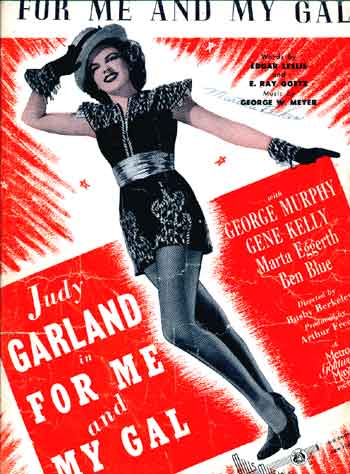 At
the height of her screen popularity, Garland was supportive of her
For Me and My Gal (1940) co-star, newcomer Gene Kelly.
At
the height of her screen popularity, Garland was supportive of her
For Me and My Gal (1940) co-star, newcomer Gene Kelly.
The top musical film star of the 1940s, Judy Garland appeared in sixteen MGM musicals (and fourteen additional feature films) during that decade, most produced by Freed. No other musical screen star ever had such an exhausting track record. Her 1940s screen musicals included –
- Little Nellie Kelly (1940) - Garland patches up a feud between her father and grandfather.
- Ziegfeld Girl (1941) - Three women have their lives changed forever when they are hired to appear in the Follies.
- For Me And My Gal (1942) - Garland and newcomer Gene Kelly star as vaudevillians hoping to play The Palace. The title tune became a major hit.
- Meet Me In St. Louis (1944) - directed by Vincente Minnelli (Garland's future husband) is the most fondly remembered of her wartime films. Garland was the picture of wholesome talent in what she often said was her favorite role. This nostalgic story of a 1903 family facing harmless domestic problems was embraced by a war-torn world. The score blended period tunes with new Hugh Martin-Ralph Blane hits – "The Boy Next Door," "The Trolley Song" and "Have Yourself a Merry Little Christmas."
- The Harvey Girls (1946) - Waitresses bring civilization to a town in the Wild West. Judy and the ensemble introduced the hit "On the Atchison Topeka."
- The Ziegfeld Follies (1946) - In this all-star revue, Garland scored with a hilarious musical spoof of celebrity interviews.
- Till the Clouds Roll By (1946) - For this bio of Jerome Kern, Garland appeared as Broadway legend Marilyn Miller singing "Who."
- The Pirate (1948) - Garland mistakes a circus performer for a dreaded pirate. She shared "Be a Clown" with Gene Kelly. Now admired, the film was a critical and box office flop.
- Easter Parade (1948) - Garland becomes Fred Astaire's vaudeville dance partner in this romantic comedy set to mostly vintage songs by Irving Berlin. The two stars introduced the memorable hobo duet "A Couple of Swells."
- In the Good Old Summertime (1949) - Garland and Van Johnson are coworkers in an 1890s music store, unaware that they are romantic pen pals. Garland sang period favorites "Meet Me Tonight in Dreamland" and "I Don't Care."
- Summer Stock (1950) - Gene Kelly's theatre company tries to stage a show on Garland's farm. Highlights include Garland's iconic rendition of "Get Happy."
Garland later insisted that MGM got the most out of her by encouraging studio doctors to prescribe a dangerous array of pills to crank her up by day and force her to sleep at night. But no other performer ever blamed MGM for encouraging chemical dependency. It was Garland's controlling mother who got her started on pills, and while the studio may have abetted the abuse, it also encouraged and supported Garland through several attempts at rehabilitation that inevitably fell apart due to her crushing workload. Between the pressures and the pills, this gifted young lady was often a physical and nervous wreck.
By the time Garland filmed Summer Stock (1950) her frequent illnesses and delays were wreaking havoc with schedules and production budgets. The same studio executives who had worked Garland like a dray horse for sixteen years now labeled her "unreliable." Garland's refusal/inability to film Royal Wedding in 1950 led to a highly publicized and humiliating suspension. The day after the suspension was announced, a distraught Garland attempted suicide. MGM then exercised the "morals clause" in her contract and fired her. Star and studio went on to separate triumphs, but both lost something irreplaceable.
MGM's next top musical star got his start working with Garland, and some of his best films were made in the years following her departure.
Gene Kelly
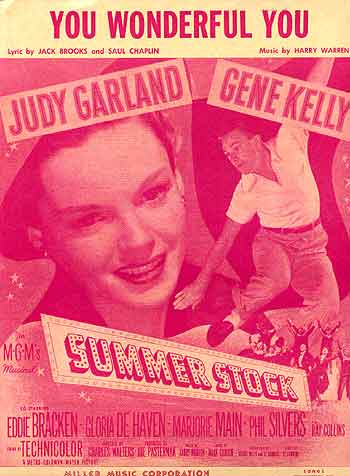 Summer Stock
(1950) turned out to be Garland's last MGM project. Gene Kelly, now reaching
the height of his career, offered her the same kind of moral support she had
once offered him.
Summer Stock
(1950) turned out to be Garland's last MGM project. Gene Kelly, now reaching
the height of his career, offered her the same kind of moral support she had
once offered him.
MGM's next great musical star got his big break on screen co-starring with Garland in For Me And My Gal (1942), where Gene Kelly's good looks and macho dance style made him an audience favorite. He was loaned out to Columbia for Cover Girl (1944), where assistant choreographer Stanley Donen put Kelly in a series of winning dance numbers, most notably an "alter ego" dance with his own reflection. Kelly won such acclaim that MGM refused to loan him out for any future musicals, and the studio began to treat him like a major star. Kelly helped pop crooner Frank Sinatra look like a capable hoofer in Anchors Aweigh (1945), and shared a dazzling song and dance duet with Fred Astaire in Ziegfeld Follies (1946).
Kelly starred in and choreographed the screen version of On The Town (1949), the first of several films he would co-direct with Donen, a former Broadway chorus dancer with a remarkable instinct for musical film. Donen, Kelly and producer Arthur Freed would create some superb screen musicals in the art form's remaining years. Kelly understood what a remarkable team the Freed unit was. As he later explained it:
"The members of the group who worked at MGM during my tenure there were very serious about musicals. That is not to say we didn't make them to entertain and lift the spirit, but we thought that to do this effectively they had to be superbly crafted; and that meant the closest kind of collaboration among the choreographers, directors, producers, musicians, conductors, musical arrangers, designers, costumers – the list is endless. There were probably more assembled talents in this field at Metro than anywhere else at any other time."
- Kelly's introduction to Clive Hirschorn's The Hollywood Musical (NY: Crown Publishing, 1981), p. 7
Although film scholars make much of the "Freed unit," Stanley Donen has denied that such a thing really existed. However, one could say this denial amounts to a confirmation –
"The Freed unit, of course, is a myth. You were under contract to MGM just like everybody else was. It was only that Arthur Freed had particular taste and appreciation of things, and would collect those people together. And he kept collecting those same people over and over so they got to be known as the Freed unit. The other producers were very envious of people being called that, when in fact it didn't exist. There was no Freed unit, except that we did all keep working for Arthur Freed. So, there was a Freed unit in a way, but it was only in all our heads."
- From an interview in The Movie Makers: Stanley Donen (Los Angeles: AMC/Lorac Productions, 1995).
Few would have believed that the original Hollywood musical was entering its final decade, but in a development as monumental as the advent of sound films, television was changing America's movie-going habits. When all-star spectaculars appeared in your living room for free, why bother paying to see a movie? The old vaudevillians who starred in many early television shows may have felt a bittersweet sense of revenge as their work on the small screen made studio moguls squirm.
Although the Hollywood musical was doomed, its last gasps would be among its most glorious.