
Theatre Lover's Journal for Nov. 2000
Blackface and Old Wounds
by John Kenrick
Spike Lee is a master at zeroing-in on dangerous issues and pushing people's buttons – something few film makers are willing to do these days. In his new comedy Bamboozled, a black TV executive produces a racially stereotyped minstrel show. Lee uses this story to illustrate how people can wind up contributing to their own oppression. I applaud Lee's intentions, but I am disturbed by the way many ill-informed commentators are approaching the subject of blackface performance. Whatever they think of Lee's work, too many critics are letting their cultural ignorance show.
 Dockstaders Minstrels in
full production - note the minstrel line in front.
Dockstaders Minstrels in
full production - note the minstrel line in front.
Beginning in the 1830's, troupes of white entertainers performed songs and skits in the supposed style of Negro slaves. Using burnt cork to blacken their faces, they depicted blacks as either country bumpkins or self-defeating city slickers. These "minstrel shows" became one of America's most popular forms of entertainment. Black performers became part of minstrelsy after the Civil War, using the same makeup to darken their faces, and perpetuating the same degrading caricatures. (Of course, it is doubtful that white producers gave them any choice.)
We are frequently reminded that former minstrel Al Jolson continued to use blackface on stage and screen in the early 20th Century, but he was far from alone. Eddie Cantor wore burnt cork, and Hollywood thought nothing of putting blackface on such white stars as Fred Astaire, Mickey Rooney and Judy Garland – to name just a few. These stars were not racists, and they had no idea how hateful their blackface performances would seem to us decades later. Much as we may hate to admit it, 20th Century America was an amazingly racist nation, with practices and attitudes frighteningly close to the apartheid mentality of South Africa. It was not until the Civil Rights movement caught fire in the 1950's and 60's that performing in blackface fell into disrepute. Today, many old musical films are televised minus their blackface numbers, and any performer appearing in blackface risks a publicity firestorm. (Consider how Ted Danson was vilified for appearing in blackface at a celebrity roast for then-girlfriend Whoopi Goldberg.)
There is no disputing that blackface was and is an embodiment of racism, and that it could only thrive in a culture that took bigotry as a casual fact of life. It is right for us to deplore the use of blackface and all it represented. However, I think it is painfully naive – and insufferably self-righteous – to condemn well-intentioned entertainers of a previous time for not meeting our contemporary standards of sensitivity.
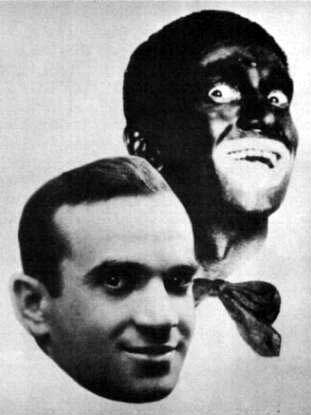 Al
Jolson and his black-face alter ego "Gus."
Al
Jolson and his black-face alter ego "Gus."
Those who smeared burnt cork on their faces decades ago were not inherently evil. Jolson openly refused to eat in restaurants that would not serve black performers. When bigots protested Cantor offering his handkerchief to a perspiring Sammy Davis Jr. on 1950's television, Cantor bluntly told them where they could stick their hatred. Contemporary critics who personally attack these performers (as one particularly nasty letter writer did in the NY Times on 11/05/2000) should make sure their halos are well-polished bore spewing their inanities. How hatred-free are their souls? How actively did they protest when Dr. Laura was given a talk show to promote her anti-gay bigotry? How loudly did they complain about the racial hypocrisy of the Republican national convention this past summer? Have they personally responded to the bigotry openly espoused by the Boy Scouts and certain leaders (both white and black) of various so-called religious organizations? One wonders how "enlightened" these commentators – and our society – will seem to those who look back on us a century from now.
Bamboozled serves a valuable purpose. We need to remember that blackface entertainment existed, and to develop an honest understanding of what it indicated about our society. We must keep that memory in a clear light – just as we must do with other historic embodiments of hatred. It is only in remembering that we can hope to keep bigotry at least partially in check in our own time. But surely we can deplore racism without blindly condemning performers of the past who had no way of realizing what burnt cork would represent to generations unborn. Bigotry is ugly and unacceptable – but so is self-righteous ignorance.