
A History of The Musical
Burlesque - Part II
by John Kenrick
(Copyright 1996 & 2004)
(The images below are thumbnails – click on them to see larger versions.)
Classic Comedy Skits
From the 1880s onwards, burlesque comedy was built around settings and situations familiar to lower and working class audiences. Courtrooms, street corners and inner city schoolrooms were favorites, as were examining rooms ruled over by quack physicians. Sexual innuendo was always present, but the focus was on making fun of sex and what people were willing to do in the pursuit of it. Some examples –
(Injured Man crosses stage in assorted bandages and casts.)
Comic: What happened to you?
Injured Man: I was living the life of Riley.
Comic: And?
Injured Man: Riley came home!
(A buxom Girl drops her purse, and a Comic tries to return it.)
Comic: I beg your pardon.
Girl: What are you begging for? You're old enough to ask for it.(Minister walks up to a beautiful young woman.)
Minister: Do you believe in the hereafter?
Woman: Certainly, I do!
Minister: (Leering) Then you know what I'm here after.
Many burlesque routines spoofed social conventions and linguistic idiosyncrasies. The most famous was Bud Abbott and Lou Costello's glorious "Who's On First," which had fun with the sometimes confusing nicknames given to popular baseball players. It was the descendant of several earlier routines that involved two men exchanging an intricate series of misunderstood words.
Another popular bit was aimed at the convoluted names of nepotistic businesses and law firms –
Man at Desk: (picks up phone) Hello, Cohen, Cohen, Cohen and Cohen.
Caller: Let me speak to Mr. Cohen.
Man at Desk: He's dead these six years. We keep his name on the door out of respect.
Caller: Then let me speak to Mr. Cohen.
Man: He's on vacation.
Caller: (Exasperated) Well then, let me speak to Mr. Cohen.
Man: He's out to lunch.
Caller: (Yells) Then let me speak to Mr. Cohen.
Man: Speaking.
Many routines showed the underdog getting the best of a confrontation. One skit involved a man pushing a baby carriage. The baby screams until the man takes a beer bottle and beats the unseen tyke into silence. Papa then proclaims, "That ought to show the little sucker," whereupon a stream of yellow liquid flies out of the carriage and hits him square in the face. Talk about justice!
Burlesque performers developed a unique backstage language of their own. Some examples found in H. M. Alexander's Strip Tease (Knight Publishers, NY, 1938, pp. 120-123) –
Jerk – audience member
Yock – a belly laugh
Skull – make a funny face
Talking woman – delivers lines in comedy skits
Cover – perform someone's scenes for them
The asbestos is down – the audience is ignoring the jokes
From hunger – a lousy performer
Mountaineer – a new comic, fresh from the Catskill resort circuit
Boston version – a cleaned-up routine
Blisters – a stripper's breasts
Cheeks – a stripper's backside
Gadget – a G-string
Trailer – the strut taken before a strip
Quiver – shake the bust
Shimmy – Shake the posterior
Bump – swing the hips forward
Grind – full circle swing of the pelvis
Milk it – get an audience to demand encores
Brush your teeth! - comedian's response to a Bronx cheer
"Somethin' Wrong With Strippin'?"
In the 1920s, the old burlesque circuits closed down, leaving individual theater owners to get by as best they could on their own. The strip tease was introduced as a desperate bid to offer something that vaudeville, film and radio could not.
There are a dozen or more popular legends as to how the strip was born – telling how a dancer's shoulder strap broke, or some similar nonsense. In fact, it had been around since Little Egypt introduced the "hootchie-kooch" at the 1893 Chicago World's Fair, and had always remained a mainstay of stag parties. Burlesque promoters like the Minsky brothers took the strip tease out of the back rooms and put it onstage. While stripping drew in hoards of randy men, it also gave burlesque a sleazy reputation. As moralists once again expressed outrage, male audiences kept burlesque profitable through most of the Great Depression.
Strippers had to walk a fine line between titillation and propriety – going too far (let alone "all the way") could land them in jail for corrupting public morals. Some gave stripping an artistic twist and graduated to general stardom, including fan dancer Sally Rand and former vaudevillian Rose Lousie Hovick – better known as the comically intellectual Gypsy Rose Lee.
The strippers soon dominated burlesque, and their routines became increasingly graphic. To avoid total nudity but still give the audience what it wanted, the ladies covered their groins with flimsy G-strings and used "pasties" to cover their nipples. This was usually enough to keep the cops at bay, even though pasties were far more vulgar that a plain naked breast.
Death Knells
Legal crackdowns began in the mid-1920s, including a now legendary raid on Minsky's in Manhattan. Burlesque managers relied on their lawyers, who kept coming up with legal loopholes for more than a decade. Reform-minded Mayor Fiorello LaGuardia closed New York's remaining burlesque houses in 1937, dismissing them as purveyors of "filth." He was not altogether wrong – by this time, most burlesque shows had degenerated into a series of bump and grind strip routines interrupted by lifeless comic bits. Burlesque managers were so resilient that LaGuardia outlawed the use of the words "burlesque" or "Minsky" in public advertising!
Some sources praise the burlesque comics of the 1920s and 30s, but by this point, men went to burlesque shows to watch women strip -- period. The more the gals took off, the more the audiences liked it. At a time when fear of personal scandal and sexual disease were rampant, burlesque was a relatively safe source of titillation for married men and youngsters alike. The comedy was no longer a key attraction.
Without New York City, which had been the hub of burlesque's universe, the remaining promoters around the US presented increasingly tacky strip shows. The best burlesque comics segued into radio, film and television, taking many classic routines with them.
By the 1960s, hard core pornography was in theatres all across the United States. Men no longer needed strippers to feed their sexual fantasies. The few remaining burlesque shows devolved into campy soft-porn, with even the strippers aiming for "yocks." An article in Esquire (July 1964) describes how Blaze Starr played her strip for laughs. After one of her breasts "accidentally" bounced out of her costume –
Blaze tripped to the microphone. Looking down at her exposed breast, she said, "What are you doing out there, you gorgeous thing?" Then she covered herself. "You got to tell them they're pretty," she said; "it makes them grow" . . . Then she flung herself on the couch and quickly stripped down to a transparent bra and black garter pants. She produced a power puff and asked rhetorically, "Who's going to powder my butt?"
Revivals: "Sugar Babies"
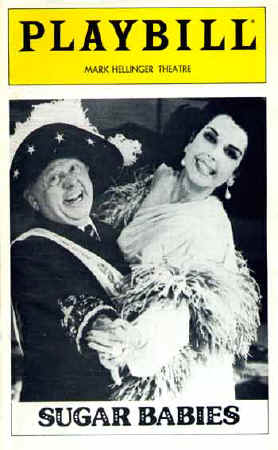 Mickey Rooney and Ann Miller in the Broadway revue
Sugar Babies (1979).
Mickey Rooney and Ann Miller in the Broadway revue
Sugar Babies (1979).
Over the decades, several revues tried to revive the burlesque format – usually with a well-known stripper like Ann Corio heading the cast. Corio and others penned books about the genre, always giving inordinate attention to the strip tease. Many graduates of burlesque became familiar faces on television – and the likes of Red Skelton, Milton Berle and Jackie Gleason recycled many an old "burly" gag on their comedy telecasts. It took a tribute to the pre-stripper era to restore burlesque's fading reputation.
The Broadway hit Sugar Babies (1979 - 1,208 performances) starred MGM veterans Mickey Rooney and Ann Miller. With mildly raunchy sketches, period songs and lovely chorus girls, this lavish show caught the comic spirit of 1930s burlesque's comic spirit while making it look classier than it had ever really been. The only striptease routine in the show ended when a chorus girl removed her brassiere – unleashing a floor-length evening gown! The key to the show's success was the comedy. During more than a decade of research, Professor Ralph G. Allen identified more than 1,800 basic burlesque comedy sketches that performers had "borrowed" and recycled for decades. These skits formed the basis for a college revue that eventually grew into Sugar Babies.
A burlesque comedian always plays the child of nature. He represents man stripped of moral pretense, lazy, selfish, frequently a victim, but never a pathetic one, because in nine bits out of ten, he blunders into some kind of dubious success . . . The jokes are classy or corny, depending on your point of view. But most of us love jokes we know. They reassure us, and therefore the earth does not yawn at our feet . . . If only we too could make the law an ass, or win five aces in a poker game, or receive an invitation from a lovely lady to meet her 'round the corner for unspecified delights.
- Dr. Ralph G. Allen, from the Sugar Babies souvenir program, 1980
Legacy: Burlesque Today?
While the "golden age of burlesque" is long gone, its legacy is very much alive. Every time a comedian does a "spit take" or tells a joke with a double-meaning, or whenever Saturday Night Live skewers politicians and movie stars, you are watching the spirit of burlesque in action.
Big screen spoofs such as Young Frankenstein, Spaceballs, and the Austin Powers films are clearly carrying on the tradition of early burlesque -- making fun of well-known entertainments, social mores, etc. Shrek 2 (2004) is a superb example of the kind of comedy that Lydia Thompson and her British Blondes offered in the 1860s, getting in good natured jabs at a wide variety of contemporary social targets in a supposed fantasy story -- all while challenging audiences to look beyond appearances.
The tawdrier burlesque tradition lives on too. Every time The Jerry Springer Show gives a woman "Jerry beads" for flashing her digitally obscured breasts, it is a classic burlesque tease -- and raucous Springer audiences are eerily reminiscent of those who sought tacky thrills at bump and grind houses a few decades ago. All of these entertainments have their righteous critics, and all appeal to a nation-wide audience.
In the early 2000s, a spate of "new burlesque" shows are cropping up on both sides of the Atlantic, featuring comics, strippers and specialty acts that offer a new spin on the old "burly-q" mix. Is it too early to fully assess this trend, but the fact that such shows have spontaneously sprung up in places as diverse as Manhattan, Montreal and Oslo suggests there is a widespread interest crossing all sorts of physical and generational barriers.
Why? I would suggest that there is a natural human need for the bold comic challenge that burlesque poses to the social, cultural and sexual status quo. The word "burlesque" was seriously tarnished by the mid-20th Century, when it was linked to witless soft porn strip revues in seedy venues. Now, a new generation is open to re-evaluating both the word and the format, recognizing the spirit of spoofery that made burlesque a potent form of entertainment back in the 1860s. At the dawn of a new millennium, burlesque is still alive and giggling.
By the time vaudeville and burlesque were in full swing, Broadway was already home to several thriving forms of musical theatre. For the details . . .