
Camelot
Paper Mill: The State Theater of NJ
Millburn, NJ - April 2003
Review by John Kenrick
(The images below are thumbnails – click on them to see larger versions. All photos below by Jerry Dalia, courtesy of Paper Mill)
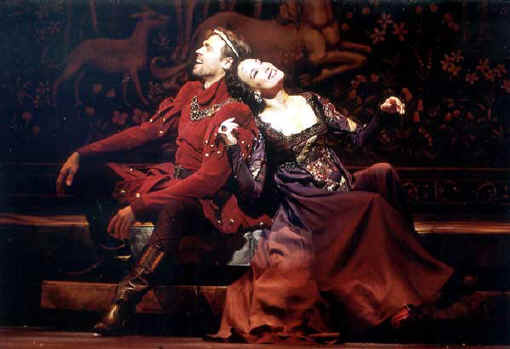 Brent
Barrett and Glory Crampton wonder "What Do
the Simple Folk Do?" in Paper Mill's Camelot.
Brent
Barrett and Glory Crampton wonder "What Do
the Simple Folk Do?" in Paper Mill's Camelot.
Camelot has always been a problematic musical. Despite a gorgeous score and a witty, literate book, most productions of it prove disappointing. The original Broadway version had a nightmarish pre-Broadway tour, with murderous re-writes that went on even after the show opened in New York. Since then, major revivals (and the ghastly film version) have made various changes, invariably doing more harm than good. The more one cuts, the more murky the action gets. But thanks to the classic cast recording, the polished lyrics of Alan Jay Lerner and the irresistible music of Frederick Loewe, people keep loving Camelot and hoping someone will solve its puzzle.
Well, those hopes are fulfilled by the ravishing new production at Paper Mill. In fact, this is easily the finest production of Camelot I have ever seen, one that proves just how marvelous this musical really is. How did they do it? By taking the show on its own terms and providing three things most previous revivals have sadly lacked – clear direction, the sensible restoration of several key songs, and (are you listening, Broadway?) a first-class cast of actors who can sing the heck out of every number. That's right – instead of slumming movie or pop stars who have no idea how to sell a showtune, Paper Mill gives us a full lineup of real singers who make every note count. We have finally reached the point where casting good singers in a musical seems like a revolutionary concept – long live the revolution!
 Lancelot
(Matt Bogart) and Guenevere (Glory Crampton) realize
their love as a heartbroken King Arthur (Brent Barrett) looks on.
Lancelot
(Matt Bogart) and Guenevere (Glory Crampton) realize
their love as a heartbroken King Arthur (Brent Barrett) looks on.
Director/choreographer Robert Johanson does not waste any energy trying to fix Lerner's book. He takes the novel (and refreshingly sensible) view that nothing is really wrong with it. To clarify the sometimes complicated story line, he restores the often deleted "Take Me to the Fair," "The Persuasion" and "Fie On Goodness." (He also makes a minor but crucial adjustment to the placement of Arthur's "Excalibur speech" that vastly strengthens the end of Act One.) The resulting show lasts three hours, but it satisfies in ways abbreviated versions cannot hope to. Johanson also has no problem with the script's unusual blend of sophisticated wit, poetic irony and unabashed romance – in short, he let's Camelot be Camelot. In this, he gets uniformly strong support from Paper Mill's production team. Michael Anania's sets and Thom Heyer's costumes are wondrously lavish. Like the libretto (and the T. H.White novel that inspired it), these designers happily blend elements from the Dark and Middle Ages with more than a little Renaissance, and the resulting spectacle adds to the overall sense of fantasy. Lighting designer F. Mitchell Dana outdoes himself, offering some particularly breathtaking moments. Musical director Tom Helm sets a perfect pace throughout – those singers who sought needlessly slower tempos on opening night will soon realize that they are better off relying on his judgment.
If anyone doubts that Brent Barrett is one of the finest leading men in musical theatre today, his brilliant performance as King Arthur permanently settles that point. He masters this complex character's transitions from comedy to tragedy to triumph with confidence and flair. And no one has ever sung this role like Barrett does – his glorious voice gives each song added beauty and power. Glory Crampton is both lovely and touching as Guenevere, the ill-starred Queen who's love for two men ultimately destroys Arthur's round table. Crampton keeps us believing as she grows from petulance to penitence. She and Barrett complement each other well, making the most of the crucial opening scenes and sparking genuine delight with "What Do the Simple Folk Do."
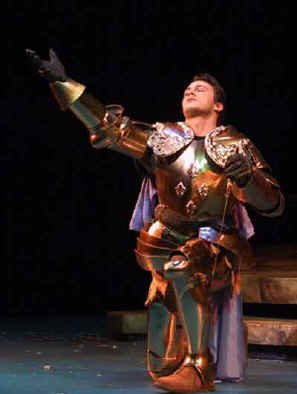 Matt
Bogart as Sir Lancelot proclaims his devotion to King Arthur's round table.
Matt
Bogart as Sir Lancelot proclaims his devotion to King Arthur's round table.
Matt Bogart handles the role of Sir Lancelot with both physical and vocal élan, bounding through the wildly egotistical "C'est Moi," and filling the evergreen "If Ever I Would Leave You" with enough devotion to melt any lover's heart. For once, it is easy to understand Guenevere's dilemma. Heck, if I had to choose between this Lancelot and this Arthur, I'd be stuck too! Much loved Broadway veteran George S. Irving is a joy playing both Merlin and the bumbling Pellinore, winning every laugh with the kind of flawless comic technique almost no one else in the business today can match. And it is a real pleasure to see Barrett Foa's shamelessly evil performance as Mordred. Too many actors have played this character as an effeminate wimp. Not this time! With a Scottish burr and a healthy does of butch menace, Foa had the audience relishing every despicable twist and turn, adding immesurably to the success of this production. As Nimue, Diane Veronica Phelan offers a sumptuous "Follow Me." The outstanding ensemble handles a physically demanding production while retaining musical and dramatic focus. In particular, Christopher Carl, Matt Stokes, Abe Reybold, pyrotechnic tenor Enrique Acevedo and the rest of the knights make "Fie on Goodness" a sizzling testosterone fest.
So the secret is finally out – when you take Camelot on its own terms, it becomes the masterwork its creators always hoped it would be. If Paper Mill were to magically relocate itself a few miles East to midtown Manhattan, this production would easily rate as the best musical revival of the current season. At a time when our world has been torn anew by questions of war and peace, this show is more relevant than ever. So if you want to see a great musical at its best, or want to ponder the future of humanity – or if you just want to enjoy one heck of a good show, get out to Paper Mill and relish this gorgeous Camelot.
This limted run closed May 18, 2003.