
G&S 101
The Gilbert & Sullivan Story - Part II
by John Kenrick
Copyright 2000 (Revised 2020)
(All the photos on this page are thumbnails – click on them to see larger versions.)
"Pinafore-mania"
H.M.S. Pinafore (1878 - 571) was the story of a British naval captain's daughter who spurns the attentions of the First Lord of the Admiralty (the Cabinet minister in charge of the Royal Navy) because she loves a common sailor. This show spoofed Britain's rigid system of social stratification, which limited each person's options in life based on the class they were born into.
Pinafore also lampooned the British public's tendency to condemn anyone marrying outside their original class while hypocritically applauding sentimental plays and novels that suggested "love levels all ranks." The satire was all the more effective because Gilbert's sets, costumes and staging were realistic.
In "When I Was A Lad," The First Lord (assisted by a legion of "his sisters and his cousins and his aunts") explains how a man with no nautical experience could attain his lofty position --
Of legal knowledge
I acquired such a grip
That they took me
Into the partnership.
And that junior partnership, I ween,
Was the only ship
That I ever had seen.
But that kind of ship
So suited me,
That now I am the Ruler
Of the Queen's Navee!
I grew so rich
That I was sent
By a pocket borough
Into Parliament.
I always voted
At my party's call,
And I never
Thought of thinking
For myself at all.
I thought so little,
They rewarded me
By making me the Ruler
Of the Queen's Navee!
Now landsmen all,
Whoever you may be,
If you want to rise
To the top of the tree,
If your soul isn't fettered
To an office stool,
Be careful to be guided
By this golden rule –
Stick close to your desks
And never go to sea,
And you all may be rulers
Of the Queen's Navee!
Thanks to a freak heat wave and critical disapproval of anything making fun of Britain's class system, Pinafore did sluggish business. Then Sullivan began including medleys of the catchy score in his popular summer symphonic concerts. Listeners were intrigued, ticket sales soared, and the show became a sensation
Pinafore was such a hit that D'Oyly Carte's investors tried to literally steal the production from him, sending thugs to carry off the sets and costumes in the middle of a performance. the cast and crew fought the ruffians off, and the thieving investors lost their share in a theatrical gold mine. Carte formed an exclusive producing partnership with Gilbert and Sullivan, splitting the expenses and profit three ways. No interpolations by other composers were allowed, and the three men had joint say in casting and production decisions.
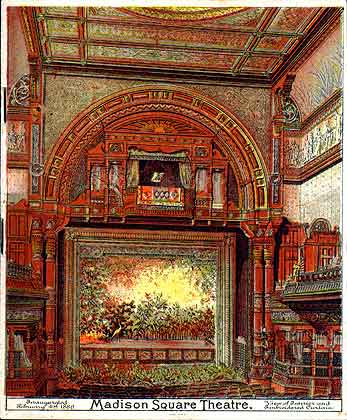 This 1885 program cover
for New York's Madison Square Theatre shows a lavish Victorian interior. This
is where Gilbert and Sullivan's Pirates of Penzance premiered six
years before, when the space was called The Fifth Avenue Theatre.
This 1885 program cover
for New York's Madison Square Theatre shows a lavish Victorian interior. This
is where Gilbert and Sullivan's Pirates of Penzance premiered six
years before, when the space was called The Fifth Avenue Theatre.
The new partnership faced some daunting challenges. Since international copyright laws did not yet exist, American producers had no qualms about stealing material. The United States was inundated with unauthorized ("pirated") Pinafore productions. When Gilbert and Sullivan brought their company of Pinafore to New York, the casts of several unauthorized Pinafore's brazenly turned out to welcome them.
Although critics acclaimed the authorized staging as superior to all other versions, it had a relatively brief New York run. After all, most of the public had already seen one or another version of the show. D'Oyly Carte was determined to protect the American rights to Gilbert and Sullivan's next work from piracy.
Conquering the Pirates
 A poster for the original
production of The Pirates of Penzance.
A poster for the original
production of The Pirates of Penzance.
D'Oyly Carte secured the first international copyright by premiering The Pirates of Penzance (1880) simultaneously in New York and Great Britain. Illegal productions still sprang up, but this time were fought successfully in the courts.
Pirates is the story of Fredrick, a young man who was accidentally apprenticed to a band of pirates. He falls in love with a Major General's ward and tries to atone for his past by plotting the destruction of his former comrades. When it turns out the soft-hearted pirates are really "noblemen who have gone wrong," they and a relieved Frederick marry the multitudinous wards of a rather "Modern Major General" who doesn't know the difference between "a Mauser rifle and a javelin." The success of Pirates confirmed Gilbert and Sullivan's place in popular culture. The amazing thing was that they were just getting started.
Gilbert & Sullivan next took aim at artistic snobbery in Patience (1881 - 578), the story of a pretentious poet who dazzles every woman in an English town except the only one he desires, a simple dairy maid. The comedy targets here were the "aesthetes," a London-based group of colorful writers and artists obsessed with beauty. To make sure Americans would understand this essentially British phenomenon, D'Oyly Carte sent famous aesthete Oscar Wilde on a lecture tour of the U.S., keeping him one city ahead of the Patience tour. The resulting publicity helped to make Patience a hit in the States.
In Gilbert and Sullivan's earlier operettas, many of the characters were familiar but one-dimensional, inspiring little empathy. With Patience, the authors initiated went further, deepening characterization. They also made a greater effort to integrate words and music in order to serve plot and characterization. There were any number of songs in their earliest collaborations that could be exchanged from one character to another – even one show to another. From Patience onwards, the major characters are more thoroughly realized, and the songs are almost always custom fit to each character and situation. Long before Rodgers and Hammerstein, Gilbert and Sullivan were writing the first English language integrated musicals. Yes, G&S billed their shows as "comic operas," but these shows were musicals.
How They Worked
Sullivan would begin to compose after Gilbert delivered the completed librettos. Gilbert developed his story ideas in hefty leather bound notebooks, which are preserved at the Pierpont Morgan Library in New York. These books show how Gilbert worked through plot twists and characterizations in pages of detailed notes, often developing plot points in short story form before beginning the actual script. His dialogue and lyrics show frequent revisions, and he was often willing to discard complete songs and scenes.
It is no exaggeration to say that Gilbert redefined the art of stage direction for the musical theatre. Before rehearsals, he would work out stage movements on a model stage using small blocks of wood to represent the actors, then teach this "blocking" to the cast. He was a demanding director, and not above sarcasm. When a hefty actress tripped and landed on her rump during one rehearsal, Gilbert bellowed, "I knew you'd make an impression on the stage one day!" In most cases, he was far more civil, and often showed remarkable patience while training performers to achieve the effects he desired.
Once a production was set, Gilbert forbade ad-libbing or the addition of any unauthorized stage business. He was assisted in this by his wife Lucy, who made frequent return visits to the Savoy and gave her husband detailed reports on the performances.
For further reading on Gilbert's literary and directorial methods, see Jane W. Stedman's W.S. Gilbert: A Classic Victorian and His Theatre (New York: Oxford University Press, 1996).
The Savoy Theatre
D'Oyly Carte built The Savoy Theatre on London's Strand, moving the company there in October of 1881. The first theatre in Great Britain to use electricity (in the U.S., The California Theatre in San Francisco beat it out by four years), the Savoy took its name from a medieval palace that once stood on the same location. (This is why Gilbert & Sullivan's works are called "Savoy Operas," and their performers are referred to as "Savoyards.")
Customers complained that there were no good places to eat nearby. The best restaurants at that time were always in hotels, so in 1889, Carte built the Savoy Hotel adjacent to the theatre, providing first-class dining for his theatre goers. Both the hotel and its restaurant remain world class venues to this day.
The long-running Patience moved to the Savoy for its final months. Iolanthe (1882 - 398 performances London) was the first G&S operetta to premiere there, with its tale of a fairy queen humbling a "rather susceptible" Lord Chancellor and reforming the House of Lords in order that a mere shepherd may marry the Chancellor's lovely ward. This was Gilbert's "topsy-turvy" world view at its dizziest, and the chorus of fairies caused a sensation by appearing with illuminated electric wings.
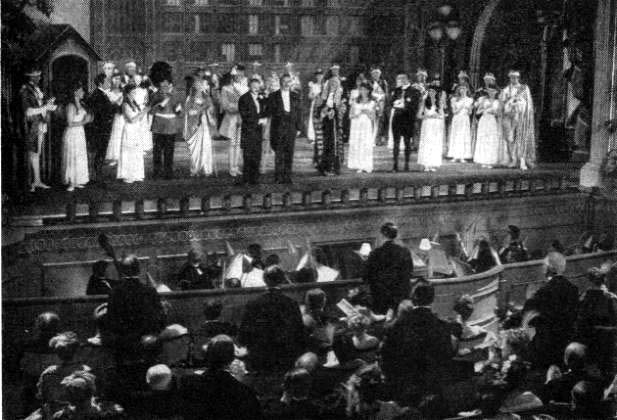 The premiere of Iolanthe as recreated in The
Gilbert and Sullivan Story, with Maurice Evans as Sullivan and Robert Morley
as Gilbert.
The premiere of Iolanthe as recreated in The
Gilbert and Sullivan Story, with Maurice Evans as Sullivan and Robert Morley
as Gilbert.
With its focus on the British political system, Iolanthe was not as popular in the US as other G&S works, but Gilbert's comedy in this show is so solid, his aim at human pretense so timeless, and Sullivan's music so rich and irresistible that many American fans (this author included) consider Iolanthe a personal favorite.
Princess Ida (1884 - 246 performances London) spoofed Tennyson's romantic poem about a fictional medieval prince winning the hand of a princess who thinks women are superior to men. Based on one of Gilbert's early plays, it is the only G&S operetta where the dialogue is in blank verse. Although the plot pokes fun at militant feminism, it comes to the conclusion that true love makes men and women equals.
Despite a superb score, the original Savoy production of Princess Ida got an uneven reception and closed months sooner than expected. In accordance with the terms of their partnership agreement, D'Oyly Carte asked his authors for a new work. Despite the success they had enjoyed, the collaborators both had reservations about continuing their partnership. Unable to agree on a libretto, they seriously considered going their separate ways.