
Stage Musicals vs. History: R to Z
by John Kenrick
(Copyright 2000, Revised 2003)
- Ragtime
- 1776
- The Sound of Music
- Teddy and Alice
- Titanic
- Unsinkable Molly Brown
- The Will Rogers Follies
(All photos below are thumbnails - click on them to see larger versions.)
Ragtime
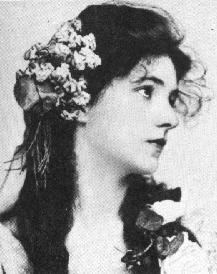 Evelyn
Nesbit during her years on stage.
Evelyn
Nesbit during her years on stage.
Coalhouse Walker, Sarah, Tateh and "The Family" are fictional, but the period setting and many of the supporting characters in Ragtime are straight out of the history books. The musical follows E.L. Doctorow's best-selling novel closely in depicting them. For example:
- Stanford White was murdered while attending a performance at one of NY's summertime rooftop theatres. Harry K. Thaw was "a violent man," one of the first American murderers to successfully avoid the death penalty by using the insanity defense.
- Evelyn Nesbit was acclaimed for her beauty. After she testified for husband Harry Thaw's defense, he divorced her – leaving her with a paltry settlement. She headlined in vaudeville, but gradually slid into obscurity, spending her final years in poverty.
- Harry Houdini was interested in spiritualism, but he eventually moved from belief to skepticism.
- Emma Goldman's anarchist speeches and writings infuriated the authorities, who eventually had her deported.
- Booker T. Washington was a voice for peaceful progress in race relations, but some African American leaders felt him too willing to appease powerful whites.
- Henry Ford and J.P. Morgan were hopelessly removed from the concerns of working class Americans, and neither was averse to using murderous violence to control their workers.
- I have found no record of a black woman being arrested – let alone killed – for attempting an attack on any Vice-President of the early 1900s.
1776
Author Peter Stone often boasted about the historical veracity of his 1776 libretto, and it is accurate up to a point. The scenes and songs shared by John and Abigail Adams are taken almost verbatim from their private correspondence, and the sharp divisions in the colonies over rebellion and slavery are honestly depicted. The personalities of Adams, Franklin and Jefferson are brought to delightful life, and audiences get a convincing taste of the emotions of a distant era. Because their deliberations were considered treasonous, Congress kept no notes on its actual debates -- but the final arguments over independence as Stone conceives them are brilliant and riveting. No wonder this show and its handsome screen version remain effective entertainment after more than three decades. However, Stone did take a number of (you should pardon the expression) liberties. The most notable include --
- The real congressional chamber had no daily calendar – that device was added to make the passage of time clearer to the audience.
- Those who signed the Declaration did so over a period of several weeks. To provide a strong final image, 1776 depicts everyone signing at the same time.
- John Adams did write to Abigail that he was "obnoxious and disliked," but he was actually one of the most respected figures in Congress. Happily, the gifted actor William Daniels succeeded in capturing the man's singular devotion to "independency."
- Martha Jefferson was seriously ill during the summer of 1776. She didn't have the energy to write her husband letters, let alone the stamina required for the then arduous journey to Philadelphia. So Thomas Jefferson wrote the Declaration of Independence without the "refreshment" of a conjugal visit.
- The surviving first draft shows that Jefferson had a relatively smooth time writing the Declaration -- by his own account, there were no mountains of crumpled rejects scattered across his floor.
- Richard Henry Lee was a somber Puritan noted for his oratorical skill. Other than his height, he bore no resemblance to the effusive blowhard portrayed so delectably by Ron Holgate.
- Stephen Hopkins of Rhode Island did enjoy a tot of rum, but never to excess and only at night -- he drank nothing stronger than water during the day.
- The early summer of 1776 saw Washington's army planning the defense of New York City, so the General's dispatches during these weeks would have been filled with optimism. It was not until August and the British victory at the Battle of Long Island that Washington expressed a gloomier view.
- James Wilson did not change his vote at the last moment to avoid the wrath of posterity -- he openly switched over to the pro-independence side some time before the final vote took place.
- The real John Dickinson did not oppose the idea of American independence -- he just felt it was too soon to take such a drastic and then unprecedented step. In the end, Dickinson refused to stand in the way and gracefully chose not to show up for the final vote -- knowing his absence would guarantee passage of the Declaration.
The Sound of Music
The real Captain Von Trapp was relatively easy-going, and easily old enough to be Maria's father. Ex-postulant Maria was the disciplinarian. By her own admission, she initially married the Captain because of her love for the children – the couple's affection for each other developed over time. Most of the family fortune, which the Captain inherited from his first wife, was wiped out in the Great Depression. In fact, the Von Trapps had been forced to rent out most of their palatial home to lodgers and head out on concert tours years before the Nazi's arrived. While it is true that the family left Austria when the Captain refused a commission to command a submarine in the Nazi German navy, the Von Trapps did not leave behind a fortune or climb any mountains to escape – they simply took a train to neutral Switzerland. And the real Maria used harsh methods to keep her brood in tow, even authorizing electro-shock therapy for one daughter who never fully recovered.
Teddy and Alice
We have no reason to believe that Theodore Roosevelt's second marriage and relationship with his daughter Alice were plagued by the ghost of his lamented first wife. This predictable approach turned what could have been a fun musical comedy about America's most famous father-daughter tug-of-war into a weak soap opera. Pity, since the enjoyable score had some entertaining songs, with several based on melodies by John Phillip Sousa.
Titanic
 Isidor
and Ida Strauss shortly before The Titanic sailed.
Isidor
and Ida Strauss shortly before The Titanic sailed.
Every character in this musical was an actual passenger or crew member of the R.M.S. Titanic. Many are depicted in a factual manner – including Isidor Strauss and his wife Ida, who refused to leave the sinking liner without her longtime husband. However, librettist Peter Stone changed some life stories to enrich the atmosphere. For example, Charles Clark and Caroline Neville (who are seen eloping in the show) were already married, and the little boy who runs about with a model sailing ship during the opening number was actually a strapping teenager. As far as I have been able to determine, Alice Beane's hilarious social ambitions and Kate Murphy's unwed pregnancy are fictitious. However, all technical information regarding the ship and it's tragic accident are depicted with textbook accuracy, and the finale truthfully reflects who survived – and who did not. It is not surprising that this skillful use of truth as drama came from the same librettist responsible for 1776.
The Unsinkable Molly Brown
The real Molly Brown was no hillbilly tomboy -- but she was resilient. Born and raised in Hannibal, Missouri, Margaret Tobin was 18 and every inch a lady when she moved to Leadville, Colorado to work in a department store. She wed engineer J.J. Brown in 1886, and when his mining efforts brought them wealth, she became an early advocate for women's and workers rights. Most admired her no-nonsense attitude and exquisite taste in clothes. A devout Roman Catholic, she spearheaded efforts to build Denver's Cathedral of the Immaculate Conception, and remained a social leader even after she & Brown were legally separated. She was among the survivors of the Titanic, and did force her lifeboat commander to search (in vain) for survivors. She volunteered to care for wounded Allied soldiers during World War I, and died in NYC in 1932 at age 65. In the end, her remaining estate was approximately $6,000.
The Will Rogers Follies
This show plays freely with the facts – as its narrator freely admits. Considering what had to be done to adapt the story to a Ziegfeld Follies revue format, we get a reasonable outline of the great humorist's life. He supposedly had some friction with his father, but nothing as serious as this show suggests. Rogers was nominated for the Presidency, but strictly for laughs. (Note: When I first saw this show, I had to restrain myself from belting Wily Post every time he shrieked "Let's go flying, Will!" Like we need constant reminders of how Rogers is going to die in the end?) In a business noted for its marital disasters, it is refreshing to verify that Rogers was a devoted husband and father.