
Noel Coward 101
Coward Quotations
Compiled by John Kenrick
 Coward's friend Clifton Webb starred in
the original Broadway production of Present Laughter.
Coward's friend Clifton Webb starred in
the original Broadway production of Present Laughter.
1. Noel Coward Speaks
On Theatre
"You ask my advice about acting? Speak clearly, don't bump into the furniture and if you must have motivation, think of your pay packet on Friday."
"I will accept anything in the theatre . . . provided it amuses or moves me. But if it does neither, I want to go home."
"Work hard, do the best you can, don't ever lose faith in yourself and take no notice of what other people say about you."
"It's no use to go and take courses in playwriting any more than it's much use taking courses in acting. Better play to a bad matinee in Hull – it will teach you much more than a year of careful instruction. Come to think of it, I never did play to a good matinee in Hull . . ."
"Of course, the age-old tradition that a star must appear even if he or she is practically dying is an excellent one, but it can be carried too far. I once played a performance of The Knight of the Burning Pestle with a temperature of 103 and gave sixteen members of the company mumps, thereby closing the play and throwing everybody out of work. There may be a moral lurking somewhere in this, but I cannot for the life of me discover what it is."
"In the first act, you get the audience's attention - once you have it, they will repay you in the second. Play through the laughs if you have to. It will only make the audience believe there are so many of them that they missed a few."
"She stopped the show – but then the show wasn't traveling very fast."
"Many years ago I remember a famous actress explaining to me with perfect seriousness that before making an entrance she always stood aside to allow God to go on first. I can also remember that on that particular occasion He gave a singularly uninspired performance."
"The theatre should be treated with respect. The theatre is a wonderful place, a house of strange enchantment, a temple of illusion. What it most emphatically is not and never will be is a scruffy, ill-lit, fumed-oak drill hall serving as a temporary soap box for political propaganda."
On Himself
"I'm an enormously talented man, and there's no use pretending that I'm not.."
"I can't sing, but I know how to, which is quite different."
"I should love to perform "There Are Fairies in the Bottom of My Garden" (Bea Lillie's signature song), but I don't dare. It might come out "There Are Fairies in the Garden of My Bottom."
From a 1970 interview on ABC-TV:
DICK CAVETT: You're, you . . . what is the word when one has such terrific, prolific qualities?
COWARD: Talent.
Same interview, discussing his sexually ambiguous
friend Alfred Lunt:
"Alfred wanted to be an acrobat -- and to a large extent
succeeded."
On the success of his 1950's Las Vegas act:
"It has been most gratifying . . . I now find myself as big a
celebrity as Debbie Reynolds."
When asked if a handsome 1960's actor's fame would
last, he perceptively remarked:
"Keir Dullea, gone tomorrow."
On writer Gertrude Stein:
"Literary diarrhea."
Asked in his final years if he would ever act in a Shakespearean play:
"I think I've left it till a bit late. I might play the Nurse in
Romeo and Juliet."
On death:
"The only thing that really saddens me over my demise is that I shall not
be here to read the nonsense that will be written about me and my works and
my motives. There will be books proving conclusively that I was homosexual
and books proving equally conclusively that I was not. There will be
detailed and inaccurate analyses of my motives for writing this or that and
of my character. There will be lists of apocryphal jokes I never made and
gleeful misquotations of words I never said. What a pity I shan't be
here to enjoy them!"
Told a particularly stupid acquaintance had blown
his brains out:
"He must have been an incredibly good shot."
When the opening night of the London musical
Gone With the Wind
was marred by an obnoxious young actress and a horse that relived
itself onstage, Coward was in the audience:
"If they'd stuffed the child's head up the horse's arse, they
would have solved two problems at once."
Backstage on the opening night of the London Kiss
Me Kate, Coward confronted a handsome young actor in tights:
"My boy, you have quite the prettiest legs in London, but I have
the prettiest face."
On lunching with Queen Elizabeth II:
"It was all very merry and agreeable, but there is always, for me, a tiny pall
of "best behavior" overlaying the proceedings. I am not complaining about this,
I think it is right and proper, but I am constantly aware of it. It isn't that
I have a basic urge to tell disgusting jokes and say "f**k" every five
minutes, but I'm conscious of a faint resentment that I couldn't if I
wanted to."
When Mary Renault's fiction strayed from ancient
Greece to more contemporary topics:
"I'm sure the poor woman meant well, but I wish she's stick to
recreating the glory that was Greece and not muck about with dear old
modern homos.
After seeing The Sound of Music on Broadway:
"There were too many nuns careering about and crossing themselves and
singing jaunty little songs, and there was, I must admit, a heavy
pall of Jewish-Catholic schmaltz enveloping the whole thing, but it was far
more professional, melodic and entertaining that any of the other musicals
I've seen."
When a male dancer in Coward's London revue
Sigh No More forgot to wear the proper support, Noel said to the
choreographer:
"For God's sake, go and tell that young man to take that
Rockingham tea service out of his tights."
On marriage and divorce:
"The ladies of earlier years were far smarter. No pants, drinking, swearing and
competing with the boys; they just stayed put and, as a general rule, got
their own way and held their gentlemen much longer. It really isn't surprising
that homosexuality is becoming as normal as blueberry pie."
On drama critics:
"I have always been very fond of them . . . I think it is so frightfully
clever of them to go night after night to the theatre and know so little about
it."
Also on drama critics:
"Criticism and Bolshevism have one thing in common. They both
seek to pull down that which they could never build."
Coward's opening night telegram to old friend Gertrude
Lawrence:
"A WARM HAND ON YOUR OPENING."
And when Lawrence married Richard Aldrich, Coward
telegrammed:
" DEAR MRS. A HOORAY HOORAY
AT LAST YOU ARE DEFLOWERED
ON THIS AS EVERY OTHER DAY
I LOVE YOU NOEL COWARD"
Asked why the Duke of Windsor (the former King
Edward VIII) disliked him:
"He pretends not to hate me, but he does, and it's because I'm
queer and he's queer, but unlike him I don't pretend not to be."
Asked why he would not "come out" in his
final years and announce his sexual preference:
"Because there are still three old ladies in Brighton who don't
know." (Note: he used variations on this line over the years naming
different British towns.)
Asked how he would describe the
style of his colorful tropical paintings:
"Erratic. Actually, it's known by my friends as Touch and Gauguin."
Watching Queen Elizabeth's coronation parade, friends wondered
aloud who the little man sharing a carriage with the 400 pound Queen of Tonga might
be. According to David Niven, Coward replied:
"Her lunch."
When an aging Coward fussed with a stage wig
before a benefit performance, his dresser said, "It doesn't matter. It's only the
behind." Coward responded:
"I'll have you know that in its day my behind has been much admired
and much sought after!"
Asked how it felt to be "written-off" as unimportant
after World War II:
"Well, in the first place, nobody of particular importance wrote me off.
And in the second place, I didn't notice it."
On conceit:
"Conceit is an outward manifestation of
inferiority."
A final bit of The Master's wisdom:
"To know you are among people whom you love, and who love you – that has
made all the successes wonderful, much more wonderful than they'd have been
anyway."
2. Discussing Noel Coward
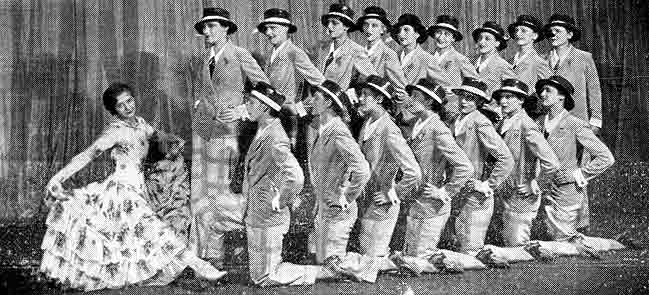 An
unidentified ensemble number from the Broadway production of Coward's revue This
Year of Grace.
An
unidentified ensemble number from the Broadway production of Coward's revue This
Year of Grace.
John Lahr:
"We're talking about a style that became a way of being for a lot of people. English cultural history between the world wars is, in some extremely large part, Noel Coward. He put himself into the narrative the English tell themselves about their struggles, their suffering, their triumphs. In the first half of this century he wrote the songs that homogenized, as it were, English public sentiment; he wrote the great historical pageant of the time (Cavalcade) and the era's great romantic story (the film Brief Encounter, 1945)."
Dame Edith Evans:
"He can get into two or three words, just dripped out, such a witty comment on the situation. He doesn't waste words."
Eddie Cantor:
"The British George M. Cohan. London or Las Vegas, Paris or New York, they've all applauded his revues, his dramas, his words and music. The most brilliant contribution England ever made to American show business."
Robert Mitchum:
"I was a guest once at Eleanor Roosevelt's place. I saw this pink nightgown and just for a gag put it on over my clothes. Noel Coward walks in and says, "My dear, you look simply divine!" and kisses my hand. Next time I see Eleanor at a party she says loudly, "Why, Bob, last time we met you were in a pink nightgown being kissed by Noel Coward. What could I do but admit it?"
Kenneth Tynan:
"Theatrically speaking, it was Coward who took sophistication out of the refrigerator and put it on the hob . . . Even the youngest of us will know, in fifty years' time, precisely what is meant by 'a very Noel Coward sort of person.'"
Bea Lillie:
"Noel and I were in Paris once. Adjoining rooms, of course. One night, I felt mischievous, so I knocked on Noel's door and he asked, "Who is it?" I lowered my voice and said, "Hotel detective. Have you got a gentleman in your room?" He answered, "Just a minute, I'll ask him."
Tim Rice:
"The wit and wisdom of Noel Coward's lyrics will be as lively and contemporary in 100 years' time as they are today."
John Kander:
"Sarcastic or sentimental, bitchy or sweet, there has never been anyone quite like him."
Terence Rattigan:
"The best of his kind since W.S. Gilbert."
Richard Rodgers:
"He wrote with style, sang with style, painted with style, and even smoked a cigarette with a style that belonged exclusively to him. Despite his ability to do so many things so superbly, he always had to endure the put-down that anyone so versatile could not possibly be a first-rate talent. What nonsense! Versatility on so high a level needs no excuse. Even one of his lesser known operettas, Conversation Piece, contains more charm, skill and originality than fifty plays put together by men specializing in particular fields." (Musical Stages, Random House, New York. 1975), p. 77.)