
History of The Musical Stage
Vaudeville- Part III
by John Kenrick
(Copyright 1996-2003)
(The images below are thumbnails – click on them to see larger versions.)
Forgotten Headliners
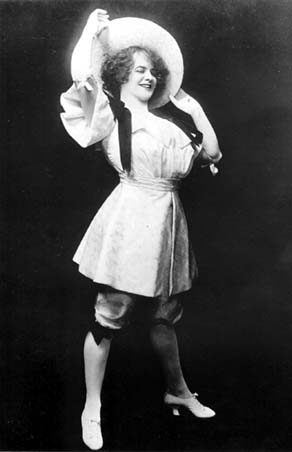 Eva
Tanguay, one of vaudeville's all-time greatest stars. Fans called her "The
Girl Who Made Vaudeville Famous."
Eva
Tanguay, one of vaudeville's all-time greatest stars. Fans called her "The
Girl Who Made Vaudeville Famous."
When a performer's name appeared on the top of the billboard listing each week's acts, they were at the "top of the bill" or a headliner. Headliners got the best dressing rooms and the highest salaries, up to $4000 a week in the big time. It is tough enough to turn on star power for one performance a day – imagine two to five shows a day! While some of the greatest vaudeville stars were short on talent, they had tons of personality and extraordinary stamina. Since many of these longtime audience favorites predated the age of talking film, their names are now forgotten. A short list of celebrated headliners –
- Eva Tanguay had a so-so voice, but her roaring energy and daring material like the hit song "I Don't Care" made her one of the most lasting vaudeville stars. "It's All Been Done Before But Not The Way I Do It," and "Go As Far As You Like" were titillating stuff in 1912.
- Nora Bayeswas the well-attired soprano who made "Shine On Harvest Moon" a hit. She fascinated fans with her string of scandalous marriages, most memorably to songwriter Jack Norworth (composer of "Take Me Out to the Ballgame.") She was one of America's first singers to attain national popularity.
- The beguiling Elsie Janis sang and clowned her way to stardom in vaudeville and musical comedy before winding up a successful Hollywood screenwriter and lyricist.
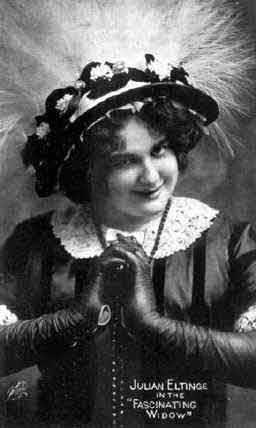 Julian Eltinge was the top
female impersonator of the early 20th Century. Here he is seen in the title
role of the Broadway musical The Fascinating Widow (1911). He remains the only
drag performer to have a Broadway theatre named after him. The Eltinge later became The
Empire. Its old facade and lobby are now part of the AMC
Multiplex on 42nd Street.
Julian Eltinge was the top
female impersonator of the early 20th Century. Here he is seen in the title
role of the Broadway musical The Fascinating Widow (1911). He remains the only
drag performer to have a Broadway theatre named after him. The Eltinge later became The
Empire. Its old facade and lobby are now part of the AMC
Multiplex on 42nd Street.
- Julian Eltinge was vaudeville's most famous female impersonator. His lavish gowns and deft mimicry of feminine behavior made him a longtime favorite. His fame faded with vaudeville, and he found few engagements in his later years. Other female impersonators with outstanding vaudeville careers include the campy Bert Savoy and the elegant Karyl Norman.
- Bert Williams was the first black performer to gain national stardom in the US, with comic gems like the song "Nobody." After partnering with George Walker in vaudeville and musical comedy, he went on to solo success in vaudeville and starred in several editions of the Ziegfeld Follies. Despite his tremendous popularity, Williams was often subjected to blind bigotry. When a bartender in a first class Chicago hotel told him that drinks for "coloreds" were $50 each, Williams pulled out a wad of fifties and ordered the man to pour a round for everyone at the bar.
- The Duncan Sisters did a musical act as "Topsy and Eva," characters from Uncle Tom's Cabin. They sang and played various instruments with limited skill but tremendous charm, pleasing fans for decades.
- Smith and Dale were one of vaudeville's most popular comedy teams. Their routines were corny but funny, relying on slapstick gags and carefully timed dialogue. (Neil Simon's The Sunshine Boys was inspired by these masters of vaudeville laughter.)
- The Cherry Sisters were considered the worst vaudeville act of all time. Ranging in number over the years from five to two, their songs and recitations were so awful that audiences threw vegetables to show their disgust. Managers saw the possibilities and encouraged audiences to hurl produce! The ladies drew huge cackling crowds, performed behind a net curtain to avoid injury, and unsuccessfully sued complaining critics. All evidence suggests that the sisters believed their act was really good. Commanding a hefty $1,000 a week, they toured for decades.
Clean Comedy
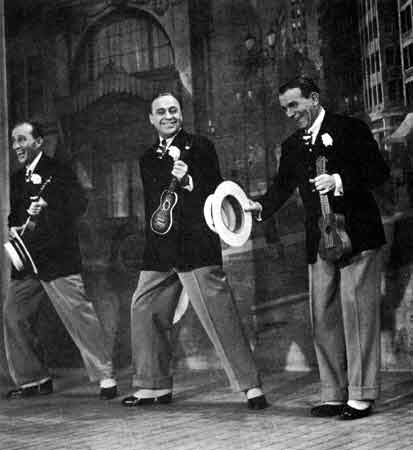 Bing Crosby joins
vaudeville veterans Jack Benny and George
Burns in a televised tribute to vaude comedy.
Bing Crosby joins
vaudeville veterans Jack Benny and George
Burns in a televised tribute to vaude comedy.
The strict decency standards Keith and Albee imposed on all vaudeville acts were hard on comedians. Imagine what it took to create fifty years worth of squeaky clean humor! Any good clean joke was likely to be stolen, and many a comic found other pilfering performers had already done his material in various towns. In years to come, radio and early television would rely on the same comics – and many of the same jokes. The New Vaudeville Joke Book, published in 1907, offered these examples –
SANDERSON: My friend has been elected mayor.
BOWMAN: Honestly?
SANDERSON: What does that matter?DUMMY: My father killed a hundred men in the war.
VENTRILOQUIST: What was he? A Gunner?
DUMMY: Nope, a cook.YOUNG MAN: I want to ask for the hand of your daughter in marriage.
OLD MAN: You’re an idiot!
YOUNG MAN: I know it. But I didn’t suppose you’d object to another one in the family.
Much of vaudeville's "clean" humor relied on ethnic stereotypes that would inspire public outrage today. The most popular targets were were Germans (called "Dutch" acts), Jews, Blacks, Italians and the Irish, but most anyone was fair game – even rich WASPs. The various ethnic groups in urban audiences loved to laugh at what they perceived (or chose to perceive) as someone else's foibles.
Vaudeville was an equal opportunity insulter. Joe Laurie Jr.'s affectionate Vaudeville: From Honky Tonks to the Palace (Henry Holt & Co., NY, 1953, p. 427) includes a complete script for the classic "School Act," with characters covering a wide range of then-acceptable comedy stereotypes – a bumbling German teacher contends with such students as "Percy" (sissy), "Tony" (Italian), "Jesse James" (street tough), "Gladys Umpah" (lisping girl), "Skinny Jones" (overweight boy), "Rastus Johnson" (Negro) and "Abey Maloney Goldstein" (a Jewish boy who's added an Irish middle name "for protection").
As times and attitudes changed, such acts were gradually forced from the scene.
Comedy routines burlesquing "micks" and "kikes" and "wops" were almost as common as "coon" routines in the early years of the (20th) century, signifying a lack of originality, if nothing else. Such practices were so offensive to ethnic communities in Boston and New York that both municipalities passed ordinances banning ethnic epithets on stage.
- Jim Haskins & J.R. Mitgang, Mr. Bojangles: The Biography of Bill Robinson (New York: William Morrow & Co., 1988), p. 59.
While ethnic gags were (for a time) acceptable, coarse language and sexual innuendo were not. Keith and Albee even forbade seemingly harmless phrases like "hully gee." Of course, there were always performers willing to test the limits. These bits were censored in vaudeville's golden years –
MAN: She thinks "lettuce" is a proposition!"
WOMAN: Someone is fooling with my knee.
MAN: It's me, and I'm not fooling!WOMAN: I'm not married.
MAN: Any children?
WOMAN: I told you, I'm not married.
MAN: Answer my question!WOMAN: He's the father of a baby boy but his wife doesn't know it yet.
Here is a refrain sung on both sides of the Atlantic by British music hall comedienne Marie Lloyd. Gentle as it sounds today, it left some American vaudeville managers steaming in the early 20th Century --
What's that for, eh? Oh, tell me Ma.
If you won't tell me, I'll ask Pa.
But Ma said, "Oh, it's nothing,
Hold your row."
Well, I've asked Johnny Jones see,
So I know now!
Vaudeville audiences were far more likely to hear the latest from Tin Pan Alley, where songwriters knew that vaudeville could turn a song into a hit. Irving Berlin's "Alexander's Ragtime Band" became an international sensation after Emma Carus and Al Jolson (among others) included it in their acts. Publishers often included the photos of popular vaudevillians affiliated with a particular tune on sheet music covers to boost sales.