
Ziegfeld101
Florenz Ziegfeld: Bio - Part IV
by John Kenrick
(Copyright 2002-2004)
(All the photos on this page are thumbnail images – click on them to see larger versions.)
Show Boat
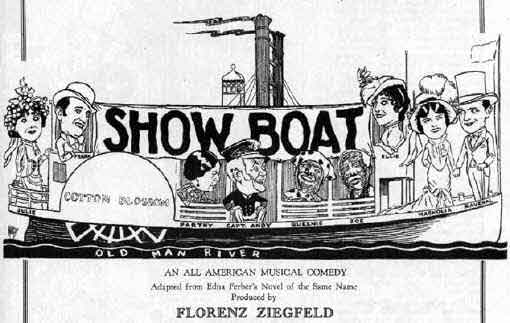 A
caricature of Show Boat's original stars, taken
from the title page of the program.
A
caricature of Show Boat's original stars, taken
from the title page of the program.
Show Boat (1927 - 572 performances) is one of the most powerful and popular musicals ever written. With music by Jerome Kern and a libretto by Oscar Hammerstein II, it tells the epic tale of the inhabitants of a Mississippi showboat from the 1880’s to the 1920’s. The libretto deals with racism, mixed marriage and marital abandonment (subjects that had been taboo in musicals), and the character-driven score is loaded with hits, including "Make Believe," "You Are Love," "Bill" and "Old Man River." When the stunned opening night audience reacted to the show in near silence, Ziegfeld was convinced his gamble had failed. The rave reviews in the papers and long lines at the box office the next morning proved otherwise. Although time has credited this show's success to Kern and Hammerstein, the original raves stressed that this was a triumph for Ziegfeld.
This innovative masterpiece spawned no trends, but it showed what musical theater could aspire to. Ziegfeld took an active role in shaping Show Boat, so he deserves some share in the credit for its lasting success. There have been four successful Broadway revivals (the most recent in 1996), and an ongoing succession of major productions worldwide. With each generation emphasizing different aspects of the story, no two productions of Show Boat have ever been quite the same. Few musicals have been as resilient.
What Goes Up . . .
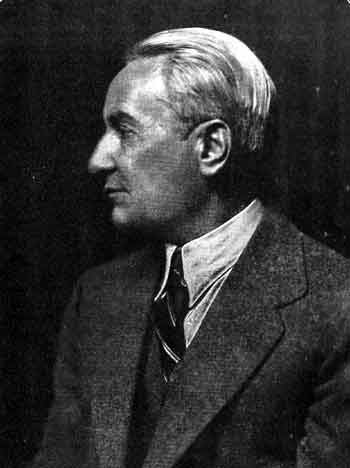 Ziegfeld as he appeared in the
program for Show Boat in 1928 – at the height of his career.
Ziegfeld as he appeared in the
program for Show Boat in 1928 – at the height of his career.
With the triumph of Show Boat, Ziegfeld reached the apex of his career. He was the undisputed King of Broadway, and all of show business looked upon him as something of a living legend. Through all his years in show business, Ziegfeld never lost the twangy Chicago accent that made him sound more like a stock yard worker than a typical Broadway producer. He also never lost his love for gambling, losing as much as $50,000 a night at roulette. While this risk-loving instinct led to some of his most daring successes, it also kept wiping out the funds he needed to make his shows a reality. His gambling instinct also made him a major player in the stock market at the worst possible moment.
The summer of 1929 saw Ziegfeld's production of Show Girl (1929 - 111), a backstage saga starring Ruby Keeler. At the first pre-Broadway performance in Boston, she was dancing to the Gershwin showstopper "Liza" when Al stood up in the audience and started singing it. The audience, thinking that Jolson was encouraging his wife, roared its approval. Ziegfeld made the most of the situation by convincing Al to repeat the stunt during the show's first week in New York.
This unleashed enough publicity to help the lavish but mediocre show sell tickets. Soon afterward, Ruby suffered an injury or illness (sources differ) and withdrew from the show. Ziegfeld tried to carry on with an understudy in the lead, but was soon forced to close the show. Ziegfeld could not have known it, but his once unlimited luck had run out.
. . . Must Come Down
In October 1929, Ziegfeld returned from a long day in court contesting a heated lawsuit (over a $1,600 marquee sign) to find that the stock market had crashed, wiping out his entire fortune of nearly three million dollars. Ziegfeld's perfect world quickly fell apart – and the more he did to fight it, the worse things became. For starters, he set aside his hatred of the big screen to produce a fictional film tribute to the Follies called Glorifying the American Girl (1929). To his fury, he found that studio moguls worried about his infamous spending habits had put all real power over the film in the hands of others. The resulting movie was such a crashing bore that they delayed the release for months. In the end, critics savaged it.
Back on Broadway, a series of promising projects failed with frightening speed. The longtime Ziegfeld approach of gathering the best talents and spending whatever it took had little meaning in a world where most of his potential audience was stuck on bread lines or begging for food. Simple Simon (1930) starred Ed Wynn and featured a score by Rodgers and Hart, and the lavish Smiles (1930) teamed Marilyn Miller with Fred and Adele Astaire – and both shows closed in a matter of weeks, leaving Ziegfeld with mountainous debts.
Refusing to give up, Ziegfeld put together one last Follies, as usual sparing no expense. The 1931 edition was nostalgic but offered little in the way of fresh entertainment. Flo kept it limping along for several months to partial houses, but the high production costs made it impossible to turn a profit. His secretary Goldie Clough had to smuggle him out of the office by way of a fire exit every night to avoid the creditors and summons servers waiting at the theater door.
Curtain Call
Ziegfeld had always indulged his taste for beautiful women, engaging in a series of sometimes scandalous love affairs with chorines (Olive Thomas, Anna Daly) and stars (Marilyn Miller, Lillian Lorraine) that infuriated his wife Billie Burke. As Ziegfeld's professional fortunes crumbled, his health faltered. He developed pleurisy, a recurring lung infection. Ziegfeld submerged a lifelong fear of illness and death in an increasingly degrading series of clumsy infidelities.
While Billie was in Hollywood trying to work off their debts, Ziegfeld staged gin-soaked orgies at their Westchester home. At his office, a daily parade of chorus girls left "private conferences" with hair and clothes disheveled. According to his secretary Goldie, an anxious telegram delivery boy once rushed into Ziegfeld's inner office unannounced, emerging in horror to exclaim, "Geez, the guy's laying the dame right there on the desk!"
"Ziegfeld's furious expression of sexuality in those months was not a joyful thing -- it was an act of sad challenge to death and decay, to the certain knowledge that the darkness would soon engulf him. He had no belief at all in an afterlife. He believed that the body was all that counted and knew that it was all too perishable."
- Charles Higham, Ziegfeld (Chicago: Henry Regnery Co., 1972), p. 216.
Billie Burke heard about what was going on, which ignited some enraged telephone arguments. But she stuck to her "in better or worse" vows. Since Billie's acting income kept them afloat, she stayed in Hollywood and hoped Flo would come to his senses before it was too late.
As a final gambit, Ziegfeld took the old Show Boat sets out of storage and reunited most of the original cast for a revival in May, 1932. The one new lead was Paul Robeson, who had introduced his unforgettable rendition of "Ol' Man River" in the first London production. The critics cheered, but it had only been a few years since the original had closed, and the Great Depression was at its worst. There simply were not enough customers to make the production profitable. The cast took salary cuts to keep the show running a few months. Helen Morgan then headlined a cut-rate tour -- but Ziegfeld's last gamble had failed.
Weeks after Show Boat opened, Ziegfeld's lung infection developed into pneumonia. Burke brought him out to California to recuperate. Arriving in a state of near delirium, he soon seemed to rally and even talked of a new career in film. But it was not to be. On the evening of July 22, 1932, Billie Burke was filming a screen test with young actor Walter Pidgeon when word came that her husband was sinking fast. By the time she reached the hospital, it was too late. Broadway's greatest showman was dead.
Burke worked tirelessly for decades to settle Ziegfeld's debts. Over the years, Burke and her daughter Patty also did whatever they could to preserve Ziegfeld's memory -- writing books, giving interviews, encouraging the production of films and new editions of the Follies, etc. They needn't have worried – Florenz Ziegfeld's name has stood the test of time.