
Ziegfeld 101
Follies Chronology I
by John Kenrick
The photos below are thumbnails – click on them to see full size versions.
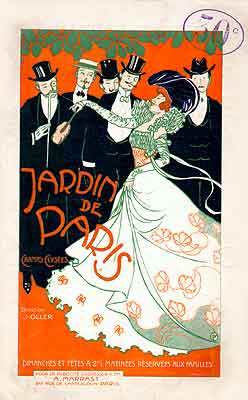 A 1902 program for the original Jardin de Paris,
a popular night spot on the
Champs Elysees. Ziegfeld and Abe Erlanger borrowed its name for the run down New
York roof theatre where the Follies premiered in 1907.
A 1902 program for the original Jardin de Paris,
a popular night spot on the
Champs Elysees. Ziegfeld and Abe Erlanger borrowed its name for the run down New
York roof theatre where the Follies premiered in 1907.
This is a year by year breakdown of Florenz Ziegfeld's legendary Follies. The cast and production information given here was confirmed by referring to the original programs, as well as articles and books covering the Follies. For details on Ziegfeld's other Broadway productions, click here.
1907
Opened: The Jardin De Paris (atop The New York Theater), June 8 (70 performances)
Book and lyrics: mostly by Harry B. Smith
Score: Maurice Levi and various composers
Dances by: Gus Solke, Jack Mason
Principles Directed by: Herbert Gresham
Chorus Directed by: Julian Mitchell
Uncredited Directors: Jose Smith and John O'Neill
Musical Conductor: Frederick Solomon
Featuring: Grace LaRue, Emma Carus, Harry Watson, Helen Broderick and
The Anna Held Girls. Nora Bayes joined the cast towards the end of the run.
Notes: Subtitled, "Just One of Those Things in Thirteen Acts,"
this $13,000 rooftop production was meant for a limited summer run. Although Ziegfeld conceived and mounted the show,
the actual producers were Klaw and Erlanger, who paid Ziegfeld $200 a week
for his "managerial" services. The script involved Capt. John Smith
and Pocohontas traveling through time to visit the sights and celebrities of
modern New York City. Skits gently spoofed current figures
(Teddy Roosevelt, Victor Herbert, etc.) and the score included such forgettable songs
as "In the Surf," "The Ju-Jitsu Waltz" and "I Oughtn't to Auto
Any More." Almost every scene provided excuses to showcase pretty chorines in
handsome but revealing costumes. At one point, Ziegfeld marched his girls into the aisles banging
on drums, allowing patrons a close look at their charms. After the initial run,
this production moved to Broadway's Lyric Theatre for two additional weeks,
toured for two months, had a week long return run at the Grand Opera House on
West 23rd Street, then spent a final month in Philadelphia. This success
was extraordinary for what was meant to be a summer rooftop diversion.
1908
Opened: The Jardin de Paris, June 15 (120 performances)
Book and lyrics: mostly by Harry B. Smith
Score: Maurice Levi and various composers
Principles Directed by: Herbert Gresham
Ensemble Numbers Produced by: Julian Mitchell
Featuring: Nora Bayes, Grace LaRue, Mlle. Dazie and Harry Watson
Notes: Having stumbled on a winning format, Ziegfeld made sure his
second Follies was as much like the first as possible -- and audiences
embraced the results. With the history of civilization as its theme, this edition almost
doubled the run of its predecessor, moving downstairs into the New York Theatre
for several weeks. An otherwise forgettable score featured Nora Bayes
singing her memorable hit "Shine On Harvest Moon." The Ziegfeld girls were the
other main attraction, appearing as curvaceous New Jersey mosquitoes (wings and all)
commuting through the then-unfinished Holland Tunnel. In a tribute to Broadway's
latest hit, the girls paraded as "Merry Widows of the World."
A more suggestive production number had them dressed as taxi cabs, with electric signs
indicating if they were "on duty."
1909
Opened: The Jardin de Paris, June 14 (64 performances)
Book and lyrics: mostly by Harry B. Smith
Score: Maurice Levi and various composers
Settings by: Lee Lash Studios, John Young, Ernest Albert, Hugo Baruch
Costumes by: Edel, W. H. Matthews, Jr., and others
Staged by: Julian Mitchell
Featuring: Lillian Lorraine, Bessie Clayton, Sophie Tucker, Nora Bayes and
Jack Norworth. Eva Tanguay joined the cast in mid-run.
Notes: Nora Bayes returned, singing her latest hit, "By the Light
of the Silvery Moon." When newcomer Sophie Tucker proved a hit on the
pre-Broadway tour, a jealous Bayes demanded Tucker be dismissed. Tucker was left
with one scene, playing a hefty leopard in a jungle number. When Bayes left early
in the Broadway run, Ziegfeld brought in the dynamic vaudeville star Eva Tanguay
– who was such a hit that she had to be given top billing. Ziegfeld's mistress
Lillian Lorraine was given "Shine on Harvest Moon," and further displayed
her creaky voice (and some more appealing attributes) singing "Nothing But a
Bubble" while soaking in a bathtub. A production number entitled "The
Greatest Navy in the World" featured the Ziegfeld girls wearing battleships
as headgear that lit up when the stage lights were lowered. In another memorable
sequence, several chorines flew over the audiences heads in a replica of the Wright
Brothers' airplane.
1910
Opened: The Jardin de Paris, June 20 (88 performances)
Book and lyrics: mostly by Harry B. Smith
Score: Gus Edwards "and many others"
Settings: John Young, Unitt & Wicks, Ernest Albert
Costumes: Herr Crage, W.H. Matthews, Jr.
Staged by: Julian Mitchell
Conducted by: Frank Darling
Featuring: Fanny Brice, Bert Williams and Lillian Lorraine, (with Anna Held
on film)
Notes: The little-known burlesque vocalist Fanny Brice made such a hit on opening night singing
"Lovey Joe" and "I Thought He Was a Business Man" that Ziegfeld
tore up her contract the next morning, giving her a major raise and elevating
her to star status. Bert Williams became the first Negro to co-star with whites in a major Broadway
show – but only after Ziegfeld defied bigoted protests. As a precaution, in
this edition Williams only appeared alone or with men, never sharing the stage
with the all-white chorus girls. Williams justified the
effort, becoming one of the most popular and lasting Follies comics. Anna Held
was seen in an innovative filmed sequence playing the role of Hailey's
Comet. The chorus girls (still billed as "The Anna Held Girls") appeared in a daring swimming tank
extravaganza. They later joined Lillian Lorraine to ride
swings over the audience's heads, tossing bouquets while singing "Swing Me High, Swing Me Low."
1911
Opened: The Jardin de Paris, June 26 (80 performances)
Book and lyrics: George V. Hobart and others
Score: Maurice Levi, Irvin Berlin and others
Staged by: Julian Mitchell
Featuring Fanny Brice, Bert Williams, The Dolly Sisters, Lillian Lorraine,
Leon Errol, Vera Maxwell and Bessie McCoy
Notes: This was the first edition officially called The Ziegfeld
Follies, an overdue tribute from co-producers Klaw and Erlanger.
Comic Leon Errol made his Follies debut as a nervous
tourist led through the Grand Central Station construction site by porter Bert
Williams. This marked the first of many showstopping skits these two comics
would share over the years. Williams also began appearing on stage with the
all-white Follies chorus girls, completing his personal demolition of a
longstanding Broadway racial barrier -- and he introduced the comic solo
"Woodman, Woodman, Spare That Tree.". A dance specialty had
vaudeville's popular Dolly Sisters costumed as
Siamese twins. The ladies of the chorus appeared attired as sailors on the
"HMS Vaudeville," and danced the "Texas Tommy Swing." Lillian
Lorraine's behavior became increasingly temperamental, culminating in a
backstage catfight with Fanny Brice – which Brice ended by dragging the
defeated Lorraine by the hair across the stage in full view of a roaring audience. Soon
afterward, Lorraine skipped an important rehearsal, and was fired at the insistence
of co-producer A.L. Erlanger.
1912
Opened: The Ziegfeld Moulin Rouge (formerly The Jardin de Paris), October
21 (80 performances)
Book and lyrics: Harry B. Smith and others
Score: Raymond Hubbell and others
Scenery: Ernest Albert
Staged by: Julian Mitchell
Conducted by: Frank Darling
Orchestrations by: Frank Sadler
Featuring: Bert Williams, Elizabeth Brice, Leon Errol, Ray
Samuels, Lillian Lorraine and Harry Watson
Notes: Erlanger renamed the Music Hall (downstairs from the Jardin de Paris
rooftop space) in Ziegfeld's honor for this autumn edition
which critics and audiences acclaimed as the finest Follies
yet. The performance began with several cast members planted in the audience,
arguing over what sort of show it should be -- a surreal touch that caught
audiences and critics off guard. Errol and Williams performed
a \ taxicab sketch, and
Elizabeth Brice (no relation to Fanny) scored singing "Row, Row, Row."
The finale was an eye-popping "Society Circus Parade,"
with ponies and showgirls circling the stage. The volatile Lillian Lorraine returned to sing
"Daddy Has a Sweetheart," but was fired by Erlanger for missing
rehearsals. Though she would return to the series in 1918, this marked the last
year that Lorraine figured in Ziegfeld's private life.
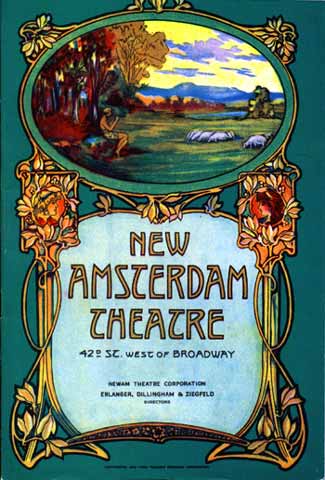 From
1904 through the 1920s, this was the New Amsterdam Theatre's standard program cover.
Acclaimed as Broadway's most sumptuous venue, this house was the pride of
Klaw and Erlanger's theatrical empire. It served as the home for Ziegfeld's Follies
from 1913 through 1927, also housing such Ziegfeld hits as Sally (1920) and
Whoopee (1928).
From
1904 through the 1920s, this was the New Amsterdam Theatre's standard program cover.
Acclaimed as Broadway's most sumptuous venue, this house was the pride of
Klaw and Erlanger's theatrical empire. It served as the home for Ziegfeld's Follies
from 1913 through 1927, also housing such Ziegfeld hits as Sally (1920) and
Whoopee (1928).
1913
Opened: The New Amsterdam Theater, June 16 (96 performances)
Book and lyrics: Gene Buck, George V. Hobart and others
Score: Raymond Hubbell, David Stamper and others
Scenery: Ernest Albert, John Young and others
Staged by: Julian Mitchell
Featuring: Leon Errol, Frank Tinney, Jose Collins and Ann Pennington
Notes: Recognizing Ziegfeld's success, Erlanger housed the seventh
edition of the Follies in his glamorous flagship theatre, The New
Amsterdam, where the series would remain through 1927. Diminutive dancer
Ann Pennington's high kicks and dimpled knees proved a sensation. Eccentric
comic Leon Errol danced a "Turkish Trot," with his pants falling down
in the midst of a massive Julian Mitchell dance ensemble. Women
calling for the right to vote were spoofed in "The Ragtime
Suffragette," and a production number depicted the opening of the Panama
Canal, with the Ziegfeld girls pouring forth as one of the locks opened. The finale was
set in a "Satanic Cabaret."
1914
Opened: The New Amsterdam, June 1 (112 performances)
Book and lyrics: George V. Hobart, Gene Buck and others
Score: Raymond Hubbell, David Stamper and others
Scenery: Ernest Albert and others
Staged by: Leon Errol (replacing Julian Mitchell)
Conducted by: Frank Darling
Featuring: Ed Wynn, Leon Errol, Bert Williams, Annette Kellerman, Vera
Maxwell and Ann Pennington
Notes: After a battle with Ziegfeld, director Julian Mitchell walked out in
the midst of rehearsals. Errol took over – a grateful Ziegfeld reputedly lent a
hand but gave Errol sole program credit. Bert Williams introduced "Darktown
Poker Club," a pantomimed poker game that became a personal trademark. He
also clowned with Leon Errol on top of an unfinished skyscraper. Vaudeville comic
Ed Wynn scored well in his Follies debut,
appearing as "Joe King the Joke King." Several scenes referred to the latest
dance craze, the Tango, including the finale – a lavish "Tangorilla"
dance routine set in the jungles surrounding Ziegfeld's beloved Palm Beach.