
Ziegfeld 101
Anna Held - Part II
by John Kenrick
The photos below are thumbnails – click on them to see full size versions.
Stardom
When Held enjoyed a smashing success in vaudeville in the late 1890s, Ziegfeld realized that his productions had not made the most of her charms. In 1899, after Held had become more confident in her use of English, Ziegfeld was able to construct a show with the blend of glamour, naughtiness and publicity appeal that showed her to best advantage. In Papa's Wife (1899), Held's teasing songs and hourglass figue delighted men, while her dazzling Paris fashions fascinated women. It proved to be Anna's first bona fide hit. Capitalizing on press coverage of Held's being one of the first women to drive her own automobile, she closed the first act by driving off in one.
 Ziegfeld backed
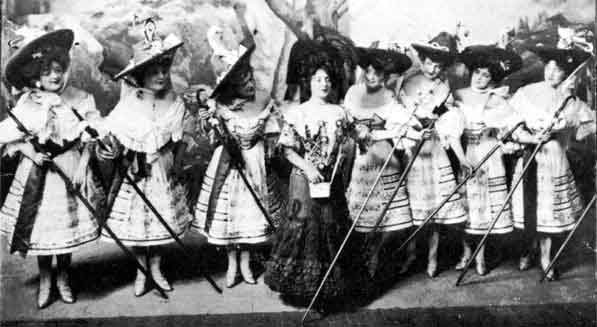
his wife with his first line of showgirls, a troupe of wholesome but attractive chorines
called "The Anna Held Girls" (photo left).
In their next production, he continued to give Anna the most lavish costuming
possible. She and her girls appeared in glamorous gowns provided by famous
Parisian designers. but this did not make up for weaknesses in other departments. The weak
script in Mam'selle Napoleon (1903) moved one critic to write,
"Between gowns, the plot crept in."
Ziegfeld backed
his wife with his first line of showgirls, a troupe of wholesome but attractive chorines
called "The Anna Held Girls" (photo left).
In their next production, he continued to give Anna the most lavish costuming
possible. She and her girls appeared in glamorous gowns provided by famous
Parisian designers. but this did not make up for weaknesses in other departments. The weak
script in Mam'selle Napoleon (1903) moved one critic to write,
"Between gowns, the plot crept in."
Held introduced several hit songs over the years, including her signature song, "I Just Can't Make My Eyes Behave." Its lyric invoked memories of an earlier Held hit –
I just can't make my eyes behave;
Two bad brown eyes,
I am their slave,
My lips may say,
"Run away from me,"
But my eyes say,
"Come and play with me!"
And you won't blame
Poor little me, I'm sure –
For I just can't make my eyes behave.
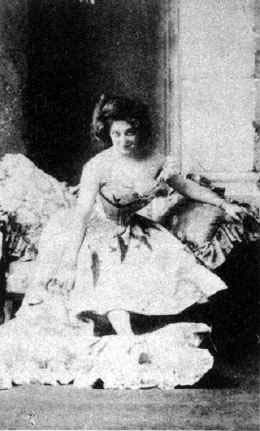 A seductive portrait photo of Anna Held on a
small sofa, inviting viewers to "Come and Play With Me."
A seductive portrait photo of Anna Held on a
small sofa, inviting viewers to "Come and Play With Me."
Held's biggest hit musicals were The Parisian Model (1905) and Miss Innocence (1908). Each ran for a full season on Broadway, followed by years of touring. Aside from earning Ziegfeld a fortune, these shows made Anna Held a millionaire in her own right, something rare for an actress at that era. While both of these musicals seem harmless by modern standards, many critics condemned them as scandalous and obscene. This fuss only made the public more anxious to see what the fuss was about, guaranteeing full houses.
The score to The Parisian Model included "It's Delightful to Be Married," for which Held was credited with the lyrics. This success of this song relied heavily on her accented delivery. As for her lyric, judge it for yourself. How ironic that this song was popularized by a woman who left the raising of her only child to others –
It's delightful to be married.
To be, to be, to be, to be, to be married.
There is nothing half so jolly as
A jolly married life.
And I love to play with baby,
With my pretty little, darling little baby.
You are papa, I am mama,
What a jolly family!
The Parisian Model was also the first production to feature the sort of sexy-but-respectable production numbers that became Ziegfeld's trademark. The song "I'd Like to See a Little More of You" had the female chorus seemingly undress while modeling behind easels in an artist's studio, only to have the girls step forward to reveal they were wearing strapless gowns that tactfully reached down to their knees.
The ever-vigilant Ziegfeld never missed an opportunity to get Held's name in the papers. Her passion for bicycling (rare among women of that time) gave him several excuses for creativity. When Anna took a minor tumble while cycling through Brooklyn, Ziegfeld informed the press that she had leapt off her bike to stop a runaway carriage and save the life of a retired judge. Most of the press didn't buy it, and one columnist asked in print which drugs Ziegfeld was using when he came up with such silliness! During the tour of Miss Innocence, Held made much of her "diamond gown," which she claimed was covered in more than 3,000 diamonds. It is hard to believe that such an extraordinary garment could simply disappear, but its fate is not known.
According to Ziegfeld, it was Held who first suggested that he should stage a Folies Bergere-style revue in New York. His first Follies (1907) featured "The Anna Held Girls" without Anna, who was still touring in Miss Innocence. In fact, her only appearance in the Follies series would be was as a flying comet in a film used in the 1910 edition. But Held had done so much to enrich Ziegfeld's sense of fashion and entertainment that it is fair to say she was part of every Follies
Philandering Flo
 Ziegfeld
used Anna Held's expressive eyes as a powerful publicity ploy. In this poster,
he showcased those eyes in a half-dozen different moods.
Ziegfeld
used Anna Held's expressive eyes as a powerful publicity ploy. In this poster,
he showcased those eyes in a half-dozen different moods.
Ziegfeld and Held had lived together ever since her arrival in America, sharing a thirteen room suite in the elegant Ansonia Hotel on Manhattan's upper West side. Held was an adept homemaker and the couple appeared to share an affectionate relationship. Over time, Ziegfeld's heavy gambling and relentless publicity schemes soured things. When the skeptical press and police concluded that the 1906 "theft" of Held's beloved jewel collection was another headline-grabbing stunt staged by Ziegfeld, Anna realized that her husband was abusing her trust. She started banking her savings in Europe, far from his grasp.
One disturbing tale that has found its way into several biographies involves Ziegfeld forcing Held to abort a pregnancy in 1909. Held's autobiography--which many historians feel was posthumously revised, or perhaps entirely invented, by her embittered daughter Liane--claims that Ziegfeld wanted nothing to delay Anna's starring in Miss Innocence and forced Anna to submit to a dangerous and illegal abortion. Liane's obsessive hatred of her stepfather makes this story questionable. Moreover, Ziegfeld was never known to be physically cruel to any woman, so such an act would be a radical departure from everything we know about him. Since he later embraced the opportunity to become a father, there is ample reason to dismiss this story as a fabrication.
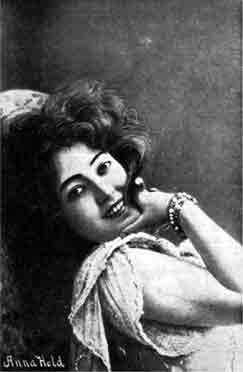 This photo of Held appeared on period
sheet music.
This photo of Held appeared on period
sheet music.
We do know that in 1909 Ziegfeld began a prolonged affair with the gorgeous but volatile showgirl Lilliane Lorraine. Held took the continental approach, looking the other way when her husband indulged in discreet infidelities with chorus girls. But Ziegfeld defied convention and made this affair a matter of public record. He took Lorraine to top restaurants, and even installed her in the Ansonia, just floors away from Anna. He also featured Lorraine in Follies production numbers which made the most of her beauty, doing what he could to distract audiences from Lillian's lack of singing or acting ability.
Soon, all of New York society was talking about the Ziegfeld-Lorraine liason. At one point, Lorraine married somone else to excite Ziegfeld's jealousy, then sat by when her husband publicly trounced Ziegfeld in a restaurant. Incredibly, Ziegfeld's pursuit of Lorraine continued for years. Even to the most open-minded, such public scandal was not socially acceptable. After several attempts at reconciliation, Held filed for divorce in 1912, naming Lorraine as one of several co-respondents. Since Held and Ziegfeld had never legally wed, this filing was little more than an attempt on Held's part to preserve her sense of public dignity.
From this point on, Held dismissed suggestions of a "remarriage" with Ziegfeld, and was quoted as saying "One does not re-light a dead cigarette." However, many believe she still nursed private hopes of a reconciliation when she attended a 1913 New Year's Eve gala at the Astor Hotel. Her hopes rose when an inebriated Lillian Lorraine argued with Ziegfeld and stormed out, but then Anna watched in helpless fury as Ziegfeld spent the rest of the evening courting actress Billie Burke. After choosing to ignore gossip about their romance in the months that followed, Held was supposedly shocked when Ziegfeld married Burke in April of 1914. However, Held did not waste away from heartache. As an international star, she was very much in demand, and remained busy on both sides of the Atlantic.
After Ziegfeld
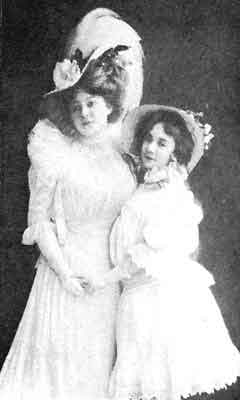 Anna Held and her daughter Liane.
With the world plunging into World War I, Held adjusted to changes in fashion and popular taste, keeping her public persona as irresistible as ever. She enjoyed continued success in vaudeville and became a tireless spokesperson for her beloved France. A series of death-defying visits to the Allied trenches made her a wartime heroine. As the war dragged on in Europe, Held starred in the silent Hollywood comedy Madame la Presidente (1916), then infuriated Ziegfeld by making an acclaimed return to Broadway in a musical produced by his hated rivals, the Shubert Brothers. Follow Me (1916) delighted Held's fans and critics. After a relatively brief two month run on Broadway, she personally took over management of the touring version so she could set aside time to raise funds for various Allied relief charities.
The year-long tour of Follow Me was a financial success, but the once tireless Anna soon complained of strange aches and fatigue. She collapsed on stage in Milwaukee in early 1918 and returned to New York, where she was diagnosed with multiple myeloma, a rare form of bone marrow cancer. After months of horrific pain, Anna Held died in New York's Savoy Hotel on August 12, 1918. She was only in her late 40s. Her $257,000 estate consisted mostly of jewelry, including one necklace valued at $100,000. Ziegfeld's lifelong fear of sickness and death (and no doubt a lingering sense of personal guilt) kept him from visiting Anna's sickroom or attending her funeral. Her remains were buried at Gate of Heaven Cemetery in Westchester.
If Held is remembered today, it is primarily because of Luise Rainer's Academy Award-wining performance as Anna in MGM's The Great Ziegfeld (1936). This moving, sympathetic portrayal provides a fitting tribute to the woman who's "dreamy eyes" and continental charm once captivated audiences on both sides of the Atlantic. As a character, Anna Held was just as crucial to the success of the MGM film as the real Anna was to the success of Florenz Ziegfeld.