
History of the Musical Stage
1879-1890: The First Musical Comedies
by John Kenrick
(Copyright 1996; revised 2020)
(The images below are thumbnails – click on them to see larger versions.)
Harrigan and Hart
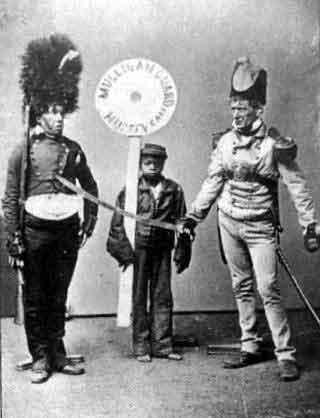 Tony Hart, Ned Harrigan
and an unnamed assistant perform "The Mulligan Guard March.
Tony Hart, Ned Harrigan
and an unnamed assistant perform "The Mulligan Guard March.
Some British sources credit London producer George Edwardes with creating the first musical comedies. He began using this phrase to describe his shows as of 1893, and most of his Gaiety Theater productions were little more than Gilbert and Sullivan-style operettas with chorines in shortened skirts. But someone on the other side of the "pond" beat him to it.
The form we know as musical comedy was actually born on Broadway in a series of shows starring Edward (Ned) Harrigan and Tony Hart. Produced between 1878 and 1884, with book and lyrics by Harrigan and music by his father in law David Braham, these musical comedies featured characters and situations taken from the everyday life of New York's lower classes -- minus any sign of showgirls. With these distinctly American book musicals, Harrigan, Hart and Braham laid a path that Broadway would follow profitably for more than a century to come.
Harrigan started out as a comedian in the variety halls of San Francisco. Hart was a stage-struck reform school escapee with a rare gift for comedy. They met the mid-1870s, and developed a routine that poked fun at New York's neighborhood militias. These local "guard" units were little more than uniformed drinking clubs sponsored by local politicians. Weekend parades usually became so beer-soaked that the stumbling participants looked ridiculous. In their variety act, Harrigan and Hart donned ill-fitting uniforms and staggered through an inept military drill while singing a merry march.
We shouldered arms
And marched
And marched away,
From Baxter Street
We marched to Avenue A.
With drums and fifes
How sweetly they did play
As we marched, marched, marched
In the Mulligan Guards.
Audiences loved the act, and the catchy "Mulligan Guard's March" was soon being sung all around the world. In the novel Kim, Rudyard Kipling notes that it was a favorite with British troops in India who replaced the names of New York streets with various Indian locales.
The Mulligan Shows
When Harrigan and Hart reached New York, their "Mulligan Guard" act was such a sensation that it played the city's top variety theaters for more than a year. In order to capitalize on this acclaim, the team expanded the act into The Mulligan Guard Picnic (1878), a forty minute sketch that drew packed audiences into Broadway's Theatre Comique for a month -- a healthy commercial run for that time. This initiated a seven year series of full length musical farces. The versatile Harrigan performed, produced, and directed while writing the scripts and lyrics. The action was always set in the scruffiest wards of downtown Manhattan, with Harrigan playing politically ambitious Irish saloon owner "Dan Mulligan" and Hart winning praise as various characters, most notably the African American washerwoman "Rebecca Allup."
The Mulligan Guard Ball (1879), Cordelia's Aspirations (1883) and the rest of the series proved extremely popular with New York's immigrant-based lower and middle classes, who loved seeing themselves depicted on stage. Powerful politicians made a point of showing up too, anxious to curry the favor of voters. Harrigan & Hart's plots focused on such real-life problems as interracial tensions, uneasy romances between members of different ethinicities, political corruption and gang violence, but these were always served up with enough clownish humor to keep audiences laughing. Since every class and ethnic group was treated as fair game (and often depicted with surprising sympathy), nobody took offense.
Harrigan's dialogue relied heavily on puns and ethnic dialects to win laughs. In Squatter Sovereignty (1882), an Irish immigrant has the following exchange with his wife when he realizes a fish has been tied to his back as an April Fool's Day prank –
MICHAEL: Be heavens, that's a haddock.
ELLEN: 'Tis, and was hanging to a sucker.
MICHAEL: You're only codding me.
ELLEN: What eels you?
MICHAEL: I've smelt that before.
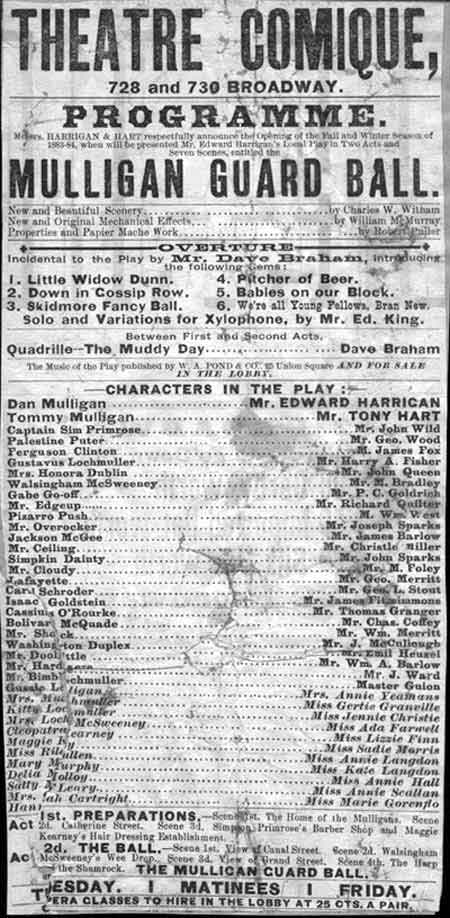 Program for
The Mulligan Guard Ball (1883). I
discovered this tucked between the pages of a tattered Victorian novel -- you never
know what might be hiding at your local flea market.
Program for
The Mulligan Guard Ball (1883). I
discovered this tucked between the pages of a tattered Victorian novel -- you never
know what might be hiding at your local flea market.
Harrigan and Braham's songs were in the popular style of their day, with lots of sentiment mixed with street-smart humor set to simple, catchy melodies. The lyrics were redolent with slang, ethnic accents and imperfect grammar -- speech forms which had not been set to music before. New Yorkers adored these tunes, and every neighborhood in Manhattan rang with renditions of "Paddy Duffy's Cart" or "The Babies on Our Block," which describes some aspects of Irish tenement life –
If you want for information
Or in need of merriment,
Come over with me socially
To Murphy's tenement.
He owns a row of houses
In the first ward, near the dock,
Where Ireland's represented
By the babies on our block.
There's the Phalens and the Whalens
From the sweet Dunochadee,
They are sitting on the railings
With their children on their knee,
All gossiping and talking
With their neighbors in a flock,
Singing "Little Sally Waters"
With the babies on our block.
"Oh, little Sally Waters,
Sitting in the sun,
A-crying and weeping for a young man;
Oh rise, Sally, rise,
Wipe your eye out with your frock";
That's sung by the babies
A-living on our block.
- Lyric transcribed from sheet music
Since these songs were only peripherally connected to the plots of the shows, hits from previous Braham-Harrigan scores could be interpolated when things needed a lift. In particular, Harrigan and Hart often reprised their "Mulligan Guards March," to show-stopping effect.
Over time, Harrigan's habit of hiring relatives alienated Hart, and the team split up in 1885. Hart went off on his own, but the crippling effects of advanced syphilis forced him off the stage the following year, and he died soon afterwards at age 36. Harrigan continued to produce and star in musicals until 1893. George M. Cohan's jaunty song "H-A-double R-I-G-A-N spells Harrigan" was an affectionate tribute to this early giant of the American musical stage.
For more on Harrigan & Hart:
- Kahn, E.J. The Merry Partners: The Age and Stage of Harrigan and Hart. (New York: Random House, 1955)
- Moody, Richard. Ned Harrigan - From Corlear's Hook to Herald Square. (Chicago: Nelson Hall, 1980)
Forgotten Hits
There were other troupes offering musical comedy in the 1870s and 80s. The Salisbury Troubadours brought their touring production of The Brook (1879) to Broadway, where it lasted a then-profitable six weeks. Several sources claim that The Brook contained the first seeds of modern musical comedy, but this is questionable. The plot involved two women and three men who go on a picnic via a short boat ride. Along with food, their picnic baskets produced the costumes and props for specialty numbers, turning the show into a vaudeville-style procession of acts. The songs were recycled from various sources. By the time this mishmash reached New York, Harrigan and Hart were already a going concern.
During the 1880s, Broadway musicals became more numerous and profitable than ever. Aside from the imported works of Gilbert & Sullivan (discussed elsewhere in these essays), most of the hits from this decade are forgotten today. However, at least one American musical from this period remained popular well into the next century.
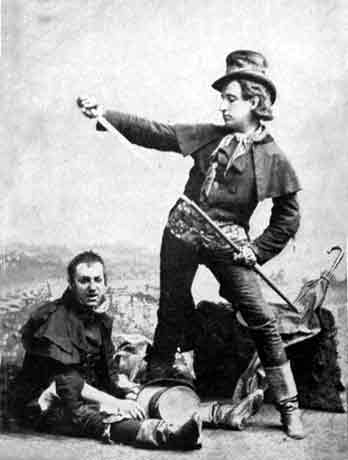 Francis
Wilson (seated) as the cowardly thief Cadeaux, and William S. Daboll as his
daring partner Ravennes are plotting a kidnapping in Erminie (1886).
Francis
Wilson (seated) as the cowardly thief Cadeaux, and William S. Daboll as his
daring partner Ravennes are plotting a kidnapping in Erminie (1886).
Erminie (London 1885, NY 1886) was the tale of two thieves who kidnap a young bride in hopes of a ransom, inadvertently liberating the girl from a marriage she dreads. This lighthearted silliness ran for over 500 performances in London, and was revived so often on Broadway that it racked up more than 1,200 performances there by 1900. As the timorous thief Cadeaux, Francis Wilson achieved lasting stardom. Unlike most of the stage clowns of his time, Wilson did not rely on physical mugging to win laughs --
"Wilson's comedy and farce were rooted in his sense of characterization. He achieved much of the force of his humor by the unerring consistency with which successive bits of business built up a rounded and believable character."
- Cecil Smith, Musical Comedy in America (New York: Theatre Arts Books, 1950), p. 93.
Although the versatile Wilson played many roles over the course of his long stage career, he periodically reappeared in Erminie, starring in a Broadway revival as late as the 1930s. Wilson was so admired by his fellow stage actors that they made him the first president of their union, Actor's Equity.
In the final years of the 19th Century, other writers and performers would bring Broadway's musical comedies a new sense of vitality.