
History of the Musical Stage
The 1890s: Part I
by John Kenrick
(Copyright 1996: revised 2020)
(The images below are thumbnails – click on them to see larger versions.)
Broadway in "The Gay 90s"
 The
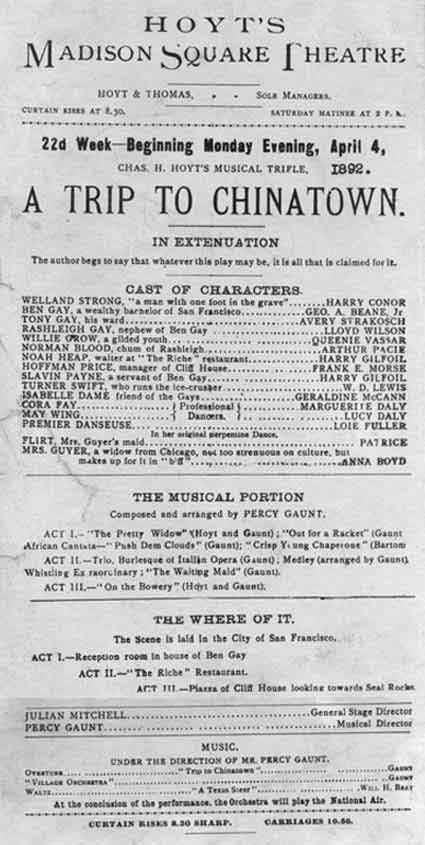
program for A Trip to Chinatown (1891) announces that curtain
time was 8:30 PM, and informs theatergoers that their carriages may pick them up
at 10:50. New York's subway system would not appear until 1904, so those without
carriages had to literally "hoof it" themselves.
The
program for A Trip to Chinatown (1891) announces that curtain
time was 8:30 PM, and informs theatergoers that their carriages may pick them up
at 10:50. New York's subway system would not appear until 1904, so those without
carriages had to literally "hoof it" themselves.
Although none of the Broadway musicals of the 1890s would merit a commercial revival today, this decade was a time of extraordinary theatrical bounty. It was not unusual for fifty or more musical productions to open in a single season. While numerous revivals and European imports were in the mix, many of these shows were homegrown originals, including farcical musical comedies. Following the Harrigan and Hart model, these shows had loose plots involving "ordinary people," offering enough gags and dialogue to get from song to song. Any number of composers might contribute to a single score.
Producer-playwright Charles Hoyt mastered this form, which reached its peak with A Trip To Chinatown (1891 - 657), the story of a widow who accidentally maneuvers several young suburban couples into a big city restaurant where a rich man loses his wallet before true love wins out in the end. (The bare outline of this plot would serve again two generations later in Hello Dolly.) The show was cobbled together, using songs by a multitude of composers.
The producers had the bright idea of inviting New York's top music publishers to contribute songs. Interpolations made during the New York run, the score eventually included the perennial favorites "Reuben, Reuben," "The Bowery," and "After the Ball" none of which had any real connection to the plot. A Trip to Chinatown toured for several years, and its record-setting Broadway run would not be surpassed until the early 1920s. When the landmark hit Show Boat (1927) needed a song to embody the sound of the 1890s, Hammerstein and Kern interpolated "After the Ball."
The Belle of New York (1897) did poorly on Broadway with its tale of a Salvation Army girl who prevents her millionaire boyfriend from being disinherited. But a London production in 1898 proved a surprise sensation, running more a year and receiving nine West End revivals over the next four decades. This was the first American musical to enjoy unqualified success in Britain.
It also made a star out of Edna May, an attractive dark-haired American soprano who played the title role on both sides of the Atlantic. The songs, popular in their day, have not had any lasting fame. However, when most people think of the entertainments of the "Gay 90s," The Belle of New York is the sort of show they picture – lighthearted musical comedy with a touch of innocent romance, all designed to showcase lovely young women in lavish but moderately immodest outfits.
The 1890s brought the first Broadway revue, The Passing Show (1894). This vaudeville-like hodgepodge of songs, sketches and specialty acts drew little attention, and the revue format would not catch on until Florenz Ziegfeld introduced his Follies in 1907. There is far more on this in the pages ahead.
Early Black Musicals
In the years following the Civil War, minstrel shows were the only professional stage outlet open to African American performers, so it is no surprise that the earliest black musicals grew out of the minstrel tradition. The Creole Show (1890) reshaped minstrelsy's all-male tradition by offering a female interlocutor and other women in an all-black cast. With a successful tour and a New York run, this production proved that black musicals had commercial appeal.
John W. Isham, The Creole Show's booking agent, later produced The Octoroons (1895), a touring black musical farce that placed traditional minstrel comedy routines in a continuous plot. The show's racial attitude is reflected in the title of its hit song, "No Coon Can Come Too Black for Me."
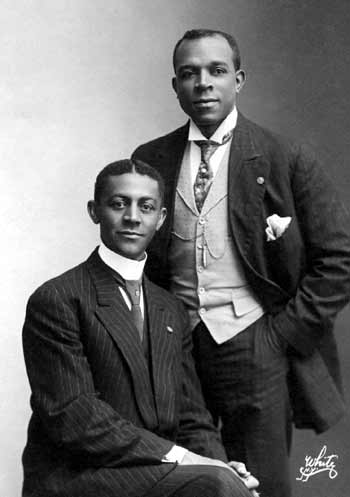 Bob Cole (seated) and J.R. Johnson, two
of the earliest African American songwriters to succeed on Broadway.
Bob Cole (seated) and J.R. Johnson, two
of the earliest African American songwriters to succeed on Broadway.
Popular singer Sisseretta Jones starred in Black Patti's Troubadours (1896), which toured the US for eighteen years and gave many talented black performers their first professional showcase. Black composer/lyricist Bob Cole wrote one-act musicals for the troupe, including "At Jolly Coon-ey Island."
When Cole eventually found it impossible to work with the company's white managers, he established his own all black production company. Cole composed and produced the first full-length New York musical comedy written, directed and performed exclusively by blacks, A Trip to Coontown (1898). Aside from the now-offensive title (which spoofed A Trip to Chinatown), it relied on minstrel stereotypes to tell the story of con artist Jimmy Flimflammer's unsuccessful attempts to steal an old man's pension. With variety acts thrown in to keep things lively, the show had a successful tour and two runs in New York. Cole went on to compose several more black musicals with lyricist J.R. Johnson, including The Red Moon (1909).
While A Trip to Coontown was still running at the Third Avenue Theater, Clorindy, the Origin of the Cakewalk (1898) opened at the Casino Theatre's Roof Garden. This hour long sketch was the first all-black show to play in a prestigious Broadway house, thanks to a daring maneuver by composer Will Marion Cook. He and his company simply walked into the Casino Roof one day and informed the manager that the owner had sent them – an outright lie, but it got them onto the stage. Their unauthorized performance caused such a sensation that producer Edward Rice booked the show for a run.
Clorindy's libretto relied on demeaning minstrel-style comedy, but the innovative ragtime score brought acclaim to Cook, who went on to write musicals for Broadway's first top rank black stars, Bert Williams and George Walker. The history of African American musicals continues in our article on the early 1900s.