
History of The Musical Stage
1920s II: US Operetta & Britain
by John Kenrick
(Copyright 1996; revised 2020)
(The images below are thumbnails – click on them to see larger versions.)
In the 1920s, two European-born composers created lush, melodic operettas that ranked among the most popular Broadway musicals of the decade. Some sources dismiss their work as "corny," but it is impossible to appreciate the popular culture of this period without considering these once-beloved shows. And while London was no longer the center of the commercial theatre, it still turned out its share of memorable new musicals.
Rudolph Friml
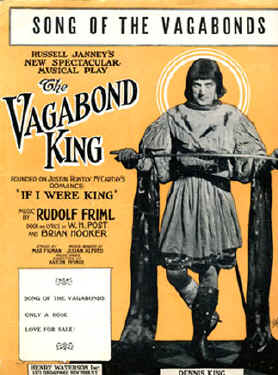 Sheet music
for "Song of the Vagabonds" from Rudolph Friml's long running
operetta The Vagabond King (1925).
Sheet music
for "Song of the Vagabonds" from Rudolph Friml's long running
operetta The Vagabond King (1925).
Beginning in 1912, Czech native Rudolph Friml composed twenty Broadway operettas. His best scores were fresh and inventive enough to make the wildest romantic plots believable, and his rich melodies made many of his songs popular standards. Handsome baritone Dennis King became a top matinee idol starring in three of Friml's biggest 1920s hits –
Rose Marie (1924 - 557 performances) was the story of a girl who must get the Canadian Mounties to clear the name of the man she loves. The score features "The Mounties" and "Indian Love Call" ("When I'm calling you-oo-oo-oo...), which was introduced by King and co-star Mary Ellis.
The Vagabond King (1925 - 511 performances) featured King as Francois Villon, a poetic thief who leads the street people of Paris in the rousing "Song of the Vagabonds," proclaiming allegiance to the besieged Louis XV "and to hell with Burgundy!" King also introduced the ballad "Only a Rose" with co-star Carolyn Thompson.
The Three Musketeers (1928 - 319 performances) brought the classic Dumas novel to musical life with flashing swords and ringing high notes in a lavish Ziegfeld production. King starred as D'Artagnan, singing the "March of the Musketeers."
Friml continued composing into the 1940s, when many dismissed his work as out of date. He accepted the change in popular taste and segued into teaching. But his best songs are still enjoyed by anyone who has a weakness for melody and romance.
Sigmund Romberg
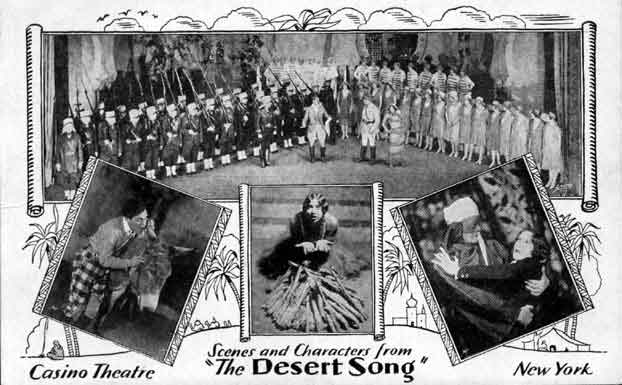 A publicity postcard for
the original Broadway production of Romberg's The Desert Song.
A publicity postcard for
the original Broadway production of Romberg's The Desert Song.
As staff composer for the Shubert Brothers, Hungarian-born Sigmund Romberg contributed to more than fifty Broadway scores, including several Al Jolson vehicles. However, Romberg knew his talents deserved a more ambitious showcase, and on several occasions he argued his way into creating the most successful operettas the Shuberts ever produced –
The Blue Paradise (1915 - 356 performances) was set in a Viennese cafe, where a man learns it is impossible to recapture a long lost love. The sentimental waltz "Auf Wiedersehen" became Romberg's first hit, and made a star of 18 year old soprano Vivienne Segal.
Maytime (1917 - 492 performances) told of two frustrated lovers who's grandchildren wind up falling for each other. With Peggy Wood and Charles Purcell singing "Will You Remember" ("Sweetheart, sweetheart, sweetheart"), it became America's top World War I stage hit. At one point, the Shuberts had two companies of Maytime running simultaneously on Broadway to meet the demand for tickets.
Blossom Time (1921 - 592 performances) was a fictitious love story involving the great composer Franz Schubert. Romberg's score used variations on Schubert's classic melodies. For example, the popular hit "Song of Love" was taken from the first movement of Shubert's Unfinished Symphony.
The Student Prince in Heidelberg (1924 - 608 performances) tells of Prince Karl Franz, who must choose between royal duty and his collegiate love for a tavern waitress. Dorothy Donnelly provided the sophisticated book and lyrics. "Golden Days," "Deep In My Heart Dear," and "Serenade" became hits, and the rousing "Drinking Song" became a particular favorite with Prohibition-era audiences. The bittersweet ending was unusual for its time.
The Shuberts kept these hits touring across the US for decades, bringing them back to Broadway as often as they dared. With recycled sets and costumes, these tours became a running joke to theatre professionals, and gave Romberg's charming scores a seedy reputation they did not deserve. In the mid-1920s, Romberg broke free of the Shuberts, composing two hits that became international favorites.
The Desert Song (1926 - 432 performances) centered on a masked Moroccan freedom fighter called "The Red Shadow," played by Scottish baritone Richard Halliday. He battles the French Foreign Legion while having a Rudolf Valentino-style desert romance with a French beauty played by Vivienne Segal. The score, with lyrics by Oscar Hammerstein II, featured "One Alone" and the popular title song. ("Blue heaven, and you and I, and sand kissing a moonlit sky . . .")
The New Moon (1928 - 509 performances) was the semi-fictional story of Robert Mission (portrayed by Richard Halliday), a French nobleman with pro-revolutionary sentiments in colonial New Orleans. With book and lyrics by Hammerstein, it featured swordfights, a costume ball, tropical moonlight, and the hit songs "Wanting You," "Lover Come Back to Me" and "Stouthearted Men."
Romberg's lush scores exemplify Broadway operetta at its grandest. Although dripping with sentimental romance, these shows provided solid entertainment. While Romberg was sometimes known to borrow a melodic idea (the opening notes of New Moon's "One Kiss" are identical to Vincent Youmans' title tune for "No, No Nanette"), he made improbable plots acceptable thanks to the sheer beauty of his music.
Romberg continued composing for stage and screen. His final hit was Up in Central Park (1945 - 504 performances), a musical comedy about young lovers fighting 1800s corruption in Boss Tweed's New York. Romberg continued writing and conducting popular concerts of his music until his death in 1951.
Britain in the 1920s: Coward & Co.
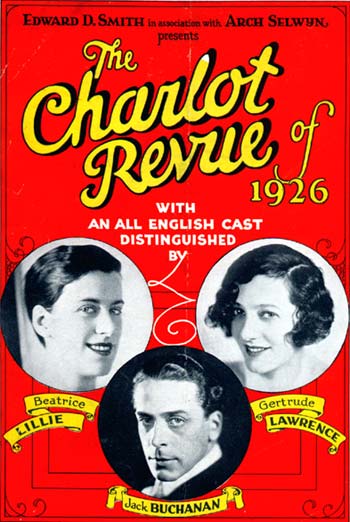 Bea
Lillie, Jack Buchanan and Gertrude Lawrence appear on
a brochure for the Broadway run of The Charlot Revue of 1926.
Bea
Lillie, Jack Buchanan and Gertrude Lawrence appear on
a brochure for the Broadway run of The Charlot Revue of 1926.
Most homegrown Broadway revues of the 1920s were a continuation of the lavish, underdressed "girlie shows" that thrived in the 1910s -- including Flo Ziegfeld's Follies, George White's Scandals, the Shuberts' Passing Shows and Artists and Models, and Earl Carroll's scandalous Vanities. (All these are discussed in a previous chapter.) The possibilities of a more intimate revue were not understood until an acclaimed London production made its way to New York in 1923.
Frenchman Andre Charlot produced a revolutionary series of intimate London revues, achieving such success that he was often referred to as "The British Ziegfeld" -- a title he loathed. Charlot's productions relied on visual elegance, sophisticated wit and top-quality scores. One of his greatest discoveries later explained it this way --
"Charlot's revues were characterized by an exquisite economy, a camaraderie between all the players and the audience such as had not been known in America up to this time. It was not a rough-and-ready intimacy, and never a jocular ad-libbing, but a mental closeness hard to define, and immediate in its appeal."
- Gertrude Lawrence, A Star Danced (New York: Doubleday and Company, 1945), p. 129.
Charlot introduced Beatrice Lillie, Gertrude Lawrence and Jack Buchanan to West End audiences in such revues as London Calling (1923 London). When they all traveled to Broadway in Andre Charlot's Revue (1924 NY - 298 performances), audience demand caught them off guard, and a planned six week run was extended to nine sold-out months. This provided an American springboard for the most important British musical theatre talents of the 1920s.
Among those creating the songs for Charlot's revues was Noel Coward, a British newcomer who's talents as an actor, playwright, composer and lyricist would make him the brightest light in the British theatre. Along with his work on the Charlot revues, Noel co-starred with Bea Lillie in the Broadway staging of This Year of Grace (London 1928 - 316 performances/NYC 158 performances). Produced by London impresario Charles B. Cochran, it included "A Room With a View," "Dance, Little Lady" and "World Weary." It was the first revue with songs and skits exclusively by Coward, who up till then was primarily known as an actor and aspiring playwright.
The "world weary" Coward surprised everyone with his next project, the sentimental operetta Bitter Sweet (London 1929 - 647 performances). The plot concerned a British heiress who gives up wealth and family to marry a poor Viennese composer. After her beloved is killed in a duel, she goes on to operatic fame, and years later encourages a young girl to choose love over everything else. The score included "I'll See You Again" and "If Love Were All," which became two of Coward's greatest hits. The only British book musical imported to Broadway in the 1920s, its opening coincided with a disastrous stock market crash. Despite good reviews, Flo Ziegfeld could not keep it running for more than 159 performances.
Most of the British musical comedies of the 1920s have faded into obscurity. One exception is Mr. Cinders (1929 - 528 performances), a lighthearted reversed gender version of the Cinderella tale. London audiences cheered when Binnie Hale sang "Spread a Little Happiness," which became a popular British anthem of hope during the Depression-racked 1930s. Although this was the greatest hit in the long career of composer Vivian Ellis, it was considered "too British" for American audiences and was never professionally staged in New York.
Even more excitement was being generated on Broadway by a platoon of new songwriters, the most dazzling pool of talent ever to appear in the realm of American popular music.