
History of Musical Film
1927-30: Hollywood Learns To Sing
by John Kenrick
(Copyright 1996; revised 2014)
(The images below are thumbnails – click on them to see larger versions.)
Vitaphone
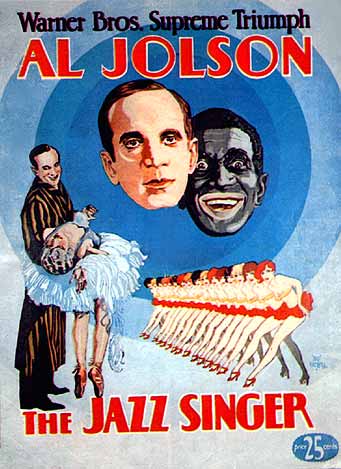 Souvenir program
cover for The Jazz Singer, starring Al Jolson.
Souvenir program
cover for The Jazz Singer, starring Al Jolson.
The late 1920s saw the birth of a new performing art form, musical film. The earliest Hollywood musicals were mostly clumsy, and it would be several years before filmmakers recognized this new genre's unique artistic needs and possibilities, but from the beginning, audiences embraced screen musicals with tremendous enthusiasm.
Technologically primitive "talkies" with synchronized sound were introduced as a vaudeville oddity as early as 1907, but audiences were not impressed. The earliest technology was plagued by tinny sound and weak amplification. Hollywood had built a multi-million dollar industry using a wordless language of image and gesture that the whole world responded to, so few people in the business believed that sound films would ever be more than a minor sideline.
But the technology slowly improved, and Hollywood always had its share of newcomers who were hungry enough to try something new. By the mid-1920s, several studios were experimenting with sound. The Warner Brothers Studio had been around since 1918, but had long been held back by financial problems and an uneven creative reputation. In 1926, Warners took a gamble on Vitaphone, a system which coordinated filmed images with sound recorded on large phonograph disks. Vitaphone's strength was an amplified speaker system that could fill large theatres with relatively clear sound. From the start, the executives at Warners were more interested in music than in audible dialogue. Harry Warner said, "Who the hell wants to hear actors talk? The music – that's the big plus about this."
Don Juan (1926) starring John Barrymore was the first feature film released with a full-length synchronized soundtrack. There was no dialogue, but rather a background score performed by the New York Philharmonic, plus a few selected sound effects. It was shown with several Vitaphone short subjects starring well-known opera and vaudeville stars offering musical specialties. The premiere at Warner's Theatre in New York City on August 6, 1927 drew rave reviews, particularly for Metropolitan Opera tenor Giovanni Martinelli's rendition of Pagliacci's "Vesti la giubba." This Vitaphone program toured other major cities (there were too few technicians to enable a general release). Vitaphone technology was fragile -- the sound disks had to be replaced after every ten uses, and it was easy for the picture and discs to fall hilariously out of synch. But audiences responded to the new technology with awe. The Warner brothers were so impressed that they decided to use prerecorded background scores for all their future feature films, but dialogue was still not in the plan.
The sound fad grew as Fox Studios started using Vitaphone in its popular, including audible appearances by politicians and celebrities. With change knocking at the door, the rest of Hollywood decided to stonewall. In A Song in the Dark: The Birth of the Musical Film (NY: Oxford, 1995), film historian Richard Barrios tells us that most of the major studios (including MGM, Paramount and Universal) met behind closed doors and secretly agreed that "the threat of sound should be officially ignored. abrogated, or at least forestalled as long as possible."
All of the industry's denials and objections would be swept aside by a tidal wave of audience demand -- a wave provoked by a Broadway legend in black face minstrel make-up.
The Jazz Singer
 Warner Brothers' The Jazz Singer (Warner
Bros. - 1927) was the first full-length feature to include recorded song and dialogue.
Original plans were to film it as a silent film with vaudeville comic George Jessel,
who had starred in the 1925 Broadway production. When Jessel demanded a
higher salary for the use of his voice, the studio heads decided that they
would be better off investing in established superstar
Al Jolson. With
"the world's greatest entertainer" heading the cast, Warners also decided
to insert a few songs. What would be the point of paying for Jolson if
audiences couldn't hear him sing?
Warner Brothers' The Jazz Singer (Warner
Bros. - 1927) was the first full-length feature to include recorded song and dialogue.
Original plans were to film it as a silent film with vaudeville comic George Jessel,
who had starred in the 1925 Broadway production. When Jessel demanded a
higher salary for the use of his voice, the studio heads decided that they
would be better off investing in established superstar
Al Jolson. With
"the world's greatest entertainer" heading the cast, Warners also decided
to insert a few songs. What would be the point of paying for Jolson if
audiences couldn't hear him sing?
Viewers today are often surprised to find this landmark film is mostly silent, and mostly slow going. Only Jolson's brief sound sequences vibrate with life. No dialogue had been planned until Jolson began ad-libbing lines in his musical sequences. While filming a nightclub scene, he responded to an audience of applauding extras by shouting his familiar stage motto, "Wait a minute, you ain't heard nothin' yet," then improvised a few sentences of dialogue before breaking into his trademark hit song "Toot Toot Tootsie, Goodbye." The resulting footage was so vivid that more opportunities for "spontaneous" dialogue were added -- most notably when Jolson sang "Blue SKies" to his adoring screen mother. Because Vitaphone recording equipment and technicians were scarce, all of the sound scenes had to be filmed during the last nine days of the film's month long shooting schedule.
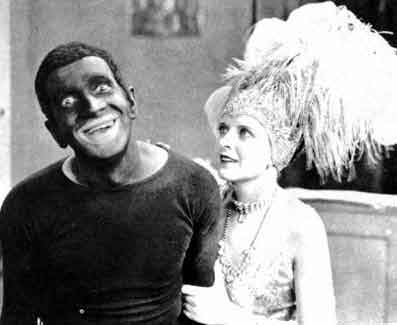
 Sarah
Rabinowitz (actress Eugenie Besserer) kvells as her beloved son Jackie (Al Jolson)
serenades her with Irving Berlin's "Blue Skies" in The Jazz
Singer. Audiences roared for these musical scenes, and movies would
never be the same.
Sarah
Rabinowitz (actress Eugenie Besserer) kvells as her beloved son Jackie (Al Jolson)
serenades her with Irving Berlin's "Blue Skies" in The Jazz
Singer. Audiences roared for these musical scenes, and movies would
never be the same.
The Jazz Singer tells the story of an Orthodox Jewish cantor whose talented son must choose between following his father's musical tradition or pursuing success as a jazz "shouter" on Broadway. In a memorable scene, Jolson chats with his doting mother before treating her to a snappy rendition of "Blue Skies," igniting his father's outrage. Accounts differ on whether Jolson's banter was scripted. Although the piano accompaniment (a studio musician played while Jolson fingered a silent keyboard) was well rehearsed, co-star Eugenie Besserer is so visibly flustered in her responses that it is reasonable to assume that Jolson was not slavishly following a script. Most likely he was engaging in the same kind of improvisation that marked his stage performances.
"You Ain't Heard NOTHIN' Yet"
The Jazz Singer premiered at Warner's Theatre in New York City on Oct. 6, 1927, just one day after the untimely death of co-producer Sam Warner. Audiences showed tremendous enthusiasm, but so few movie theatres were wired for sound that much of America saw it as a silent film, with the neighborhood pianist banging out accompaniment. That did not prevent the film from raking in a major profit. Produced for approximately $422,000, The Jazz Singer grossed $2.6 million. Although not a record-breaking amount, it was extraordinary considering how few theatres were wired for Vitaphone.
Although The Jazz Singer pointed towards serious change, most people in the motion picture business reacted with yet another wave of denial, insisting that the film did nothing more than prove Al Jolson's amazing popularity. Industry publications like Variety downplayed sound film, repeatedly pointing out how only a few dozen theatres were wired for sound, and that these systems were unreliable, and far too expensive for small theatres to install. Most of Hollywood was still insisting that sound film was no more than a fad! But professionals who attended The Jazz Singer's Hollywoo premiere in December 1927 were shaken --
As the film ended and applause grew with the houselights, Sam Goldwyn's wife Frances looked around at the celebrities in the crowd. She saw "terror in all their faces," she said, as if they knew that "the game they had been playing for years was finally over."
- Scott Eyman, The Speed of Sound: Hollywood and the Talkie Revolution (NY: Simon & Schuster, 1997, p. 160).
The Jazz Singer played to packed houses in city after city. As popular demand for more sound films grew, a "fad" became an inevitability.
More Vitaphone shorts and features with musical soundtracks appeared, each new entry stoking the public's appetite. By the time Jolson's next sound vehicle, The Singing Fool (1928), was released, Warners had equipped a nationwide chain of theatres with Vitaphone sound systems. The Singing Fool is a maudlin, partially silent melodrama about a singer who loses the young son he loves. Jolson's tear-stained rendition of "Sonny Boy" packed theatres, and for the first time the commercial impact of sound film became evident. The Singing Fool (which cost a mere $388,000 to make) grossed a whopping $5.6 million worldwide. Warner Brothers used this windfall to move to a larger studio, and solidified its place in the front rank of Hollywood's film factories.
Change was no longer knocking at Hollywood's studio doors -- it was blowing those doors off their hinges.