
History of The Musical Stage
1930s - Part II: Legendary Revues
by John Kenrick
(Copyright 1996, Revised 2020)
(The images below are thumbnails – click on them to see larger versions.)
Hassard Short
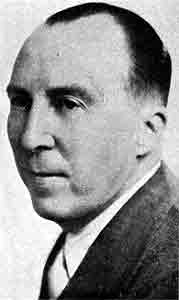 Director
Hassard Short, who brought new style to the Broadway
revues of the 1930s.
Director
Hassard Short, who brought new style to the Broadway
revues of the 1930s.
Revues remained popular in the 1930s, but only after the form underwent radical redefinition. The old "girls and gags" formula lost its appeal. Florenz Ziegfeld had ten composers contribute to a new Follies (1931 - 165 performances), but lukewarm reviews and high production costs made it impossible for the show to turn a profit. George White's Scandals and Earl Carroll's Vanities faded away after unsuccessful editions in the early 1930s. When it came to Broaway revues, bigger was no longer better.
Fewer investment dollars and changing tastes demanded a fresh approach. As the decade rolled by, the more inventive and budget conscious a revue was, the more likely its success -- and the best of them were staged by groundbreaking director and choreographer Hassard Short.
Taking a cue from the London revues of Charlot and Cochran, Short tossed out the overblown sets and curvaceous chorines of the 1920s, relying instead on stronger scores and innovative visual ideas that could please audiences without bankrupting producers. The social and political upheavals of the 1930s offered abundant topical material, and talented writers were looking for work
Three's A Crowd (1930 - 272 performances) had a fine score by lyricist (and MGM publicity director) Howard Dietz and composer Arthur Schwartz. Libby Holman sang "Body and Soul" while Clifton Webb danced. Short kept the production simple and the skits fresh, resulting in a major money maker at the height of the Great Depression. Under Short's direction, this was the first Broadway musical of the 20th Century to eliminate footlights, replacing them with floodlights suspended from the balcony. The practice soon became an industry-wide standard.
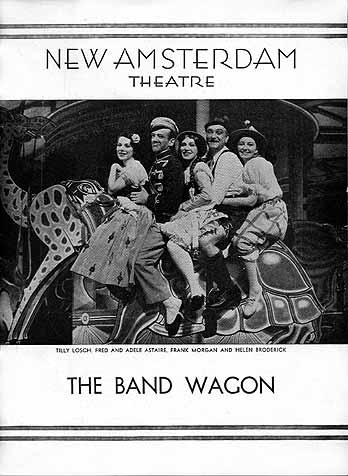 The
stars of The Band Wagon as seen on the original
program cover: Tilly Losch, Fred and Adele Astaire, Frank Morgan and Helen Broderick.
The
stars of The Band Wagon as seen on the original
program cover: Tilly Losch, Fred and Adele Astaire, Frank Morgan and Helen Broderick.
The Band Wagon (1931 - 260 performances) reunited Short, Dietz and Schwartz, with playwright George S. Kaufman providing the skits. This witty revue offered "I Love Louisa," the sensuous "Dancing in the Dark," and Adele and Fred Astaire in their last joint appearance. Short staged the show on a pair of gigantic turntables, making swift scene changes in full view of the audience – the first use of this technology in a Broadway musical. Some critics suggested that no revue could top The Band Wagon, but that challenge wouldn't go unanswered for long.
Producer Sam Harris teamed Hassard Short with composer Irving Berlin and playwright Moss Hart for Face the Music (1932 - 165 performance). It followed The Band Wagon into the same theatre, so Short was able to use the double turntable stage again, to even more dramatic effect. There was a thin excuse for a plot (a corrupt cop pours graft money into a Broadway revue), but the result was more of a revue. Topical humor in the songs and scenes aimed at such diverse targets as high society, show biz tradition, and Albert Einstein. Berlin's "Let's Have Another Cup of Coffee" depicted socialites impoverished by the Depression dining with the poor at the automat. Despite rave reviews and strong ticket sales, Face the Music was forced to close when comedy star Mary Boland headed off to Hollywood.
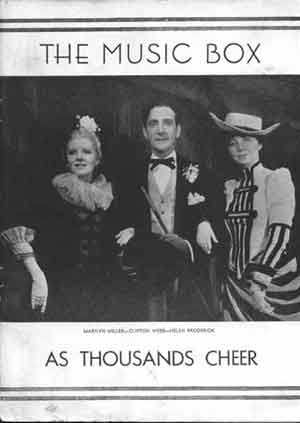 Marilyn
Miller, Clifton Webb and Helen Broderick in As Thousands Cheer,
one of director Hassard Short's sophisticated 1930s revues.
Marilyn
Miller, Clifton Webb and Helen Broderick in As Thousands Cheer,
one of director Hassard Short's sophisticated 1930s revues.
In As Thousands Cheer (1933 - 400 performance), Sam Harris reunited Short, Berlin and Hart to create the most acclaimed Broadway revue of the decade. They used a newspaper format to satirize current events and celebrities. Marilyn Miller (in her last Broadway appearance) dazzled audiences by playing Joan Crawford, heiress Barbara Hutton, a newlywed, and a little girl – among other roles! Berlin's masterful score included "Easter Parade" and "Heat Wave." "Easter Parade," had the chorus dressed in shades of brown and tan, invoking the look of sepia-toned photo magazines (then known as "rotogravures"). "Suppertime," a disturbing ballad inspired by racist lynchings in the Southern US, was sung to shattering effect by African American vocalist Ethel Waters.
The Great Waltz
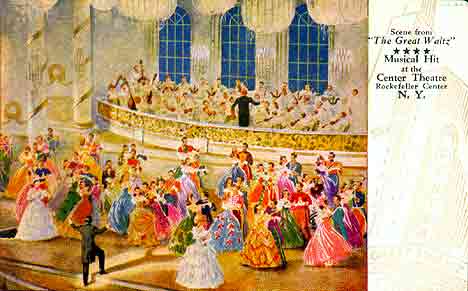 This
postcard depicting the lavish finale of The Great Waltz was
distributed free to audience members. A note on the back reads, "Why not let one of
your friends know how much you enjoyed The Great Waltz? If you address this card
and give it to one of the ushers, we will post it for you."
This
postcard depicting the lavish finale of The Great Waltz was
distributed free to audience members. A note on the back reads, "Why not let one of
your friends know how much you enjoyed The Great Waltz? If you address this card
and give it to one of the ushers, we will post it for you."
Some react to hard times by spending more, a tactic that can have surprising results. When magnate John D. Rockefeller offered to fund a production to fill a theatre in his newly built Rockefeller Center, producer Max Gordon and director Hassard Short abandoned their usual sense of economy and pulled out all the stops for The Great Waltz (1934 - 298 performances). This fictionalized musical biography of Johann Strauss II used some of "The Waltz King's" most popular melodies. With a cast of 180, 500+ costumes and massive sets moved by an innovative hydraulic system, it was the biggest spectacle Broadway had seen in decades. The "Blue Danube" finale brought a 53 piece orchestra up from the depths, eight crystal chandeliers down from above, and the massive ensemble waltzing on in lavish period attire. Most critics dismissed all this spectacle, but ticket buyers packed the 3,000 seat Center Theatre (now the site of a parking garage) for months, making the show a profitable hit.
Most Broadway producers had no Rockefeller to foot their bills, so they had to find an attractive alternative to costly book shows. That is why the 1930s became the golden age for budget-conscious Broadway revues.
Shubert Revues
The Shuberts were accused of many things, but good taste had never been among them. That changed when Lee Shubert took full control of the company in the 1930s. Forcing his contentious brother Jacob to grumble on the sidelines, Lee surprised everyone in the business by producing several high-quality revues.
At Home Abroad (1935 - 198 performances) had Bea Lillie singing about "Paree" and attempting to order "a dozen double damask dinner napkins" -- a hilarious routine she would perform for decades to come. The Schwartz and Dietz score included showpieces for vocalist Ethel Waters and dancer Eleanor Powell.
Soon after Flo Ziegfeld died in 1934, Lee Shubert purchased the rights to his old competitor's name. He then produced two handsome new editions of the Follies built around the stellar comic talents of Fanny Brice. In the Ziegfeld Follies of 1934 (1934 - 182 performances) Brice introduced Baby Snooks, a character she would play on radio for the remainder of her career. For the Ziegfeld Follies of 1936 (1936 - 227 performances), Brice returned with Bob Hope and Eve Arden on hand to spoof movie musicals, lotteries, and more.
The longest running production of the decade was a very different kind of revue -- the only Broadway hit to date that got its start as an amateur show.