
History of The Musical Stage
1930s: Part III - Revues (cont'd)
by John Kenrick
(Copyright 1996; revised 2020)
(The images below are thumbnails – click on them to see larger versions.)
Three of the most successful Broadway revues of the 1930s came from some unexpected sources -- a labor union, a "has been" pair of vaudeville comedians, and London's West End.
Pins and Needles
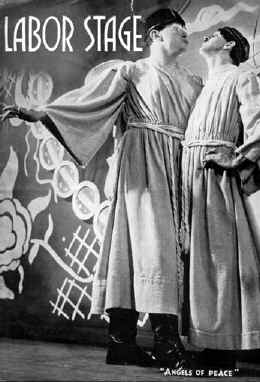 Mussolini (Murray Modick) and Hitler (Berni Gould)
claim to be "Angels of Peace" in the surprise hit revue Pins and Needles.
Mussolini (Murray Modick) and Hitler (Berni Gould)
claim to be "Angels of Peace" in the surprise hit revue Pins and Needles.
The International Ladies Garment Workers Union was using the old Princess Theatre as a headquarters and meeting hall. Several members talked the union into sponsoring an inexpensive revue that had only two pianos in the pit and a cast made up of ILGWU workers. Because of their factory jobs, rehearsals had to be held at night and on weekends, and performances could only be offered on Friday evenings and Saturdays.
The appropriately named Pins and Needles (1937 - 1,108 performances) looked at current events from a pro-union standpoint. Skits by various authors spoofed everything from Fascist European dictators to bigotry in the DAR, and the score by young composer-lyricist Harold Rome included "Sing Me a Song of Social Significance" and "It's Better With a Union Man."
Pins and Needles was fresh, melodic and funny, and word of mouth was so enthusiastic that the production soon expanded to a full performance schedule and even moved to a larger Broadway theatre. Of course, the cast then abandoned their day jobs. As the show ran into the next decade, new songs and skits were introduced every few months to keep things topical. Pins and Needles is the only Broadway hit ever produced by a labor union -- and the only time when a group of unknown non-professionals brought a successful musical to Broadway.
Hellzapoppin'
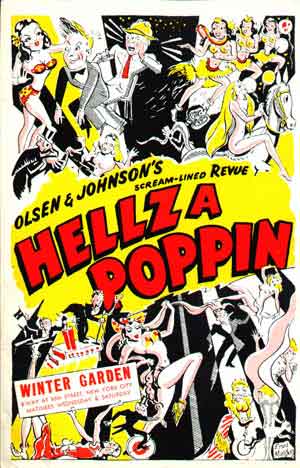 A flyer for the long-running
slapstick revue Hellzapoppin'. The artwork gives some indication of what a crazy
whirlwind of sight-gags this show was.
A flyer for the long-running
slapstick revue Hellzapoppin'. The artwork gives some indication of what a crazy
whirlwind of sight-gags this show was.
The longest-running Broadway production of the 1930s was Hellzapoppin' (1938 - 1,404 performances), a rowdy hodgepodge of skits and routines created by the brash vaudeville comedy team of Ole Olsen and Chic Johnson. They had no previous Broadway hits, and several other attempts by former vaudevillians to create revues had failed. So Olsen and Johnson caught critics and audiences off guard with this insane show. The effect was definitely one of barely controlled insanity. Opening with a mock newsreel in which Hitler spoke with a Yiddish accent, Hellzapoppin' combined zany slapstick stage acts with wild audience participation gags. Midgets, clowns and trained pigeons added a circus touch. New bits were constantly added to freshen the mayhem, delighting return customers.
The score by lyricist Charles Tobias and noted composer Sammy Fain was almost an afterthought – no one was expected to care about songs with titles like "Fuddle Dee Duddle." Hellzapoppin' became the longest running Broadway musical up to that time. Olsen & Johnson staged successful sequels through the next decade, but never matched the phenomenal success of this show.
Noel Coward
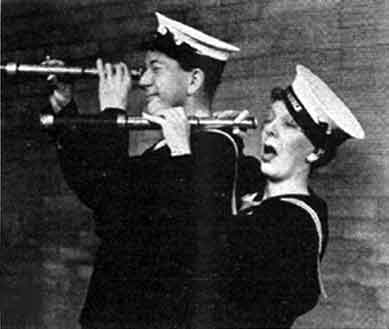 Noel
Coward and Gertrude Lawrence performing the shanty-like "Has Anybody Seen Our
Ship?" in Tonight at 8:30.
Noel
Coward and Gertrude Lawrence performing the shanty-like "Has Anybody Seen Our
Ship?" in Tonight at 8:30.
The 1930s were a lackluster decade for British musical theater, with the glittering exception of one multi-faceted talent – Noel Coward. His songs and plays made him the only Englishman to conquer both London and Broadway during this period. His transcontinental stage hits in this decade included three New York revues –
The Third Little Show (1931 - 136 performances) featured Coward's "Mad Dogs and Englishmen," a showstopper for Coward's longtime friend and sometime nemesis Bea Lillie.
Tonight at 8:30 (1936 - 118 performances) featured Coward and Gertrude Lawrence in a series of nine one-acts – including the musical The Red Peppers, in which they played an argumentative music hall husband-wife team.
Set to Music (1939 - 129 performances) featured Bea Lillie singing Coward's hilarious "I've Been to A Maaaaarvelous Party."
Coward was at his creative peak in this decade, turning out a steady stream of hit songs, revues, comedies and dramas. Coward made memorable appearances on Broadway in two of his finest comedies, Private Lives (1930) and the ing Design For Living (1933). His London stage spectacle Cavalcade (1931) was considered "too British" for a Broadway production, but a lavish Hollywood screen adaptation won the Academy Award for Best Picture in 1933. Combining a stinging condemnation of war with fervent British patriotism, it included Coward's "Twentieth Century Blues." (You can find more info on "The Master" in Coward 101.)
The 1930s saw the Broadway revue reach new heights of creativity and popularity. But network radio began offering all-star variety entertainment seven nights a week at no charge. As a result, the number of Broadway revues faded dwindled in the 1940s, and eventually moved to the less expensive realm of Off-Broadway. From the 1950s onward, revues thrived on network television, where such luminaries as Sid Caesar and Carol Burnett would carry on the entertainment traditions initiated by Flo Ziegfeld, George White and Hassard Short.