
History of The Musical Stage
1940s Part II: "Oklahoma, OK!"
by John Kenrick
(Copyright 1996; revised 2014)
- The Writing
- The Production
- Out of Town
- Opening Night
- What Changed?
- Cast Recordings
- Larry Hart's Finale
(The images below are thumbnails; click on them to see larger versions.)
The Writing
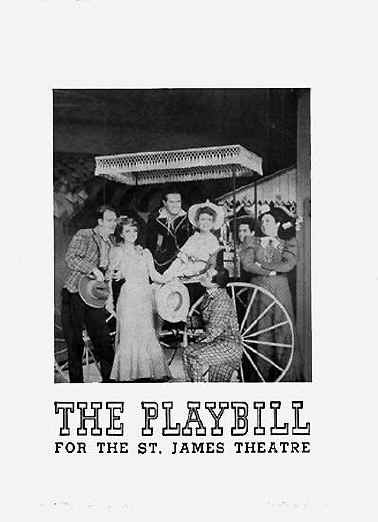 Alfred Drake and Joan Roberts
(in the surrey with a fringe on top) surrounded by other members of the
original cast on the Playbill for Oklahoma!
Alfred Drake and Joan Roberts
(in the surrey with a fringe on top) surrounded by other members of the
original cast on the Playbill for Oklahoma!
Richard Rodgers and Oscar Hammerstein II had known each other since they worked on varsity shows at Columbia University. Since then, both had deferred to songwriting collaborators who preferred to have the music written before the lyric -- an understandable practice when trying to write hit songs. The new collaborators set out to prove that a "lyrics first" approach would make it easier to integrate songs into a libretto. British giants Gilbert and Sullivan had done this long before, but in the 1940s it was considered a daring idea for Broadway songwriters.
Rodgers and Hammerstein felt that the unsuccessful play Green Grow the Lilacs needed something other than the standard musical comedy treatment. The plot involved an Oklahoma Territory farm girl of the early 1900s (Laurie) deciding whether she will go to a dance with the farmhand she fears (Jeeter in the play; Judd in the musical) or the cowboy she loves (Curly). This story takes a jarring turn when the farmhand proves to be a psychopathic murderer who the heroic cowboy is forced to kill in self defense. Murder in a musical? Another sticking point was that Hollywood had turned singing cowboys into a cliché. Could this story sing on Broadway?
The new collaborators began with a painstaking assessment of what made the characters tick, where songs would fit and what the style and content of each number should be. They also visualized possibilities for casting, set design, lighting and staging. Once they had agreed on these points, each headed home -- Rodgers to his farm in upstate New York, Hammerstein to his farm in Pennsylvania. Oscar fashioned the book and lyrics with great care, laboring for weeks over certain phrases and rhymes. He then either telegraphed or phoned in the results to Rodgers, who had been mulling over melodic options and would sometimes have a completed tune on paper in a matter of minutes.
The Production
Because the Theatre Guild was bankrupt, its mangers gave Rodgers and Hammerstein extraordinary creative control over the project. With little to lose, R&H took several artistic risks. Instead of opening with the usual ensemble number, the curtain would rise on a farm woman churning butter as a cowboy enters singing a solo about the beauty of the morning. Hammerstein's lyrics were in a conversational style, each custom designed to fit specific characters and situations.
Despite strong comic material ("I Cain t Say No") and a healthy dose of romance ("People Will Say We re In Love," "Out of My Dreams") this show was neither a typical musical comedy nor an operetta. This was something new, a fully rounded musical play, with every element dedicated to organically moving the story forward. Hammerstein had tried something similar in Show Boat (1927), but many of the characters in that libretto were two dimensional and the plot relied on melodramatic devices. This time around, he was taking things much farther.
Hoping to boost ticket sales, the Guild wanted a well-known star like Shirley Temple, but R&H insisted on casting lesser-known actors suited to the material. To direct, R&H chose the tempestuous Rouben Mamoulian, whose work on stage (Porgy and Bess) and screen (Love Me Tonight) was always innovative but not always profitable. Since the characters in this story would be dealing with emotions that might sound awkward if verbalized by cowboys and farm girls, Rodgers and Hammerstein decided to use dance as an integral element in the story-telling process. The Theatre Guild suggested modern dance choreographer Agnes DeMille. R&H were uneasy about DeMille's insistence on selecting trained modern dancers in place of the standard chorus kids, but the resulting personality-rich ensemble was a key factor in the show's eventual fate.
All these high-minded choices made Away We Go (as the musical was initially named) a tough sell to investors. Despite their distinguished resumes, Rodgers and Hammerstein had to spend months auditioning the material for potential backers, and the Theatre Guild had to sell off its beloved theater to satisfy anxious debtors.
Out of Town: "No Chance!"
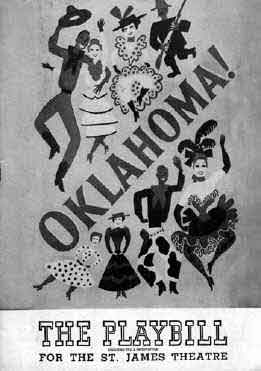 One
of several Playbill covers that Oklahoma! used in
the course of its record setting run -- this one features the original logo.
One
of several Playbill covers that Oklahoma! used in
the course of its record setting run -- this one features the original logo.
When Away We Go opened for previews in New Haven in March 1943, Variety gave it a poor review and columnist Walter Winchell reported his secretary's cold dismissal (which would eventually be attributed to at least a dozen other sources) – "No gags, no girls, no chance."
A few investors panicked and sold off their shares in the show, but many at that first performance realized that this unusual musical had potential. R&H made extensive revisions while the show played Boston. At the suggestion of an ensemble member, a duet was re-set as a choral piece. When DeMille staged the revised song with the chorus coming down to the footlights in a V formation singing "O-K-L-A-H-O-M-A, Oklahoma! Yeeeow!," the rousing number left audiences cheering and gave the show a new title. The creative team continued tinkering until one night an exhausted Rodgers put his foot down, saying, "You know what's wrong with this show? Nothing! Now everybody pipe down and let's go to bed."
Opening Night
Oklahoma! (1943 - 2,212 performances) opened at New York's St. James Theatre on the night of March 31st, 1943. The house was not sold out – with no known stars in the cast, it was difficult to even give seats away. Those who did attend found themselves cheering a surprise hit.
"They were roaring. They were howling. People hadn't seen boys and girls dance like this in so long. Of course, they had been dancing like this, but just not where the audience could see them!"
-Agnes DeMille, quoted by Max Wilk in OK: The Story of Oklahoma! (New York: Grove Press, 1993), p. 222.
As the brash but loveable Curly, baritone Alfred Drake began his reign as Broadway's top male musical star – and as the playful Ado Annie, Celeste Holm earned the stardom she would retain on stage and screen into the next century. The reviews were almost unanimous raves, and block-long lines formed at the box office the next morning.
Wartime audiences embraced this reassuring, all-American show, and the skeptics who had scoffed in New Haven pretended that they always knew "Dick and Oscar" were a sure-fire combination. Oklahoma became a cultural phenomenon, setting a new long-run record for Broadway musicals. It also ran for three years in London, toured the U.S. for seven years and made millions of dollars. By the time the original run ended, backers saw an astounding 2,500% return on their investment.
What Changed?
Before Oklahoma, Broadway composers and lyricists were songwriters – after Oklahoma, they had to be dramatists, using everything in the score to develop character and advance the action. As Mark Steyn explains in Broadway Babies Say Goodnight (Routledge, NY, 1999, p.67), with earlier songs by Lorenz Hart or Cole Porter, you hear the lyricist – with Hammerstein, you hear the characters.
In fact, everything in a musical now had to serve a dramatic purpose. The diverting dance routines of the past were replaced by choreography that helped tell the show's story. Any number of earlier shows had attempted a book-driven approach, but they showcased particular performers in songs and scenes that did not always serve the story. For example, the original Show Boat gave Captain Andy several excuses for irrelevant physical clowning, and Lady in the Dark gave both Danny Kaye and Gertrude Lawrence star turns that had nothing to do with the plot. Oklahoma rejected such high jinks, tossing out anything which did not fit the plot or bring characters into sharper focus.
"The union of two sympathetic temperaments created the first all-American, non-Broadway musical comedy (or operetta; call it what you will) independent of Viennese comic opera or French op ra-bouffe on the one hand, and Forty-fourth Street clich s and specifications on the other. Oklahoma! turned out to be a people's opera, unpretentious and perfectly modern, but of interest equally to audiences in New York and Des Moines. Its longevity and sustained popular appeal are explained by the fact that it transcends the outlook of Broadway musical comedy without disturbingly violating the canons of presentation to which the musical comedy public is conditioned."
- Cecil Smith, Musical Comedy in America (New York: Theatre Arts Books, 1950), p. 343-344.
Old-style formula musical comedies like No, No, Nanette and Anything Goes can be very entertaining, but their characters are little more than comic book figures, eliciting little sympathy. When Oklahoma's Laurie and Curly admit their love by singing "Let People Say We're In Love," audiences become a sea of smiles and moist eyes. This same holds true for the other classic musicals by R&H and their successors – the major characters are believable individuals that we can empathize with. Rodgers and Hammerstein often dealt with serious themes, but they understood that the first duty of theatre (musical or otherwise) is to tell interesting stories about fascinating characters.
While Rodgers and Hammerstein were not saints, they had genuine faith in the qualities espoused in their shows – goodness, fairness, romance, etc. Now dismissed as cornball or "hokey," such things meant a great deal in the mid-20th Century, and they keep the works of Rodgers and Hammerstein popular today. Rodgers had his own view, as expressed in his autobiography –
". . . I feel that the chief influence of Oklahoma! was simply to serve notice that when writers came up with something different, and if it had merit, there would be a large and receptive audience waiting for it. Librettists, lyricists and composers now had a new incentive to explore a multitude of themes and techniques within the framework of commercial musical theater. From Oklahoma! on, with only rare exceptions, the memorable productions have been those daring to break free of the conventional mold."
- Richard Rodgers, Musical Stages (NY: Random House, 1975), p. 229.
Cast Recordings
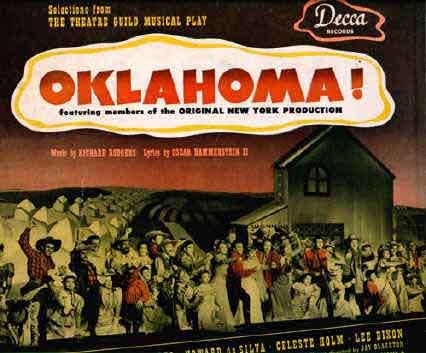 The original cast sings the rousing "Oklahoma!" – as seen
on the cover of the original cast recording, released on an album of 78 rpm records.
The original cast sings the rousing "Oklahoma!" – as seen
on the cover of the original cast recording, released on an album of 78 rpm records.
Record producer Jack Kapp came up with the idea of having the Broadway team preserve the full score as it was heard in performance. A few productions had released partial recordings beginning with the 1932 revival of Show Boat, but Oklahoma was the first Broadway musical to have every major number recorded by the original cast and orchestra, with the same orchestrations used in the theatre.
In 1943, sets of 78's were packaged in hefty book-like packs that looked like family photo albums. Even when long playing records were introduced in the late 1940s, the phrase "album" stuck. So the musical theatre and those who love it owe Kapp a debt of gratitude for inventing the original cast album, a format that preserved hundreds of musical scores which might otherwise have fallen silent with their final performances.
Larry Hart's Finale
In one of Broadway's sadder footnotes, Larry Hart was in the audience for Oklahoma's opening night, sober and stunned by its triumph. He soon agreed to help Rodgers prepare a revival of A Connecticut Yankee (1943 - 135 performances), revising the script and giving longtime friend Vivienne Segal the new comic showstopper "To Keep My Love Alive."
But once the writing was done, Hart began binge drinking again, and he showed up for Yankee's Broadway opening falling-down drunk. During the second act, he started singing along loudly from the rear of the theatre and was ejected. After spending the night on his brother's sofa, Larry disappeared, and was found days later sitting coatless on a Manhattan curbside in an icy November downpour. Weakened by years of alcohol addiction, Hart succumbed to pneumonia and died three days later during a wartime blackout. He was 48 years old.
The musical comedy had been a prime Broadway product since the late 1800s. Rodgers & Hart had created some of the finest expressions of that genre. In the wake of artistic upheaval unleashed by Oklahoma, the Broadway musical entered a new golden commercial and artistic age -- with Rodgers and Hammerstein serving as the first true masters of the new integrated musical play.