
History of The Musical Stage
1940s Part III: After Oklahoma
by John Kenrick
(Copyright 1996; revised 2014)
(The images below are thumbnails – click on them to see larger versions.)
"Many a New Day"
The day after Oklahoma! opened, no one realized that a new age had dawned on Broadway. But it soon became apparent that standards had changed, and that the slap-dash musical comedies of the past were no longer acceptable.
This new standard challenged everyone in the business, including Rodgers and Hammerstein themselves. Film producer Sam Goldwyn bumped into Richard Rodgers soon after the opening of Oklahoma! and said, "Know what you should do now? Shoot yourself!" Few could hope to follow up such a massive hit with similar successes. However, R&H remained the most important team in musical theatre for years to come by writing shows that kept re-defining the genre.
After Oklahoma opened, the two men worked apart for a short time. While Rodgers worked on the wartime revival of A Connecticut Yankee, Hammerstein concentrated on updating the libretto of Bizet's opera Carmen while leaving the music in its original form. The classic tale of a fiery factory girl who inspires a naive soldier to give up everything for the sake of their passion was reset in the American South with an African-American cast. Hammerstein's Carmen Jones (1943 - 502 performances) became the longest running black production of the 1940s.
 Rodgers and Hammerstein re-united to
create Carousel (1945 - 890
performances), the story of Billy
Bigelow and Julie Jordan, young New Englanders who fall into a passionate but abusive
marriage. When Julie becomes pregnant, Billy tries to provide for his unborn child by
taking part in a robbery – and dies by falling on his own knife. Years later, Billy's
ghost
returns from heaven for one day to help his wife and daughter get on with their lives.
This often dark story was matched to a glorious score ("If I Loved You,"
"You’ll Never Walk Alone"), luminous choreography by
Agnes DeMille, and a remarkable cast of
newcomers led by John Raitt and
Jan Clayton. Although Carousel never
matched the amazing popularity of Oklahoma, it has always enjoyed a devoted
following.
Rodgers and Hammerstein re-united to
create Carousel (1945 - 890
performances), the story of Billy
Bigelow and Julie Jordan, young New Englanders who fall into a passionate but abusive
marriage. When Julie becomes pregnant, Billy tries to provide for his unborn child by
taking part in a robbery – and dies by falling on his own knife. Years later, Billy's
ghost
returns from heaven for one day to help his wife and daughter get on with their lives.
This often dark story was matched to a glorious score ("If I Loved You,"
"You’ll Never Walk Alone"), luminous choreography by
Agnes DeMille, and a remarkable cast of
newcomers led by John Raitt and
Jan Clayton. Although Carousel never
matched the amazing popularity of Oklahoma, it has always enjoyed a devoted
following.
Next came Allegro (1947 - 315 performances), the story of a small town doctor who loses his ideals and is almost destroyed by ambition, took new artistic risks. The ensemble commented on the action, and the score was so thoroughly integrated with the book that it was hard to define individual songs. One exception was the showstopper "The Gentleman Is A Dope," sung by Lisa Kirk. Because everything in Allegro examined the idea of success, some scholars consider this the first concept musical, a form that did not come into its own until the 1970s. In 1947, critics and audiences were bewildered by this ambitious experiment, and the show was only a marginal success. A somewhat preachy condemnation of success written by the most successful songwriters on the day came across as less than sincere. Time and several attempts at revival have only confirmed that this show is one of this team's least effective efforts.
Early Innovators
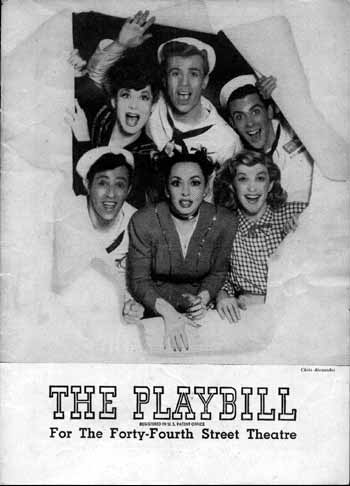 The original cast of
On the Town. On the left are Betty
Comden and Adolph Green, who also wrote the book and lyrics. In the lower left
corner is Nancy Walker, the original Hildy.
The original cast of
On the Town. On the left are Betty
Comden and Adolph Green, who also wrote the book and lyrics. In the lower left
corner is Nancy Walker, the original Hildy.
Others soon tried to follow in Rodgers and Hammerstein's footsteps. Building musical comedies with some serious undertones, adding sophisticated dance and integrating every element into the storytelling process – how hard could it be? As it turned out, it could be damned hard. The earliest competing musicals were fascinating, but have not enjoyed the lasting popularity that marks the best R&H shows –
- On The Town (1944 - 463 performances) used
modern dance and song to depict the romantic adventures of three
sailors on shore leave in New York. It was created by a team of
remarkable newcomers: score by
Leonard Bernstein, book and
lyrics by Betty Comden and
Adolph Green and choreography
by Jerome Robbins. The show and
its much-revised MGM film version did well, but the material soon
seemed dated. Several attempts to revive it have failed. (More on this
show in an upcoming chapter.
- One militantly old-fashioned romantic operetta delighted
audiences and ran for more than two years.
The Song of Norway (1944 - 860 performances) used the melodies of Norwegian
composer Edvard Grieg, adapted by MGM songwriters Robert Wright and
George Forrest and staged by George Balanchine. The hit of the score
was the lush ballad "Strange Music." Occasionally performed by opera
companies, it has not been revived on Broadway.
- Bloomer Girl (1944 - 654 performances) offered a charming
Civil War love story with a score by
Harold Arlen and
E.Y. "Yip" Harburg, a stellar
performance by Oklahoma alumni Celeste
Holm, and dances by Agnes DeMille.
But the uneven book has not stood the test
of time, and has never been revived on Broadway. In fact, Bloomer
Girl is now rarely performed anywhere.
- Operetta master Sigmund Romberg had a surprise hit with Up In Central Park (1945 - 504 performances), a deft blend of romantic music and a new-style musical book about finding love in Boss Tweed’s politically corrupt New York. Audiences loved the period charm and sets based on Currier and Ives prints, and the hit ballad "Close as Pages In a Book." After a film version starring Deanna Durbin which used little of the score, this show passed into disuse. It has not been professionally staged in decades.
Why did all of these works soon fade into obscurity? It was not because of what they had, but what they lacked. Rodgers and Hammerstein had achieved complete integration -- no extraneous comic songs or dances. It took time for this approach to be fully understood. Two experienced songwriters were among the first to catch on, creating hits that would last as long as the best R&H hits..
Learning New Tricks: Berlin & Porter
When Jerome Kern died suddenly in 1945, librettists Herb and Dorothy Fields needed a new composer for a musical about famed sharpshooter Annie Oakley. Rodgers and Hammerstein were already producing the project and swamped with other commitments, so they turned to friend and colleague Irving Berlin.
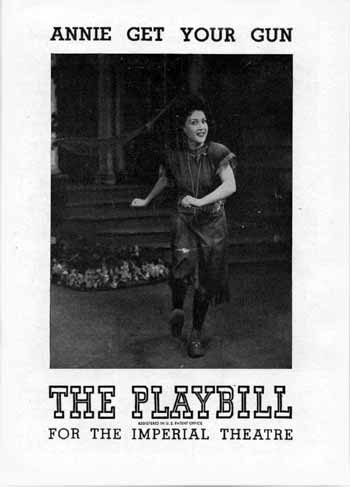 Berlin was uncertain that he could adapt to the new style of
fully integrated musical play. Handed the libretto on a Friday, he showed up the following
Monday with "Doin’ What Comes Naturally," "You Can’t Get A Man With
A Gun" and "There’s No Business Like Show Business" -- great songs that
were firmly rooted in character & the plot. Annie Get Your Gun (1946 - 1,147
performances)
became Berlin’s and leading lady Ethel Merman’s
longest running hit, and it remains a perennial favorite.
Berlin was uncertain that he could adapt to the new style of
fully integrated musical play. Handed the libretto on a Friday, he showed up the following
Monday with "Doin’ What Comes Naturally," "You Can’t Get A Man With
A Gun" and "There’s No Business Like Show Business" -- great songs that
were firmly rooted in character & the plot. Annie Get Your Gun (1946 - 1,147
performances)
became Berlin’s and leading lady Ethel Merman’s
longest running hit, and it remains a perennial favorite.
If Berlin was uncertain about writing the R&H type of musical, Cole Porter was almost petrified at the prospect. By 1948, this once invincible master of musical comedy had gone several seasons without a hit and was being written off as a has-been. When offered Bella and Sam Spewack's libretto about an estranged couple battling on and offstage while starring in a musical version of Shakespeare’s Taming of the Shrew, Porter responded by turning out the finest score of his career. In fact, the show was so well written that it needed no major revisions during its tryout tour. The young producers were on such a limited budget that many of the costumes were made from inexpensive drapery fabric, but Lemuel Ayers's designs were so imaginative that no one noticed.
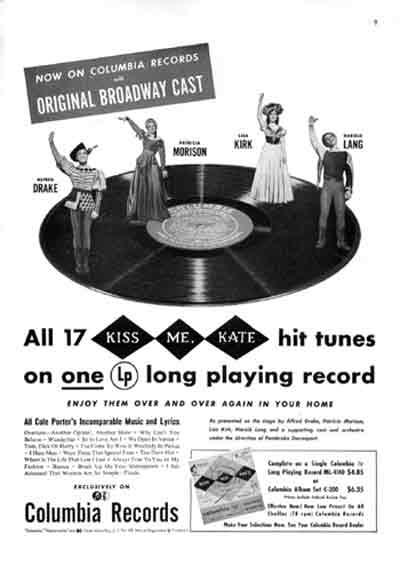 An
ad for the original cast recording of Kiss Me Kate,
one of the first to come out on the long-playing record (LP) format.
An
ad for the original cast recording of Kiss Me Kate,
one of the first to come out on the long-playing record (LP) format.
Kiss Me Kate's (1948 - 1,077 performances) opening night audience filled The Century Theater with cheers. Alfred Drake and Patricia Morison starred as the battling lovers with Lisa Kirk and Harold Lang as the misbehaving ingénues. The libretto and lyrics kept the original spirit of Shakespeare intact, but added a healthy dose of sophisticated contemporary hilarity. Porter's score included "Wunderbar," "So In Love With You Am I," and the bawdy "Brush Up Your Shakespeare." Kate received the first Antoinette Perry (Tony) Award for Best Musical. To everyone's delight (especially his own), Porter was once again "the top" in musical comedy.
At about this time, some new talents came to the forefront, and Rodgers and Hammerstein were poised to close the decade with another massive hit . .