
History of Musical Film
Screen 1940's I:
Warners, Goldwyn & Paramount
by John Kenrick
(Copyright 1996; revised 2020)
(The images below are thumbnails – click on them to see larger versions.)
WWII: Yankee Doodle Dandy
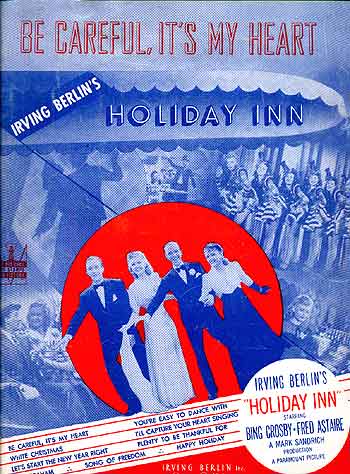 The
original sheet music cover for Irving Berlin's "Be Careful,
It's My Heart," introduced by Bing Crosby in Holiday Inn (1942).
The
original sheet music cover for Irving Berlin's "Be Careful,
It's My Heart," introduced by Bing Crosby in Holiday Inn (1942).
Throughout the 1940s, America was either preparing for, fighting in or helping the world recover from World War II. Since movie goers needed breaks from often nightmarish realities, humor and unquestioning praise for "American values" were Hollywood's cinematic order of the day.
Several major stars (Clark Gable, Jimmy Stewart, etc.) served in battle, and many others pitched in by providing entertainment. Almost every screen star toured military camps and sold war bonds. At the same time, Hollywood's musicals, sometimes patriotic, sometimes nostalgic (often both), provided a much needed morale boost before, during and after the war.
The songs were key attractions. In the 1940s, film songs frequently topped the pop charts. The most popular songwriters of the era all wrote for Hollywood, including Kern, Berlin, Porter, Fields, Warren, Rodgers and Hammerstein. So it is no surprise that many of the biggest hit songs of the World War II era ("White Christmas," "You'll Never Know," etc.) were introduced on screen.
As in the 1930s, each major studio had its own approach to churning out hits, what some scholars refer to as a "house style."
Warner Brothers
After the departure of Busby Berkeley, Warner Bros. had no director specializing in musicals. Occasionally, the studio dipped into its talent pool to produce musicals, most notably several biographies using existing songs.
The best, and arguably the most entertaining musical film bio of all time, was Yankee Doodle Dandy (1942), which soared thanks to James Cagney's Oscar-winning performance as Broadway legend George M. Cohan. Top-rank director Michael Curtiz gave the film exceptional overall polish. This flag-waving film sanitized any controversial aspects of Cohan's life, providing a first rate morale booster for a nation at war. Thanks to frequent broadcasts on television, this film has reintroduced several generations to Cohan's most memorable songs, and kept alive a great name that might have otherwise faded into obscurity. There were many patriotic screen musicals during World War II, but none matched this one's lasting appeal, even though it was filmed in budget-conscious black and white.
Warners and director Curtiz had less success with Night and Day (1946), its Technicolor musical bio of composer Cole Porter. Even the suave Cary Grant is unable to find much humor in the lifeless screenplay, but the real embarrassment is the equally lifeless performances of Porter's great songs. The only moment of real magic comes when Mary Martin recreates her star-making performance of "My Heart Belongs to Daddy." Otherwise, this film makes for dull, factually fatuous viewing. Sadly, Hollywood would do an even worse job with its next Porter bio, De-Lovely (2004).
In the late 1940s, Warners began a profitable series of musicals starring Doris Day, a band singer who proved to be a fine actress with an appealing screen presence. Her most memorable musicals would come in the next decade.
Goldwyn: Danny Kaye
When his 1930s star Eddie Cantor eased away from film projects, independent producer Sam Goldwyn went in search of new musical comedy talent. He found Danny Kaye, whose zany comedy had won praise in the Broadway hits Lady in the Dark (1940) and Let's Face It (1940). Goldwyn featured the slim, nimble Brooklyn comic in a series of hilarious screen musicals, including Up in Arms (1944), Wonder Man (1945), The Kid From Brooklyn (1946) and The Secret Life of Walter Mitty (1947).
Although Kaye could be difficult to work with, he had a good professional relationship with the equally difficult Goldwyn. Kaye went on to other studios after 1947, but re-teamed with Goldwyn for Hans Christian Andersen (1952). With a delightful score by Frank Loesser ("Anywhere I Wander," "The Ugly Duckling," "Thumbelina"), it remains a perennial favorite on TV and home video more than half a century later.
Paramount: Bing Crosby
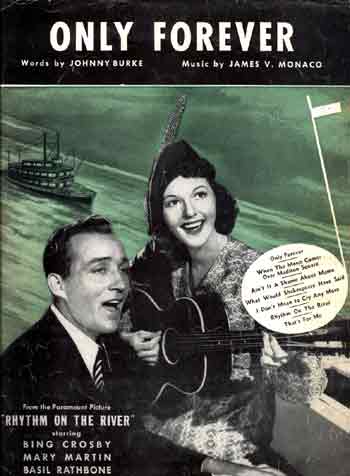 Rhythm on the River
(1940) was no classic, but it offered innocent fun with Bing Crosby and Broadway favorite Mary Martin as
struggling songwriters.
Rhythm on the River
(1940) was no classic, but it offered innocent fun with Bing Crosby and Broadway favorite Mary Martin as
struggling songwriters.
Bing Crosby remained America's most popular entertainer and Paramount's top musical star through the 1940s. He became the only person who ever reigned as Hollywood's top box office star for five consecutive years -- 1944 through 1948. Affectionately referred to as "Der Bingle," his warm vocals and laid-back screen personality made him one of the most recognized celebrities in the world, and a nation at war saw him as a reassuring presence.
"Launched by The Big Broadcast (1932), Bing Crosby's career soared in a steady arc; a trajectory ascending with greater velocity every year until, at its late 1940s pinnacle, he would be transformed from an actor-singer-star into an incontestable national icon, a match for motherhood, apple pie and and baseball."
- Gary Giddins, Bing Crosby: A Pocketful of Dreams, The Early Years 1903-1940 (New York: Little, Brown and Company, 2001), p. 297.
Aside from Crosby's weekly radio shows and numerous hit recordings, he toured extensively to entertain the troops, raised millions for war charities, and starred in more than two dozen films. Not all were full-fledged screen musicals, but even his comedies usually included a song or two. America loved to hear Bing sing. For example
- The Road series of comedies co-starred Crosby as a
schemer, Bob Hope as a bumbler and
Dorothy Lamour as the glamorous sarong-clad beauty they pursue through a
variety of exotic settings. The Road to Singaopore (1940) had four 1940s
sequels, and stretched on until The Road to Hong Kong (1962) -- becoming
the most profitable film series up to that time. In each of these genially sill
comedies, Hope and Crosby exchanged barbs and played a riotous game of patty-cake, with
an on-screen chemistry that both spoofed and reflected their
close off-screen friendship. Formulaic but reliably funny, the Road films introduced
several hit songs including the Hope-Crosby renditions of "Put It There" and
"We're Off On the Road to Morocco," as well as Crosby's solo hit
"Moonlight Becomes You."
- Holiday Inn (1942) teamed Crosby with
Fred Astaire, playing two song & dance
men in love with
the same talented girl. This well-worn plot was just an excuse to showcase a truckload
of Irving Berlin tunes, including
"White Christmas." (Bing's recording of that song became the best selling
single of all time, returning to the charts annually for nineteen of the next twenty
years.) Crosby crooned, Astaire danced on air, and audiences loved it all. The two stars
were teamed again in Blue Skies (1946),
using much the same plot and more Berlin tunes.
- Going My Way (1944) had Crosby and the thickly-brogued
Irish actor Barry Fitzgerald as Catholic priests in an impoverished Manhattan parish. The story made
the most of Crosby's trademark warmth, and his renditions of
"Swinging On A Star" and the breezy title tune topped the pop charts. The film,
Crosby and Fitzgerald all won well-deserved Academy Awards, and became Paramount's highest
grossing film up to that time. When RKO invited Crosby to play the role again, he made
his only non-Paramount live action hit of the decade . . .
- Bells of St. Mary's (1945) pitted Crosby's Father O'Malley
against Sister Ingrid Bergman in yet another financially strapped
Catholic parish,
this time trying to preserve a crumbling elementary school. Solid acting triumphed over
a melodramatic plot, and Crosby introduced "Aren't You Glad You're
You" as well as the sentimental title tune. Although not quite on a par with
Going My Way, this is one of Hollywood's most entertaining sequels.
- The Emperor Waltz (1948) had Crosby as a phonograph salesman courting
aristocrat Joan Fontaine in the pre-World War I court of Austrian Emperor Franz Joseph.
The Technicolor results are picturesque, but Bing's fans preferred seeing him in American
settings -- and singing a better grade of songs.
- The Adventures of Ichabod and Mr. Toad (1949) is Walt Disney's diverting animated version of two classic fairy tales, with Crosby providing the narration (both spoken and sung) for Washington Irving's tale of timorous schoolteacher Ichabod Crane and the fearsome headless horseman.
Crosby's position slipped somewhat with the rise of rock n' roll in the mid-1950s, but he remained one of America's most beloved entertainers, making top-rated appearances on stage, screen and television right up until his death in 1977. The reason for his lasting popularity is simple -- however musical styles changed, people liked Crosby. To this day, December is not complete without Bing's mellifluous rendition of "White Christmas."