
History of Musical Film
Screen 1940s II:
Universal, Columbia & Fox
by John Kenrick
(Copyright 1996; revised 2020)
(The images below are thumbnails – click on them to see larger versions.
Universal: Deanna Durbin
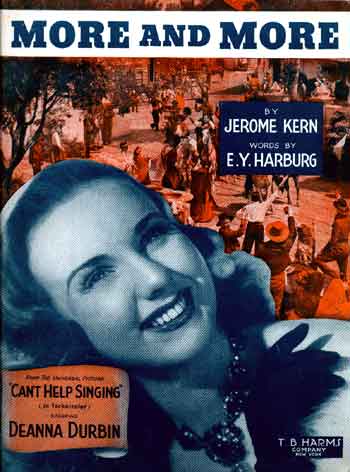 Operatic
ingénue Deanna Durbin remained an
audience favorite, starring in more than a dozen Universal Studios musicals during the
1940s. But some of these vehicles clunked. Spring Parade (1940)
featured Durbin as a young baker's assistant who sings her way to glory in Imperial
Vienna. Can't Help Singing (1944) was
Durbin's first adult role, with a score by Jerome Kern
and E.Y. "Yip" Harburg, but the story of
settlers in the Wild West seemed a strange choice for an operetta.
Operatic
ingénue Deanna Durbin remained an
audience favorite, starring in more than a dozen Universal Studios musicals during the
1940s. But some of these vehicles clunked. Spring Parade (1940)
featured Durbin as a young baker's assistant who sings her way to glory in Imperial
Vienna. Can't Help Singing (1944) was
Durbin's first adult role, with a score by Jerome Kern
and E.Y. "Yip" Harburg, but the story of
settlers in the Wild West seemed a strange choice for an operetta.
Durbin's vehicles grew weaker, culminating in a lavish but uninspired screen version of the Broadway hit Up In Central Park (1947) that dropped most of Romberg's charming stage score. Disenchanted with Hollywood, Durbin retired at age 27, refusing all invitations to return to performing – including a plea from Lerner and Loewe to create the role of Eliza in My Fair Lady.
Columbia: Ann Miller & Co.
Hollywood's most cost-conscious studio (many considered Columbia a "poverty row" operation) concentrated its efforts on low budget comedies and action films. However, Columbia also filmed a series of inexpensive black & white wartime musicals featuring statuesque tap dancer Ann Miller, including the popular Reveille with Beverly (1943). Although the presence of jazz greats Duke Ellington and Count Basie added musical magic, these films were made on the cheap, with production numbers that sometimes look as if they were staged in high school auditoriums. Miller moved on to MGM, where her outstanding dance talents found classier showcases.
Columbia's most memorable wartime musical was Cover Girl (1944), the story of a Brooklyn nightclub dancer who becomes a top magazine model. Designed as a vehicle for screen beauty Rita Hayworth (whose singing was always dubbed), it marked Gene Kelly's transition to stardom. On loan from MGM, his "alter ego" dance with a reflection of himself in a glass window proved to be the first of many classic screen moments. The number was conceived and staged by Stanley Donen, who would play a major role in Kelly's career and direct several great MGM musicals over the next ten years. Cover Girl was such a hit that MGM refused to ever again loan Kelly out for a musical role.
After the war, Columbia studio boss Harry Cohn (whose snarling managerial style won him the nickname "White Fang") decided to film Al Jolson's life story, taking the usual liberties with historic fact. For once, this parsimonious studio mounted a costly production, hiring Jolson to record the songs that actor Larry Parks lip-synched to on screen. The Jolson Story (1946) revived Jolson's popularity and led to that rarest of things, a successful musical sequel – Jolson Sings Again (1949).
The Fox Blondes
 The original sheet music for "You'll Never Know," the Academy Award
winning ballad introduced by Alice Faye in Hello Frisco, Hello (1943).
The original sheet music for "You'll Never Know," the Academy Award
winning ballad introduced by Alice Faye in Hello Frisco, Hello (1943).
20th Century Fox lost a major asset when Shirley Temple reached her teen years and stopped making musicals. (She retired from the big screen altogether in 1949.) But the studio had a battery of adult female stars who continued to churn out lighthearted musicals, delighting servicemen and civilians alike. Most of these films relied on the same premise the studio had perfected in the 1930s – an all-American girl (almost always a blonde) tries to hold onto her man in the crazy backstage world of show business. For example
- Tin Pan Alley (1940) featured
Alice Faye as a blonde singer romancing insecure but
handsome songwriter John Payne through their adventures in the crazy show
biz worlds of Tin Pan Alley,
Broadway, London's West End and World War I -- as sidekicks Jack Oakie and
Betty Grable cheer them on. The peerless
Nicholas Brothers add to the fun with one of
their patented knockout tap duets.
- Betty Grable (who had swiftly become Hollywood's top World War
II pin-up) starred in Springtime in the Rockies (1942) as a blonde
singer trying to keep the love of John Payne (yet again) amid the crazy
contemporary showbiz world of big swing bands.
Grable shows off her famous legs and eventually gets her man, but Brazilian
comedienne Carmen Miranda steals the film.
(Grable and Payne used the same formula in The Dolly Sisters (1945)-- set in the crazy backstage showbiz world of vaudeville.)
- Hello Frisco, Hello (1943) starred Alice Faye as the girl
who loves (who else?) John Payne, an egotistical producer in the crazy showbiz
world of the Barbary Coast. The film is best remembered for Faye introducing
"You'll Never Know," one of Hollywood's most
memorable love songs. Disputes with Fox executives led Faye to retire from the
screen in 1945 at the peak of her popularity. She never
regretted the decision, but her millions of fans sure did.
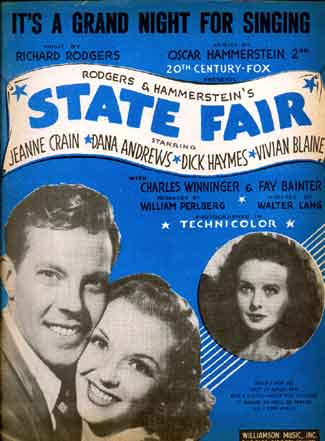 Dick
Haymes, Vivian Blaine and Jeanne Crain appear on the
original sheet music cover for "It's a Grand Night for Singing," the hit
waltz from State Fair.
Dick
Haymes, Vivian Blaine and Jeanne Crain appear on the
original sheet music cover for "It's a Grand Night for Singing," the hit
waltz from State Fair.
State Fair (1945) was the only Rodgers & Hammerstein musical written directly for the big screen. This gentle, reassuring bit of wartime Americana involved the adventures of an Iowa farm family at the annual state fair. The score featured "It's a Grand Night for Singing" and "It Might As Well Be Spring." One of its subplots involved a farm boy (Dick Haymes) who tries to hold onto his girl (Vivian Blaine) in the crazy show-biz world of touring bands . . . Rodgers and Hammerstein took the sacred Fox formula, reversed the genders, and didn't even feature a blonde star. The result was a whopping success. Rodgers and Hammerstein were so pleased that they would wind up having all of their Broadway hits filmed ny 20th Century Fox.
As impressive as all these films were, another studio turned out a consistetnly superior musical product throughout the decade.