
History of The Musical Stage
1950s I: When Broadway Ruled
by John Kenrick
(Copyright 1996; revised 2020)
(The images below are thumbnails – click on them to see larger versions.)
 Mary
Martin and Ethel Merman sing to a television audience of sixty million viewers in
1953.
Mary
Martin and Ethel Merman sing to a television audience of sixty million viewers in
1953.
On June 15, 1953, the Ford Motor Company commemorated its fiftieth anniversary by sponsoring an all-star television revue. The highlight was a joint performance by Ethel Merman and Mary Martin, staged by Jerome Robbins and transmitted live from Broadway's massive Center Theatre. The ladies sang trademark solos before sharing some duet medleys. The joint CBS/NBC broadcast attracted over sixty million viewers, and a live Decca recording of the Merman-Martin act sold over 100,000 copies in two days.
In the 1950s, Broadway musicals were a central feature of American popular culture. Every season saw new stage musicals send songs to the top of the pop charts. Public demand, a booming economy and abundant creative talent kept Broadway hopping. The biggest Broadway hits of the 1950s form the core of the musical theatre repertory. The best of these musicals integrated every element, offering recognizable characters singing in stories told with wit and genuine heart – in short, they applied the Rodgers & Hammerstein formula.
Working the R&H Formula
Even mediocre musicals that applied Rodgers & Hammerstein's formula could make a profit. Happy Hunting (1956 - 408 performances) had a score by a Brooklyn dentist, but who cared so long as Ethel Merman was on hand to sing it? The plot was ripped (in the clumsiest way) from the headlines. A low-born Philadelphia socialite who is not invited to Grace Kelly's royal wedding in Monaco avenges herself by getting her daughter engaged to an impoverished grand duke. With inescapable musical comedy logic, mama and the nobleman soon fall for each other, while the daughter falls for a young attorney. The catchy songs "Mutual Admiration Society" and "Gee, But It's Good to Be Here" helped, but Happy Hunting was all about Merman.
Co-star Fernando Lamas generated some unwelcome publicity by having a public feud with Merman. He habitually upstaged her and on one occasion openly wiped his mouth after sharing an onstage kiss. Along with damning press coverage, Lamas earned an official sanction from Actor's Equity. When Merman's one year contract ran out, Happy Hunting closed after managing a profit. But without Merman, there was no tour and no film. But theatre buffs still treasure the original cast recording.
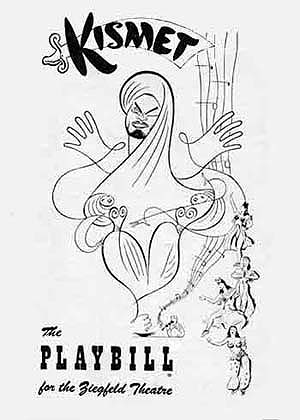 The
original Playbill for Kismet (1953). The bearded genie-like figure represents
Alfred Drake.
The
original Playbill for Kismet (1953). The bearded genie-like figure represents
Alfred Drake.
One unusual variation on the post-Oklahoma format did particularly well. George Forrest and Robert Wright, who had reset the melodies of Edvard Grieg for Song of Norway, now adapted themes by Alexander Borodin to create Kismet (1953 - 583 performances). This Arabian Nights-style tale (based on a popular melodrama by Edward Knoblock) talked like a musical comedy, dressed like a sexy burlesque skit and sang like an old-style operetta. New York's snootier critics were set to destroy this unusual hybrid, but a newspaper strike kept them out of print for a few crucial weeks. Audiences loved the lavish harem scenes and romantic melodies, and by the time the strike ended and the scathing reviews came, it was too late – word of mouth had made the show a major hit.
Alfred Drake gave a bravura performance as Hajj, a beggar-poet who becomes Wazir of Baghdad and makes his daughter Queen of Arabia by manipulating the twists of fate, his "kismet." As the Wazir's voluptuous concubine Lalume, Joan Diener's soprano pyrotechnics and knockout figure won raves, as did Doretta Morrow as Hajj's daughter Marsinah and Richard Kiley as her beloved Caliph. "Stranger in Paradise," (based on the Polovetsian Dance No. 2 from Borodin's Prince Igor) became a pop hit, and Kismet picked up six Tonys, including Best Musical. It remained an audience favorite for a generation, and is still done occasionally by opera companies (due to the vocally demanding score).
Rodgers & Hammerstein: Supermen
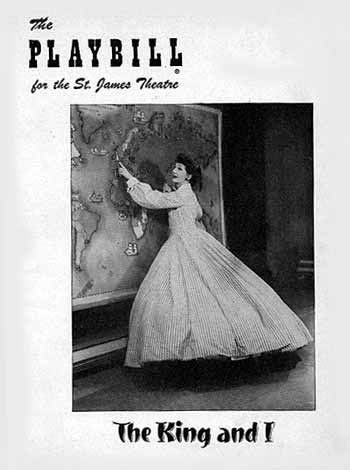 Gertrude
Lawrence as seen on the original Playbill for
The King and I.
Gertrude
Lawrence as seen on the original Playbill for
The King and I.
Richard Rodgers and Oscar Hammerstein II remained the musical theater's most potent creative team. At one point, they had four musicals running simultaneously on Broadway -- an unprecedented accomplishment.
With the 1950s film versions of Oklahoma, Carousel and South Pacific grossing millions of dollars worldwide, the two songwriters were international celebrities, so it is not surprising that the media treated each new R&H stage production as a major event.
- The King and I (1951 - 1,246 performances)
was based on Anna Leonowens real life experiences tutoring the royal family of Siam
in the 1860s. The clash of Eastern and Western cultures sets Anna and the King on a
collision course, further complicated by their unspoken feelings for each other.
Gertrude Lawrence, who had suggested the project,
played the Welsh schoolteacher. At Mary Martin's urging, the little-known
Yul Brynner was cast as the King. The score
included "Whistle a Happy Tune," "Hello Young Lovers," "I Have
Dreamed," and "Something Wonderful."
In the show's most memorable moment, "Shall We Dance," depicted an impromptu dance lesson between Anna and the King that exploded with romantic tension. The musical theater lost one of its most luminous stars when Lawrence succumbed to cancer during the run. Brynner made a career of playing the King, appearing in the acclaimed 1956 film version and numerous revivals until his death in 1985.
- Me and Juliet (1953 - 358 performances) was
a backstage love story featuring the sultry tango "No Other Love Have I."
Only a modest success by R&H standards, it had a fine score and innovative
sets (by the legendary stage designer Jo Mielziner) that allowed a swift flow of
action between on and offstage scenes.
- Pipe Dream (1955 - 246 performances) offered a sanitized adaptation of
Steinbeck's Sweet Thursday starring Metropolitan Opera
diva Helen Traubel. The raffish characters of the novel were
too much for Hammerstein. Critics and audiences were disappointed, making this Rodgers &
Hammerstein's only financial failure. But it was such an important event that the characters on the TV sitcom I Love Lucy
schemed to get Pipe Dream tickets.
- Flower Drum Song (1958 - 600 performances) did better, taking a genial look at
generations clashing in a Chinese family in San Francisco. With direction by
Gene Kelly, its score
included "I Enjoy Being a Girl" and "Love Look Away."
- The Sound of Music (1959 - 1,443 performances)
was inspired by the story of Austria's Trapp Family Singers and their escape from the
Nazis in the 1930s. The score included "Do Re Mi," "Edelweiss,"
"My Favorite Things," and the title tune. With
Mary
Martin heading the cast, The Sound of Music won the Tony for Best
Musical (in a rare tie vote with Fiorello).
Critics who dismiss this show's sweet story have missed the real point. Amid all the sentiment, The Sound of Music offers an entertaining but devastating condemnation of those who empower evil by refusing to oppose it. The real bad guys are not the Nazis, but the so-called "decent" people who acquiesce to them. A superb and literate musical, The Sound of Music remains a beloved cultural landmark.
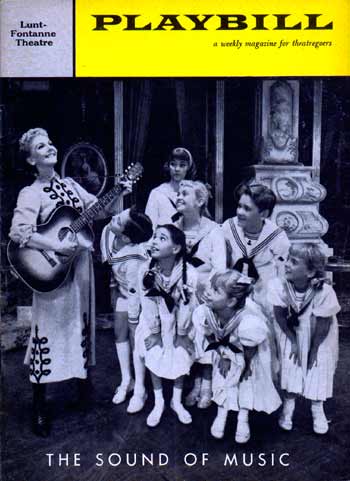 Mary Martin
leads the children in "Do Re Mi" on the
cover of the original cast Playbill for The Sound of Music (1959).
Mary Martin
leads the children in "Do Re Mi" on the
cover of the original cast Playbill for The Sound of Music (1959).
Oscar Hammerstein II died due to stomach cancer a few months after The Sound of Music opened, ending a career that spanned the golden age of musical theatre and film. After working with the innovative Jerome Kern and operetta master Sigmund Romberg, he did his finest work with Rodgers, and later coached young Stephen Sondheim. More than any other individual, Hammerstein had turned the once-innocuous Broadway musical into a potent dramatic form, and had turned lyrics into essential dramatic tools. He did it by being a superb storyteller and a dedicated craftsman. Even when dealing with serious issues, he always kept his focus on intriguing characters caught in remarkable situations.
"If the 1950s was the decade that promised a continuation of the musical's crucial place in the culture, it was at least partly because the Rodgers and Hammerstein revolution of the 1940s urged the musical to seek beyond typical fare for stories based on realistic character development: to become drama. Thus, the 1940s introduced the notion and the 1950s exploited it."
- Ethan Mordden, Coming Up Roses: The Broadway Musical in the 1950s (New York: Oxford University Press, 1998), pp. 26-27.
More than three decades after his death, during the 1995-96 season, four Hammerstein musicals appeared on Broadway, and his work remains popular in the 21st Century. So long as people "know how it feels to have wings on their heels" or believe their "heart will be blest by the sound of music," Hammerstein's lyrics will be part of civilization's common language.
Who else was composing great shows during this amazing decade?