
A History of The Musical
Burlesque
by John Kenrick
(Copyright 1996-2003)
(The images below are thumbnails – click on them to see larger versions.)
Misunderstood Genre
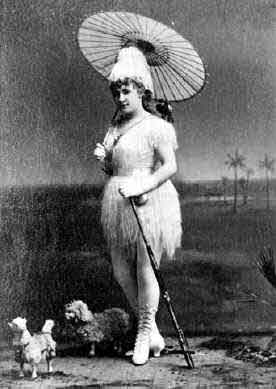 Lydia Thompson, the audacious British showgirl who's troupe of blonde
beauties made burlesque a sensation in America.
Lydia Thompson, the audacious British showgirl who's troupe of blonde
beauties made burlesque a sensation in America.
Most people think that "burlesque" means female strippers walking a runway to a bump and grind beat. But that only fits the form in its declining years. At its best, burlesque was a rich source of music and comedy that kept America, audiences laughing from 1840 through the 1960s.
Some sources try to wrap burlesque in a mantle of pseudo-intellectual respectability. Yes, it involved transgressive comedy and songs, but the primary attraction of burlesque was sex . . in the form of ribald humor and immodestly dressed women. Although many dismissed burlesque as the tail-end of show business, its influence reaches through the development of popular entertainment into the present.
Without question, however, burlesque's principal legacy as a cultural form was its establishment of patterns of gender representation that forever changed the role of the woman on the American stage and later influenced her role on the screen. . . The very sight of a female body not covered by the accepted costume of bourgeois respectability forcefully if playfully called attention to the entire question of the "place" of woman in American society.
- Robert G. Allen, Horrible Prettiness: Burlesque and American Culture (Univ. of North Carolina Press, Chapel Hill, 1991), pp. 258-259.
In the 19th Century, the term "burlesque" was applied to a wide range of comic plays, including non-musicals. Beginning in the 1840s, these works entertained the lower and middle classes in Great Britain and the United States by making fun of (or "burlesquing") the operas, plays and social habits of the upper classes. These shows used comedy and music to challenge the established way of looking at things. Everything from Shakespearean drama to the craze for Swedish opera singer Jenny Lind could inspire a full-length burlesque spoof. On Broadway, the burlesque productions of actor managers William Mitchell, John Brougham and Laura Keene were among Broadway's most popular hits of the mid-19th Century.
By the 1860s, British burlesque relied on the display of shapely, underdressed women to keep audiences interested. In the Victorian age, when proper women went to great lengths to hide their physical form beneath bustles, hoops and frills, the idea of young ladies appearing onstage in tights was a powerful challenge.
Suggestive rather than bawdy, these shows relied less on strong scripts or songs than on sheer star power. When Broadway's The Black Crook became a massive hit in 1866, its troop of ballerinas in flesh-colored tights served notice that respectable American audiences were ready to fork over big bucks for sexually stimulating entertainment. All it took was a daring producer to take things to the next level.
Lydia Thompson
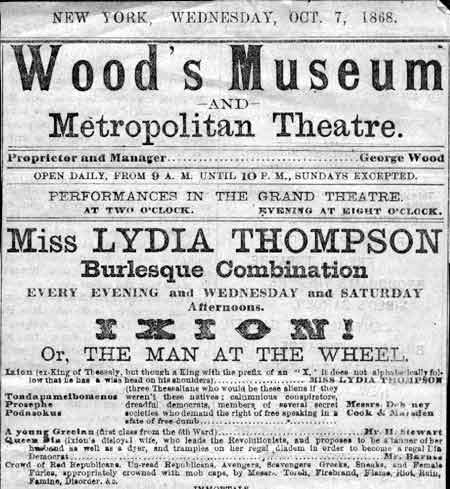 The original program to
Ixion, Broadway's first burlesque hit.
The original program to
Ixion, Broadway's first burlesque hit.
In the late 1860s, Lydia Thompson's British burlesque troupe became New York's biggest theatrical sensation. Their first hit was Ixion (1868), a mythological spoof that had women in revealing tights playing men's roles. In the Victorian age, when proper women went to great lengths to hide their physical form beneath bustles, hoops and frills, the idea of young ladies appearing onstage in tights was a powerful challenge.
Underdressed women playing sexual aggressors, combining good looks with impertinent comedy – in a production written and managed by a woman? Unthinkable! No wonder men and adventurous wives turned out in droves, making Thompson and her "British blondes" the hottest thing in American show business. Demand for tickets was such that Ixion soon moved to Broadway's most prestigious musical house, Niblo's Garden – the same theatre where The Black Crook had triumphed two years earlier. All told, Thompson's first New York season grossed over $370,000.
Thompson and her imitators did not bother with such mundane matters as hiring composers. Instead, they used melodies from operatic arias and popular songs of the day, incorporating them into the action for comic or sentimental effect. To prevent unauthorized productions, the scripts from these early burlesques were not published. In fact, the material changed so often (sometimes from week to week) that a written script would serve little purpose. We can only guess at the exact content and staging of these shows, but it is clear that audiences were delighted.
At first, the American press praised burlesques, but turned vicious under pressure from influential do-gooders. But the cries of the self-righteous had an unintended effect. Editorials and sermons condemning burlesque as "indecent" only made the form more popular! Demand was such that copycat burlesque companies soon cropped up, many with female managers.
-
Mabel Saintley became America's first native-born burlesque star, leading "Mme. Rintz's Female Minstrels" from the 1880s onwards in a stylish burlesque of all-male troupes.
-
Burlesque left little to the imagination. The popular stage spectacle Ben Hur inspired "The High Rollers" troupe to produce Bend Her, with scantily clad chorines as Roman charioteers.
-
Any stage hit could become a target for humor. The popular melodrama Trilby was spoofed in 'Twill Be.
Americans began creating their own burlesques, and some proved extremely popular. Composer Edward E.Rice teamed with actor Henry Dixey to create Adonis (1874), the story of a statue that comes to life and is so disgusted by human folly that he finally chooses to turn back into stone. The show ran over 500 performances in New York and toured for years, making the handsome Dixey the top matinee idol of his time.
Burlesque Format
As male managers took over the form in the 1880s, transgressive feminine wit was gradually replaced by a masculine determination to reveal as much of the feminine form as local laws allowed. But obscenity and vulgarity were avoided – the point was to spoof and (to a limited extent) titillate, not to offend.
Burlesque underwent a crucial change when Michael Leavitt produced burlesque variety shows using something similar to the three act minstrel show format –
-
ACT ONE: The ensemble entertains with songs and gags, dressed in formal evening clothes.
-
ACT TWO: An "olio" of variety acts (singers, comics, skits, etc.).
-
ACT THREE: A complete one-act musical burlesque. These ranged from Shakespearean take offs like Much Ado About a Merchant of Venice to a Gilbert and Sullivan spoof called The Mick Hair-Do.
By 1905, burlesque theatre owners formed vaudeville-style circuits of small, medium and big time theatres. Because big time burlesque companies played these theatres in regular rotations, the circuits came to be known as wheels -- the largest being the Columbia (Eastern U.S.), Mutual, and Empire (Western U.S.) wheels. Unlike vaudeville performers who sought weekly bookings as individual acts, burlesquers spent an entire forty week season touring as part of one complete troupe. For three decades, this system made burlesque a dependable source of steady work.
The biggest burlesque star of the early 20th Century was dancer Millie DeLeon, an attractive brunette who tossed her garters into the audience and occasionally neglected to wear tights. Such shenanigans got her arrested on occasion, and helped to give burlesque a raunchy reputation. Although vaudevillians looked down on burlesque performers, many a vaude trouper avoided bankruptcy by appearing in burlesque – usually under an assumed name, to avoid embarrassment.
Training Ground
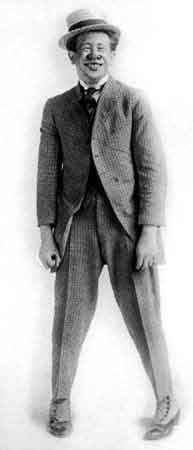 Long
before his "Cowardly Lion"
days, Bert Lahr polished his comic skills in burlesque. Note the outlandish
costume and exaggerated make-up, required attire for burlesque
comics.
Long
before his "Cowardly Lion"
days, Bert Lahr polished his comic skills in burlesque. Note the outlandish
costume and exaggerated make-up, required attire for burlesque
comics.
In time, burlesque bills began and ended with "burlettas," extended skits that made fun of hit shows and popular topics. In between came a variety olio where singers, comics, jugglers, magicians and specialty acts were all part of the mix. Herb Goldman points out in Fanny Brice: The Original Funny Girl (Oxford: NYC, 1992, p. 28-29) that burlesque – not vaudeville – was the real "break-in ground" where amateurs could prove if they had the talent and determination to survive in show business. By the time most performers reached vaudeville, they were already experienced pros.
While it was common for burlesque stars to graduate into vaudeville, vaudevillians considered it a fatal disgrace to appear in burlesque, insisting that only those who were "washed up" would stoop so low. However, many a vaudeville veteran hit the burlesque wheels during dry spells, appearing under an assumed name.
Burlesque's richest legacy was its comedy. The lead comic in a burlesque show was referred to as the "top banana," and his sidekicks were known as the second, third, etc. – supposedly because they would resort to slipping on banana peels in order to get a laugh. The lower you were in the "bunch," the more likely you were to suffer the worst of the physical humor (pies in the face, seltzer in the pants, etc.).
Some wondrous comedians learned their craft working the burlesque wheels, including future musical comedy stars Jackie Gleason, Fanny Brice, Leon Errol, Bert Lahr, W.C. Fields, Bobby Clark, Red Skelton, Phil Silvers, Joey Faye and Bob Hope. All used the same basic routines, but no two played them the same way.
So what was burlesque comedy like?