
Our Love Is Here To Stay
Special Feature: Piano Bars
by John Kenrick
(Copyright 1996-2003)
(All the images below are thumbnails – click on them to see larger versions.)
Piano Bars
 Grove Street in New York City,
onetime home of many famous piano bars.
Grove Street in New York City,
onetime home of many famous piano bars.
Piano bars became a part of New York nightlife in the 1940s, attracting those seeking something gentler than a jazz club and more casual than a supper club. The crowds that gathered around pianos to sing along (or just sip cocktails and listen) could have lots of informal fun, and campy humor was common. Although piano bars began as entertainment for the middle aged "het set," they evolved into something quite different. As popular culture turned away from musical theatre during the late 20th Century, Manhattan's piano bars became a place where musical theatre queens and their music could sing on.
Such early Greenwich Village piano bars as The Five Oaks and Marie's Crisis drew a largely gay clientele, but these were straight-owned establishments. From the 1930s through the early 1970s, the NY State Liquor Authority would withdraw the liquor license for any establishment where customers were seen kissing or even holding hands with members of the same sex. So all bars were officially "straight." The only "gay" bars in New York were seedy mob-owned dives that the police raided often enough to guarantee a steady flow of graft. Research has failed to identify any of these as piano rooms. Several private gay clubs had piano entertainment. However, these "members only" establishments were far more formal than today's piano bars.
When the Stonewall riots shook New York in 1969, the bar scene underwent radial change. Gay-owned establishments appeared, including several piano bars. Ranging from casual Village hangouts (The Duplex) to "proper attire" spots on the Upper East Side (Regent East), these piano rooms provided an alternative to the disco scene of the 1970s and 80s. They all featured sing-alongs, pianists with an encyclopedic knowledge of show tunes, and an admission policy that welcomed everyone. Open microphones were provided for customers willing to sing solos. (Willing? Hell, some soloists could not be scraped off a microphone!) At Ted Hook's beloved Backstage, the impromptu soloists could include fellow patrons, the wait staff – or Liza Minnelli and Chita Rivera.
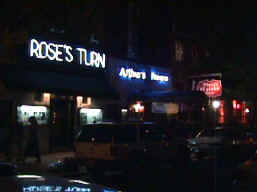
Greenwich Village is still home to The Duplex, The Monster and more recent additions like Rose's Turn. In midtown, Don't Tell Mama and Rose's Too provide a pleasant alternative to Broadway's high-priced orchestra seats. On the Eastside, piano rooms range from the elegance of The Townhouse to the cozy informality of Brandy's. All of these bars provide live showtune-based entertainment for the price of a drink. Lets take a closer look at how one long-running piano bar team helped foster the tradition of comic showtune parodies.
Parodies: Showtunes With a Twist
 Karen Miller (left) performing selections
from The Sound of Music at the legendary Eighty-Eights in
NYC.
Karen Miller (left) performing selections
from The Sound of Music at the legendary Eighty-Eights in
NYC.
In New York City, pianist Karen Miller presided over raucous showtune sing-alongs for more than twenty-two years at The Duplex, Eighty Eights and other rooms. Her showtune loving regulars became an entertainment event in their own right. Soloists included Tony nominees and office workers – some sensational, and some not. One of her following's most famous quirks was a passion for parodies. In pre-Stonewall days, parodies were often used as a subtle form of gay expression. As the bar scene opened up, so did the frankness of the material. With the musical on the cultural "endangered species" list, piano bars became a haven for the kind of clever lyric writing that once thrived on Broadway. In the 1980s, Gerard Alessedrini's long-running revue Forbidden Broadway carried parody back to the legitimate stage for the first time in years, and the form continues to thrive in piano bar's.
These re-wordings of popular show tunes are sometimes affectionate, sometimes wicked examples of contemporary gay humor. Of course straight people write parodies too, but here we are focusing on works with a gay perspective. Some of these parodies are off-center views of the gay experience, others are self-parody designed for specific performers, and still others comment on the news or the latest show biz gossip. Parodies even include the insertion of responses to well-known musical questions (An example from "Maria" in The Sound of Music: "How do you keep a wave upon the sand? WITH A DYKE!").
"Trouble"
 John Kenrick performing a parody at Eighty-Eights with
pianist Karen Miller.
John Kenrick performing a parody at Eighty-Eights with
pianist Karen Miller.
Here's an excerpt from a parody that I performed on many occasions with Karen Miller.
Sung to the melody of the middle section of "Trouble"
from The Music Man (Willson 1957) - Parody by John KenrickAnd all week long,
The gay youth of America
Are fritterin' away
I say our young gays are fritterin'
Fritterin' away their
Noon time, suppertime,
Dish time too
Learning hip-hoppin' rap!
Never mind getting cast albums bought
Or the school shows done
Or the tap shoes pounded.
Never mind learning any show tunes
Till the city is caught
With piano bars empty
On Saturday night
And that's trouble.
Yes, you've got lots and lots of trouble.
I'm thinking of the
Young gays and lesbians
Generation X-ers
Going nowhere near
A theatre after school
You got trouble folks,
Right here in New York City.
Trouble with a capital T
And it rhymes with B
And that's old Broadway!
Alas, Piano bars are fewer in number now. Eighty-Eights closed in 1999, and at most surviving establishments showtunes are no longer the core repertory. Young pianists reflect newer sounds, and the rhythms of rock and R&B are the mainstay in many piano bars.
But throughout the 1980s and 90s, when musical comedy was less than welcome on Broadway, it had a blast hiding out in piano bars. And so a genre was preserved and celebrated until a wider public was ready to embrace it again. Should the atmosphere on Broadway change again – and someday it most certainly will – one hopes that one to two piano bars will be ready to take up the slack.
So what about that short supply of musicals? Are musicals and their fans (gay and otherwise) doomed to extinction?