
A History of the Musical
Minstrel Shows: Part II
by John Kenrick
Copyright 1996-2003
(The images below are thumbnails – click on them to see larger versions.)
Minstrel Programs
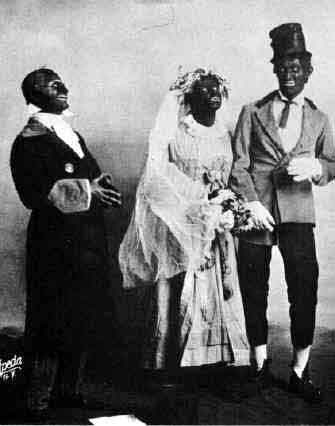 Three
blackface performers in a typical minstrel skit – racism as singing and dancing
entertainment.
Three
blackface performers in a typical minstrel skit – racism as singing and dancing
entertainment.
Edwin P. Christy's Minstrels may not have invented minstrelsy, but they eventually perfected the three part format that became the standard for all minstrel shows. All three parts would echo into the future development of the American musical theatre –
– The First Part/Minstrel Line: The full ensemble sat in a semi-circle. At the center sat the whiteface host, always called "Mr. Interlocutor." Two blackface comedians at either end (the endmen) were always called "Bruder Tambo" (playing the tambourine) and "Bruder Bones" (playing a pair of rattling rib bones or spoons). After an opening number, the Interlocutor shouted, "Gentlemen, be seated," and the endmen would lead the ensemble in a series of jokes, songs and dances. The endmen spoke in a comic caricature of black colloquial speech, while the Interlocutor's florid eloquence spoofed white upper class condescension. (Variations of old minstrel line jokes became the mainstays of Ameruican comedy, and would be heard in film, radio and television right into the 21st Century.) Intermission was followed by . . .
– The Olio: After an intermission, miscellaneous songs and variety acts were performed in front of a painted backdrop. This segment of the evening went by various names, with one troupe referring to it as a "terpsichorean divertissement." These acts were sometimes performed without blackface make-up, in part to prove that the performers were white. The last skit in the olio was often a "stump speech" given by one of the endmen. These satiric orations poked fun at contemporary issues and political figures, presaging the stand-up comedy acts of the next century. (The overall olio format would eventually evolve into vaudeville) After a second intermission came a . . .
– Afterpiece/One-Act Musical: These burlesqued a popular topic, novel or play. Two stock blackface characters were almost always depicted – "Jim Crow," an ignorant country bumpkin ripe for humiliation, and "Zip Coon," a city slicker whose self-assurance led to his comic come-uppance. Hateful to us, these stereotypes were accepted as part of wholesome family entertainment in the 1800’s. Both white and black audiences resisted attempts to change the racist tone of the songs and skits until minstrelsy disappeared. (These one act musical spoofs would grow into the full-length Broadway "burlesques" of the late1800s.)
The Cohan and Harris' Minstrels (1909) was the last minstrel show to play Broadway, but minstrel traditions remained in use for decades. The offensive content of minstrelsy lived on too. The long-running radio series Amos n' Andy featured two white actors impersonating contemporary black characters that were direct descendants of "Zip Coon" and "Jim Crow." Some blacks protested such stereotyping, but listeners made it a top series for more than a decade. When Amos n' Andy moved to TV in the 1950s, black actors were used – but the spectacle of blacks demeaning themselves had become unsettling, and the show was cancelled in 1953
Minstrel Songs
Minstrelsy spurred the development of popular music in 19th Century America. For starters, it was the first genre to commission songs specifically for use on the American stage. Minstrelsy then gave those American songs nationwide exposure. As one historian explains it –
There was no Tin Pan Alley and at first phonograph and radio were unknown. The piano occupied a prominent place in the parlor and much of its sheet music came with the minstrel show. The troopers visited a town annually, bringing with them the songs they sang in sheet music and song books. . . a great debt is due those minstrel shows. Had it not been for Christy, Steve Foster might never have attained his great fame.
- Harlow R. Hoyt, Town Hall Tonight. (New York: Bramhall House, 1955), pp. 162-163)
Most of the hit songs of the 1800s come from minstrelsy. Stephen Foster's "Camptown Races," "My Old Kentucky Home," "O Susanna" and "Old Folks at Home" were all popularized in minstrel shows. Minstrel star Dan Emmett composed several popular tunes including the unofficial Southern anthem "Dixie." In the years following the Civil War, James Bland became America's first popular black composer with such minstrel hits as "O, Dem Golden Slippers" and "Carry Me Back to Old Virginny." Bland was such a brilliant improvisational performer that he never bothered to write down more than three dozen of his 600-plus compositions. Like Foster, this composer of plantation songs was a Northerner with no direct experience of Southern life.
Many minstrel songs helped to perpetuate demeaning stereotypes. In 1890, black performer Ernest Hogan wrote a syncopated song that told of a young "dusky maiden" unable to choose between two suitors. "All Coons Look Alike to Me" became a nationwide sensation, inspiring a mania for "coon songs" – ragtime numbers with lyrics that reflected stereotyped notions of African American culture. In reality, most of these songs just reflected the ignorance of their white composers and lyricists, offering cartoonish images of gambling men and high-falutin' women, all speaking (or singing) with buffoonish accents, with razors at the ready to cut down opponents. But the genre remained popular with white and black audiences well into the 20th Century, including songs by such respected composers as George M. Cohan and Irving Berlin. A racist nation from its inception, America has never fully expunged racism from its cultural mindset. (In fairness, most every nation on earth has a skeleton of bigotry in its historic closet – but America was the only place where such hatred gave birth to a form of song and dance entertainment.)
Al Jolson
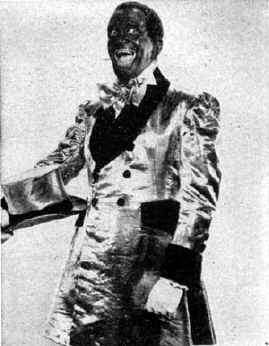 Al
Jolson in full minstrel costume – a publicity photo included in the
program for his last Broadway musical.
Al
Jolson in full minstrel costume – a publicity photo included in the
program for his last Broadway musical.
The most famous graduate of minstrelsy was Al Jolson. He toured with Dockstader's Minstrels before achieving lasting stardom in vaudeville, Broadway and Hollywood. Jolson immortalized blackface in several films, including the talking landmark The Jazz Singer (1928).
Jolson was not a racist. A Russian-born Jew, he openly befriended black performers at a time when it was unpopular to do so. In Jolson: The Legend Comes to Life (Oxford Univ. Press, NY, 1988, p. 171), historian Herbert Goldman tells of a night when the black song writing team of Noble Sissle and Eubie Blake were refused service in a Hartford restaurant. Jolson heard about it, and the next night treated them to a meal and a private performance. Jolson and Blake remained friends from then onwards.
Jolson said that blackface gave him the emotional freedom he needed to take risks as a performer. As Goldman explains –
Although the medium was later vilified for insulting the black race, Jolson's blackface was probably more of a theatricalization than a caricature. The medium allowed him to show pluck and daring – an 'lan visible in the harlequin but also traceable in the black man's cultural approach to entertainment, sports and striking back, where possible, at white society and the subservient role it forced him to assume. . . There is a magic to his work in blackface that he never captured sans burnt cork.
- Jolson: The Legend Comes to Life (New York: Oxford Univ. Press, 1988), p. 36.
Considered one of the greatest entertainers of his time, Jolson's films are often dismissed as embarrassments today. Whatever his intentions were, the sight of a white man covered with burnt cork singing "Mammy" has become an unsettling reminder of the racial/cultural mindset that minstrelsy embodied. You can find much more on this remarkable performer in our special sub-site Al Jolson 101.
It was perhaps inevitable that someone would eclipse minstrelsy with a classier version of variety. This new form would provide America's future musicals with their comic soul. It was born in New York City, and in time they would call it vaudeville.
Note: For more detailed examination of minstrelsy, one of the best books is Robert Toll's Blacking Up, Oxford University Press, New York, 1974.