
A History of The Musical
Vaudeville
by John Kenrick
(Copyright 1996-2004)
- Meeting a Need
- Calling it Vaudeville
- Keeping It Clean
- Working the Circuits
- Small to Big Time
- The Palace
(The images below are thumbnails – click on them to see larger versions.)
Meeting a Need
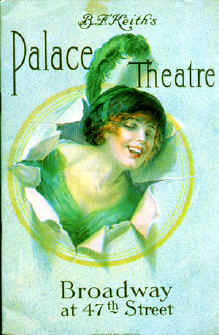 The
program cover for Keith's Palace Theater in New York City, the most desired booking
in all vaudeville.
The
program cover for Keith's Palace Theater in New York City, the most desired booking
in all vaudeville.
By the 1880's, the Industrial Revolution had changed the once rural face of America. Half of the population was now concentrated in towns and cities, working at regulated jobs that left most of them with two things they never had back on the farm – a little spare cash and weekly leisure time. These people wanted affordable entertainment on a regular basis. Most variety shows were too coarse for women or children to attend, and minstrel shows were already declining in popularity. In a world where phonographs, film, radio and television did not yet exist, something new was needed to fill the gap.
Vaudeville also tried to bridge a social gap that had divided American audiences ever since the upper and lower classes clashed in a deadly 1849 riot.
"After the Astor Place Riot of 1849 entertainment in New York City was divided along class lines: opera was chiefly for the upper middle and upper classes, minstrel shows and melodramas for the middle class, variety shows in concert saloons for men of the working class and the slumming middle class. Vaudeville was developed by entrepreneurs seeking higher profits from a wider audience."
- Robert W. Snyder in The Encyclopedia of New York City (New Haven: Yale University Press, 1995), Kenneth T. Jackson, editor, p. 1226.
Tony Pastor was the first manager to present commercially successful "clean" variety. He earned fame as a variety vocalist, songwriter and manager on New York's Bowery. But his ambitions reached far beyond the bawdy standards that marked Bowery entertainments. A devout Catholic and attentive father, Pastor wanted to provide family-friendly entertainment. When he started presenting a clean variety show at New York's Fourteenth Street Theatre on Oct. 24, 1881, the location said a great deal about his intentions.
As an early center for public transportation, Manhattan's Union Square district included most of New York City's top theatres, restaurants and shops. Respectable theatergoers had no objection to attending performances there. Each week Pastor offered a different line-up of quality acts, with reserved seats going for fifty cents. He often appeared in the star spot himself, singing such sentimental favorites as "The Band Played On" –
Casey would waltz
With the strawberry blonde
And the band played on.
He'd waltz round the floor
With the girl he adored
And the band played on.
But his brain was so loaded
He nearly exploded,
The poor girl would shake with alarm.
He married the girl
With the strawberry curl
And the band played on.
Pastor's "clean" variety show was an instant success, drawing an enthusiastic audience from all age groups and classes – including some of the most influential people in New York.
Calling it Vaudeville
Other producers soon picked up on this innovation. Beginning in Boston in 1883, Benjamin Franklin Keith and Edward F. Albee used the fortune they made staging unauthorized productions of Gilbert and Sullivan operettas to started build a chain of ornate theatres across the northeastern United States. Stealing Pastor's format, they instituted a policy of continuous multiple daily performances, which they called "vaudeville."
The origins of the term vaudeville are unclear. Some sources claim the word was a bastardization of "voix de ville," French slang for "songs of the town" – others say it came from "vaux de Vire," fifteenth century satiric songs written by Olivier Basselin, a native of the Vire valley in Normandy.
We get yet another explanation from vaudevillian Sophie Tucker in her autobiography Some of These Days (1945, pp. 155-156). Her agent, the now-legendary William Morris, claimed that a red windmill in the Vire valley started serving wine and cheese to farmers waiting to have their wheat milled. Traveling entertainers took advantage of this readymade audience by performing for the crowd and passing the hat. This arrangement proved so popular that others soon copied it. Morris insisted this place not only gave birth to the term "vaudeville" – it also inspired the name of the popular Parisian nightclub Le Moulin Rouge ("The Red Mill").
Keeping It Clean
As vaudeville spread through the United States, major theatre chains or circuits were built by Sullivan & Consodine, Alexander Pantages, film mogul Marcus Loew and others. All of them were tough businessmen, but no one could match Keith and Albee's cutthroat tactics, or their ruthless insistence that acts keep their material clean at all times. Warnings were posted backstage in all of Keith & Albee's theatres. Here is an example –
"Don't say 'slob' or 'son of a gun' or 'hully gee*' on the stage unless you want to be canceled peremptorily. Do not address anyone in the audience in any manner. If you do not have the ability to entertain Mr. Keith's audience with risk of offending them, do the best you can. Lack of talent will be less open to censure than would be an insult to a patron. If you are in doubt as to the character of your act consult the local manager before you go on stage, for if you are guilty of uttering anything sacrilegious or even suggestive you will be immediately closed and will never again be allowed in a theatre where Mr. Keith is in authority."
- as quoted by C. Samuels and L. Samuels in Once Upon a Stage (New York: Dodd, Mead & Co, 1974), p. 89.(*Note: "Hully gee" was a street slang abbreviation of "Holy Jesus," which explains why this phrase could be considered offensive.)
It was always understood that headliners could bend the rules, but transgressions by lesser known performers were not tolerated. In Sophie Tucker's autobiography, she explains that Keith's theater managers assessed every act during the first performance of the week's engagement –
"Between the (Monday) matinee and the night show the blue envelopes began to appear in the performers mailboxes backstage . . . Inside would be a curt order to cut out a blue line of a song, or piece of business. Sometimes there was a suggestion of something you could substitute for the material the manager ordered out . . . There was no arguing about the orders in the blue envelopes. They were final. You obeyed them or quit. And if you quit, you got a black mark against your name in the head office and you didn't work on the Keith Circuit anymore. During my early years on the Keith Circuit, I took my orders from my blue envelope and – no matter what I said or did backstage (and it was plenty) – when I went on for the Monday night show, I was careful to keep within bounds."
- Some of These Days, pp.148-149.
Thanks to the tint of those dreaded envelopes, anything risqu' came to be known as "blue" material. However, as historian Robert W. Snyder points out in The Voice of the City (Ivan R. Dee, Chicago, 1989, p. 132), vaudeville's exuberance and irreverence "challenged the Victorian code of sentiment and gentility – sometimes directly, sometimes indirectly," leading to "a new urban vision of success and happiness based on luxury and consumption."
Keith's authority extended far beyond his own theaters. In 1906, Keith and Albee organized most of their fellow circuit owners into a Managers Association which coordinated all bookings. Performers who fell out of personal favor with Keith or Albee had little hope of finding work in any big time vaudeville house. Keith's most infamous quote was, "I never trust a man I can't buy," but he was almost benign compared to Albee.
". . . scarcely anyone mentions E.F. Albee without intense bitterness. . . Mr. Albee, with his relentless air of holiness, was totally without humor and grim visage as he wielded his destructive power."
- Marian Spitzer, The Palace (New York: Athaneum, 1969), p. 86.
By 1907, Variety reported that vaudeville was earning $30 million a year. While enjoying the lion's share of this haul, Keith & Albee were powerful enough to neutralize anything or anyone who threatened to weaken their control of vaudeville. They crushed several attempts by performers to unionize. When a union called "The White Rats" showed signs of succeeding, Albee set up a puppet union called National Vaudeville Artists, refusing to book performers who did not join his group. It cost millions, but NVA soon wiped the White Rats out of existence. Albee kept this so-called union under his firm control, silencing all opposition to his often abusive treatment of performers.
Working the Circuits
Appearing in vaudeville was no vacation. A successful act toured for forty or more weeks a year, doing "one nighters," split-weeks or weekly stands depending on a theatre's size. The number of performances per day varied from circuit to circuit. In the musical On Your Toes (1936), lyricist Larry Hart summed it up this way –
It's two a day for Keith,
And three a day for Loew;
Pantages plays us four a day
Besides the supper show.
Performers put up with these demanding schedules because even those who did not reach the level of headliner could make good money. In 1919, when the average factory worker earned less than $1,300, a small time Keith circuit performer playing a forty-two week season at $75 per week earned $3,150 a year. Women, uneducated immigrants, the poor – anyone with determination and a talent to entertain could earn a solid, respectable living. Few other fields could claim to offer the disadvantaged such accessible rewards in the early 20th Century.
Low ticket prices helped define the audience for vaudeville. In 1912, when
seats to a Broadway hit went for as much as $2, big-time vaudeville tickets
topped out between $1 and seventy-five cents.
That same year, a Sage Foundation survey determined that approximately 700,000
New Yorkers attended 40 low-priced vaudeville theatres each week, and estimated
that the audience was 60 percent working class (versus a mere 2 percent of a
Broadway audience), and 64 percent male.
Many vaudeville theatres were poorly heated in winter and became oversized ovens in summer. Dressing rooms were small and filthy, with little if any ventilation. Musical accompaniment could be anything from a full orchestra to a lone pianist, and the quality of these musicians varied.
"I worked to all kinds of music – from bad to awful. Some bands were really great. For instance, there was the band at the RKO Palace in New Orleans. That band was so good it used to stop the show. Louis Prima was in that band. And when they played an overture – wow! On the other hand, there was the band at the New York Palace. Owen Jones was the leader. They had some women in the band, and they were so polite they used to let the women finish first – that's how the music sounded. Every act that went on had to stop in the middle and ask Owen Jones to take the tempo over again. Everybody out front knew what was happening. This bas***d was giving every act trouble. He was a musician but he couldn't cut a show."
- Billy Glason as quoted by editor Bill Smith in The Vaudevillians (New York: Macmillan Publishing, 1976), p. 43.
Small to Big Time
More than 25,000 people performed in vaudeville over it's 50-plus years of existence, working their way through the three levels defined by the trade newspaper Variety –
- "Small time" – small town theatres and cheaper theaters in larger towns. Performers made as little as $15 a week in the early years, closer to $75 over time. These often crude theatres were the training ground for new performers, or the place for old-timers on the skids to eke out a few final seasons.
- "Medium time" – good theaters in a wide range of cities, offering salaries of up to a few hundred dollars a week. Performers seen here were either on the way up or on the way down.
- "Big Time" – the finest theaters in the best cities, using a two performance-a-day format. Most big time acts earned hundreds per week, and headliners could command $1,000 a week -- or far more.
Some performers insisted that there was only "big," "small" and "small-small" time. However you labeled them, there were varying levels of vaudeville Years later, a vaudeville dancer explained how miserable the "small time" experience could be –
"In small time we worked on the Death Trail – that was the name for one-nighters in places you never heard of, like Missoula, Montana, places where nobody would go unless they really needed work – and we did. They weren't theatres, they were kind of stores, with benches instead of seats. When the show began, the baker, the laundry truck driver and maybe the garbage man dropped what they were doing and jumped in to play the music. They were the band. They'd come in and they couldn't play . . . But we got a lot of experience. The Bert Levy time was really awful. Their houses were often in the same town we were working in, but theirs weren't even as good as ours . . ."
- Mack Lathrop, as quoted in The Vaudevillians, p. 138.
The most celebrated vaudeville house of the early 1900s was New York's Victoria, located on 42nd Street just West of Broadway. Opera impresario Oscar Hammerstein I built it on the cheap with used materials, but his son William managed it so well that it made millions and became the most coveted booking in the business. Aside from standard acts, the Victoria booked murderesses, explorers – anyone who had generated enough headlines to provoke audience interest. Oscar channeled the profits into his ill-fated opera projects. When the Victoria finally faced serious competition, the disinterested Hammerstein sold it, and developers turned it into office space.
The Palace
The Orpheum Circuit had handsomely appointed houses across the western United States. When it merged with the Keith houses in the East, it formed the only "big time" vaudeville circuit to stretch from coast to coast. Martin Beck built The Palace Theatre to serve as his flagship house, but it was soon taken over by (who else?) Keith and Albee, who absorbed the entire Orpheum circuit into their organization. In a matter of months, The Palace quickly the Victoria as the most sought after vaudeville booking.
Top managers and theatrical professionals packed Monday matinees at the Palace, so a successful appearance there could lead to good bookings nationwide. Anxious performers often accepted low pay to get on the bill, and would ever afterwards boast about "the time we played The Palace."
The Palace became even more important when unemployed performers started hanging out on the concrete traffic triangle across from it to gossip and seek word of possible bookings. Since so many unemployed performers "vacationed" on this stretch of sidewalk, wags referred to it as "the beach." (This triangle now draws larger crowds than ever as the location of the TKTS discount ticket booth.)
What constituted a vaudeville act? And how was a "bill" organized?