
A History of The Musical
Vaudeville- Part II
by John Kenrick
(Copyright 1996-2003)
(The images below are thumbnails – click on them to see larger versions.)
What Was a VaudevilleAct?
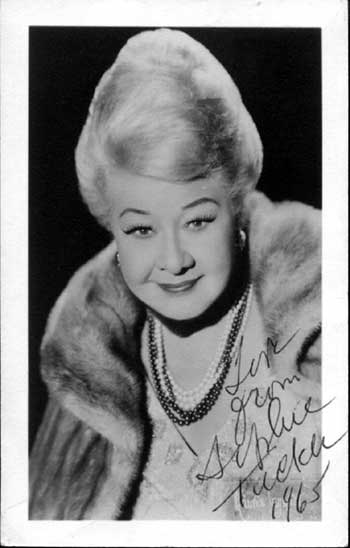 An
autographed photo of vaudeville legend Sophie Tucker, one of the few whose
stardom outlasted the art form. Long before social media, she maintained a
mailing list of several thousand fans, who all received annual birthday &
anniversary cards, as well as personal notes announcing her appearces.
An
autographed photo of vaudeville legend Sophie Tucker, one of the few whose
stardom outlasted the art form. Long before social media, she maintained a
mailing list of several thousand fans, who all received annual birthday &
anniversary cards, as well as personal notes announcing her appearces.
An act could be darn near anything that was inoffensive and entertaining. A performer's gender, race and appearance were no barrier to success, and nothing was too eccentric if it gave an audience ten to fifteen minutes of diversion. While singers and dancers were part of every bill, the specialty acts set vaudeville apart –
Acrobats, ice and roller skaters, cyclists and other non-talkers were known as "dumb acts." A few of these went on to stardom when they added humorous repartee to their routines, including juggler W.C. Fields and rope trickster Will Rogers. A few unique acts defied definition. Think-a-Drink Hoffman came onstage with an empty cocktail shaker and somehow made it pour forth any alcoholic concoction audience members called for.
Celebrities from other fields were also popular. Helen Keller, Carrie Nation, Babe Ruth, movie star Douglas Fairbanks and the scandalous beauty Evelyn Nesbitt all received thousands of dollars a week for personal appearance tours in vaudeville. Limited talents like Ms. Nesbitt started in the big time and worked their way down – the reverse of the path taken by those who achieved lasting stardom.
Vaudeville audiences were not passive observers. They were vocal and sometimes physical participants in performances. Their cheers, jeers or painful silences would make or break an act. At New York's Palace, the reaction of the show biz pros attending a Monday matinee affected an act's bookings and pay for months to come. But a bad reaction in any vaudeville theatre could ruin an act's reputation. If a local manager decided to fire an act due to audience displeasure or disinterest, a damning report was sent back to the United Booking Office. So it is no exaggeration to say that from Broadway to Boise, audiences had tremendous influence in shaping vaudeville.
Who's On the Bill?
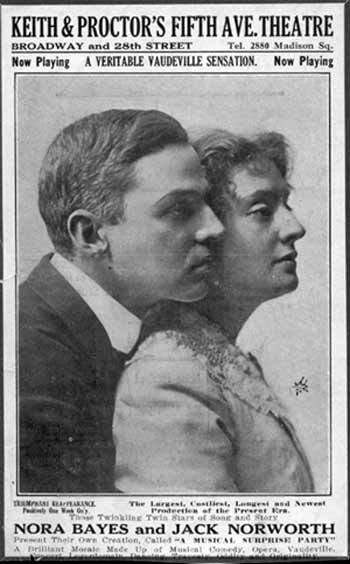 A
period advertisement depicts songwriter Jack Norworth and extremely popular
vocalist Nora Bayes, the co-creators of "Shine On Harvest Moon." She sang while he
just sat onstage admiring her, and audiences ate it up. In time, Norworth tired of Bayes' tantrums
and divorced her. Despite her temper, she remained a top vaudeville star until her death at
age 48.
A
period advertisement depicts songwriter Jack Norworth and extremely popular
vocalist Nora Bayes, the co-creators of "Shine On Harvest Moon." She sang while he
just sat onstage admiring her, and audiences ate it up. In time, Norworth tired of Bayes' tantrums
and divorced her. Despite her temper, she remained a top vaudeville star until her death at
age 48.
To cut down on squabbles among performers, theater owners came up with the idea of advertising acts in order of appearance, rather than order of importance. This is how all handbill ads for vaudeville houses were printed -- and the lineup came to be known as a vaudeville bill. A bill consisted of approximately eight acts, but could be longer or shorter in certain theatres. Most bills followed this basic format –
- The "Opening" was a "silent act" that would not be ruined by the bustle of an audience settling in. Acrobats or animal acts were ideal. For any other kind of act, getting booked in this spot was the ultimate insult.
- Usually a "singing sister" or "dancing brother" act – in which the performers were not necessarily relatives. The youngest of the singing Gumm Sisters went on to fame after changing her name to Judy Garland, and the tap dancing Nicholas Brothers played this spot before becoming headliners
- A comedy sketch or one-act play. These could be old melodramas with unknown casts or new works featuring top Broadway stars. Sarah Bernhart, Ethel Barrymore, Walter Hampden, Nazimova and Helen Hayes toured in vaudeville. Alfred Lunt got his first big break touring with the infamous actress Lillie Langtry in a vaude one-act. Some of the finest professional writers provided sketches and one-act plays for vaudeville use, including J.M. Barrie, Arthur Conan Doyle, David Belasco, Jack London, George M. Cohan and W.S. Gilbert.
- A novelty act or eccentric dance act was thrown into the fourth spot to liven things up.
- This spot was reserved for rising stars or falling ones, to close out the first half of the program with a solid crowd pleaser.
- After intermission came a "big" act involving a large set – choirs, novelty orchestras and top animal acts were typical choices for this slot.
- "Next to closing" was the star spot reserved for the headliner – usually a vocalist or comedian. Jack Benny, Sophie Tucker, George Burns and Gracie Allen, Marie Dressler, Al Jolson and Eddie Cantor were among the few headliners whose fame outlived vaudeville. Singer Kate Smith (best remembered for introducing Irving Berlin's "God Bless America" on radio) was held over at the Palace by popular demand for eight weeks – making her the longest-running headliner that house ever had.
- The "closing" spot was reserved for short films -- or annoying acts that might encourage patrons to leave before the next show. A clunky one-man band or a grating singer were typical closers.
Placement on a bill was a vital issue. Performers considered the opening or closing slots humiliating, since audiences were too busy settling in or filing out to pay serious attention.
"The star system also emphasized the rewards of success through the pacing of the bills. The top acts played the best houses, had the longest acts, and, most important, made the most money, a fact that was apparent from one's place on the eight-act bill and from discussions in the popular press. Vaudeville encouraged urbanites to enter a redefined race for success, transforming Horatio Alger into a consumer of material pleasure."
- Lewis A. Erenberg, Steppin' Out: New York Nightlife and the Transformation of American Culture 1890-1930 (Chicago: University of Chicago Press, 1981), p. 68.
Comedians and Hoofers
Vaudeville was a particular challenge for comedians, who had to find material that could win laughs from coast to coast. Milton Berle, who went on to fame in radio and television, explained –
"It took monologists like Jack Benny, Bob Hope, Benny Rubin, Rank Fay and me eighteen months to two years to get seven solid minutes to put into an act. You weeded out the crap, deleted and edited stuff that wouldn't play. Then when you went to Wilkes-Barre, it had to be changed again. And then another town, and still more changes. Where can you get that kind of training today?"
- as quoted by editor Bill Smith in The Vaudevillians (New York: Macmillan Publishing, 1976), p. 73.
In later years, comics were brought in to act as master of ceremonies, talking up the acts and helping a mediocre bill go over like a hit show.
TRANSCRIPT: Weber & Fields Vaudeville Sketch
A complete comedy sketch developed in the 1880s by vaudeville's most popular comedy team.
Musical accompaniment could be anything from a single piano to a full sized orchestra, and some small-time houses boasted two to three dozen musicians in the pit. To give conductors the proper tempo, dancers would beat their feet on the stage before entering. The resulting sound (like a horse pounding its hoof) led to the still popular nickname "hoofers."
Were all vaudeville shows wonderful? Far from it – they could be mediocre or even tedious, especially in medium and small time houses. The popularity of vaudeville rested in the fact that there were eight or more chances in every show to find something to your taste. If you did not like a particular act, you only had to wait a few minutes for something (hopefully) better to come on.
TOBA and Blacks in Vaudeville
Vaudeville did much to to teach audiences of different ethnic and social backgrounds to get along. Defying the racist norm that dominated American society, vaudeville had black and white performers sharing the same stage as early as the 1890s. But managers had to deal with the legal and social realities of their time. Most southern states did not allow blacks and whites to sit in the same theatre, and even most Northern cities barred blacks from the best seats as late as the 1920s.
The TOBA Circuit ("Theatre Owners Booking Agency," which performers re-named "Tough On Black Asses") were the only venues below the Mason-Dixon Line that welcomed "colored" customers in the early part of the 20th Century, offering all-black bills for all-black audiences. For midnight performances on Saturdays, some TOBA houses allowed whites to sneak into the balcony.
Admission was twenty five cents in most TOBA houses, so production budgets were tight. Many black performers accustomed to top pay in big-time vaudeville performed this circuit for a fraction of their usual fee. It was the only way they could reach the appreciative black audiences of the deep South. Black vaudeville showcased such outstanding performers as –
Ethel Waters (a.k.a. "Sweet Mama Stringbean") - who went on to Broadway and film stardom
Ma Rainey - jazz vocalist
Bert Williams - Ziegfeld Follies star
Bessie Smith - jazz vocalist
Bill "Bojangles"Robinson - tap dance legend
With none of Keith and Albee's restraints, black vaudeville developed a tradition of sexually suggestive blues numbers peppered with double meanings. Favorites included "You Got the Right Key But the Wrong Keyhole" and "Kitchen Man" –
I'm wild about his turnip tops.
Likes the way he warms my chops!
I can't do without my kitchen man.
Now when I eat his donut
All I leave is just the hole.
And if he really needs it,
He can use my sugar bowl!
Aside from the raunchy humor, black audiences saw the same kinds of acts found in standard vaudeville. Variety made a point of reviewing black vaudeville acts, helping to increase their level of recognition throughout the industry. Some white performers were hostile to black colleagues, but the only thing managers cared about was audience response. In vaudeville, the color of money was the only color that really mattered.