
Ziegfeld 101
Florenz Ziegfeld: A Brief Biography
by John Kenrick
(Copyright 2002-2004)
(All the photos on this page are thumbnail images – click on them to see larger versions.)
Please note: Facts are tricky things -- truths are even trickier. Ziegfeld so embellished his life for publicity purposes that it is often hard to separate the facts from his creative fictions. All of his biographers have fallen for at least a few of his whoppers. This brief profile tries to side step the worst of the lot, offering our best shot at "the truth."
Beginnings
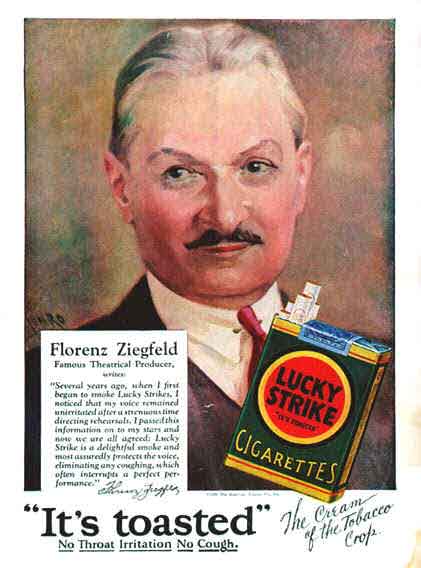 In
this ad found on the back of a program for Show Boat, Ziegfeld is quoted
as saying that Lucky Strike cigarettes "most assuredly protect the voice."
Note the portrait, from Ziegfeld's brief moustache period.
In
this ad found on the back of a program for Show Boat, Ziegfeld is quoted
as saying that Lucky Strike cigarettes "most assuredly protect the voice."
Note the portrait, from Ziegfeld's brief moustache period.
Florenz Ziegfeld, Jr. was born in Chicago on March 15, 1867. (Some published sources list March 21 -- I have not seen solid documentation to verify which is the correct date.) His German immigrant father ran the successful College of Music, and raised his family in an atmosphere of relative comfort. Young Flo had two brothers, one sister, and a strict but loving mother who kept her brood in line. Even as a boy, Flo showed a penchant for creative publicity. He went a bit too far when he sold kids tickets to see a school of "invisible fish" that turned out to be nothing more than a glass bowl filled with water. The resulting fuss taught him a valuable lesson. In his adult career, he always tried to build his publicity around the best talent he could find.
In later years, Flo would claim that at age 16 he ran off with Buffalo Bill's Wild West Show and beat Annie Oakley in an 1883 shooting match – but since Oakley did not begin touring until 1885, odds are that this was one of Ziegfeld's many self-perpetuated legends. We do know that Ziegfeld so hated school that his parents sent him off to a brief stint at a Wyoming cattle ranch. After a few months playing cowboy, the teenager returned to Chicago.
In 1893, Ziegfeld's father opened The Trocadero, a nightclub designed to capitalize on the city's upcoming World's Fair. When the club's mix of classical music and variety acts failed to draw much of an audience, Flo offered to save the day. Given a free hand, he booked strongman Eugene Sandow and staged a massive publicity campaign. Sandow's statuesque physique and dramatic feats of strength wowed the opening night audience. When several high society matrons stopped backstage to see the handsome hunk flex his fifty eight inch chest up close, the resulting press coverage made the Trocadero the hottest night spot in town.
After saving his grateful father from bankruptcy, Ziegfeld took Sandow on an extended vaudeville tour, winning fresh press coverage in every city with a series of inventive publicity stunts. In San Francisco, things backfired when Ziegfeld announced Sandow would wrestle a man-eating lion – the thousands who showed up could see that the poor beast had been drugged into submission. After two years, Sandow and Ziegfeld parted on good terms.
Although Sandow's tour had been a tremendous success, Ziegfeld's penchant for gambling had eaten up most of his profits. He decided to try his luck on Broadway.
What Broadway lacked, at the turn of the century, was a figure who could fuse the naughty sexuality of the streets and the saloons and the burlesque show with the savoir-faire of lobster palace society -- someone who could make sex delightful and amusing. What it lacked was Florenz Ziegfeld.
- James Traub, The Devil's Playground: A Century of Pleasure and Profit in Times Square (New York: Random House, 2004), p. 31.
Anna Held
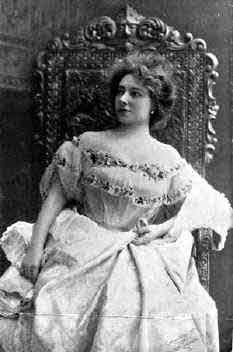 Anna Held at
the height of her fame.
Anna Held at
the height of her fame.
Anxious to make his first production a sure hit, Ziegfeld persuaded the leading comedy team of Charles Evans and Bill Hoey to star in a musical version of their popular comedy A Parlor Match. Ziegfeld and Evans sailed to Europe in 1895 to find a new female star. While in London, they saw music hall sensation Anna Held. Her colorful French accent, eighteen inch waist, hourglass figure and coquettish personality captivated Ziegfeld. Aware that Held was under contract to the Folies Bergere, he wined and dined her with relentless zeal. It is doubtful that his main motivation was love, unless one means love of money.
For all her aristocratic Parisian ways, Held was the Polish-born daughter of a Jewish glove maker. She made her stage debut in England and rose to fame in the cafes of Paris. Although married, her husband's heavy gambling had long since driven them apart, so Held proved quite susceptible to Ziegfeld's advances. She soon gave him her heart, as well as her signature on a contract.
When the Folies Bergere demanded a $1,500 pay off for the loss of Held's services, Ziegfeld (who had spent the last of his bankroll wooing Anna) had close friend "Diamond" Jim Brady wire payment from New York. By the time Held crossed the Atlantic, Ziegfeld's publicity efforts had landed her name and photo in every major newspaper. All Anna had to do was live up to the hype.
Milking Publicity
The 1896 Broadway revival of A Parlor Match had two musical highlights – the hit song "Daisy Bell" (also known as "A Bicycle Built for Two"), and Anna Held's performance of the playful "Won't You Come and Play With Me?" To guarantee ongoing publicity, Ziegfeld let out word that Held took daily milk baths, and he won headlines by suing a popular dairy for sending sour milk. The outraged dairy owner soon revealed that it was all a hoax – Held bathed in scented water that just looked milky. The brouhaha succeeded in making Held a national celebrity. After a calculated brief run (guaranteeing too few tickets for the growing demand), Ziegfeld took A Parlor Match on tour for several months. Held's continental style and lavish tastes added to her appeal, drawing curious audiences everywhere she performed.
Over the next twelve years, Ziegfeld produced seven Broadway musicals tailored to showcase Held's charms. Each one ran for a few weeks in New York before touring. When a brief vaudeville engagement proved a sensation, Ziegfeld realized he had not been capitalizing on Held's music hall appeal. From Papa's Wife (1899) onwards, her shows were better suited to her coquettish style. She introduced several hit songs, including "I Just Can't Make My Eyes Behave" and "It's Delightful to Be Married." Ziegfeld backed her with a troupe of comely chorines called "The Anna Held Girls" – the first of his signature chorus lines.
Ziegfeld never missed an opportunity to get Held's name in the papers. When she took a tumble while cycling through Brooklyn, Ziegfeld informed the press that Anna had leapt off her bike to stop a runaway carriage and save the life of a retired judge. Most of the press didn't buy it, and one columnist wondered what drugs Ziegfeld was using to come up with such nonsense!
When Held obtained a divorce from her first husband in 1897, she and Ziegfeld declared themselves married. There was never any formal public ceremony -- their extended cohabitation made them common law spouses in the eyes of New York State. (It also spared Held from embarrassing condemnation by the Catholic Church.) Ziegfeld's heavy gambling and dictatorial management soon soured the relationship. After he staged the theft of Held's beloved jewel collection for publicity purposes, she realized that he was abusing her trust.
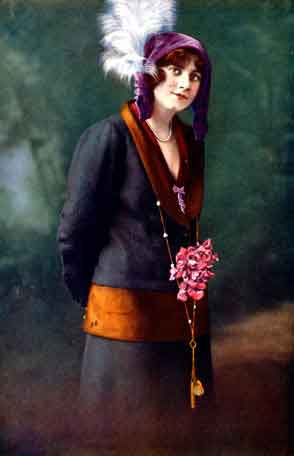 Several
biographers have perpetuated a story (told by Held's daughter from her
first marriage) that Ziegfeld forced Held to abort a pregnancy that threatened to
delay the expensive production of Miss Innocence (1909). While this claim is
now considered questionable, we do know that was the year Ziegfeld began his
all-too public pursuit of showgirl Lillian
Lorraine. Lorraine was a temperamental beauty who's taste for alcohol and
monumental tantrums would plague Ziegfeld as their on-again/off-again love
affair spread over the next two decades.
Several
biographers have perpetuated a story (told by Held's daughter from her
first marriage) that Ziegfeld forced Held to abort a pregnancy that threatened to
delay the expensive production of Miss Innocence (1909). While this claim is
now considered questionable, we do know that was the year Ziegfeld began his
all-too public pursuit of showgirl Lillian
Lorraine. Lorraine was a temperamental beauty who's taste for alcohol and
monumental tantrums would plague Ziegfeld as their on-again/off-again love
affair spread over the next two decades.
Held tried to reconcile with Ziegfeld several times, but he was not interested. Exasperated, she tried to force him to his senses by filing for divorce in 1912, naming Lorraine as one of several co-respondents. When Ziegfeld refused to contest the action (a scandalous gesture guaranteed to generate publicity), a heartbroken Held refused alimony. She resumed her career, finding independent success on Broadway and in vaudeville, and performing for the frontline troops in World War I. A rare form of bone cancer lead to her death in 1918. Ziegfeld, who suffered all his life from a morbid fear of death, refused to attend her funeral.