
Ziegfeld 101
Anna Held
by John Kenrick
Copyright 2002-2004
The photos below are thumbnails – click on them to see full size versions.
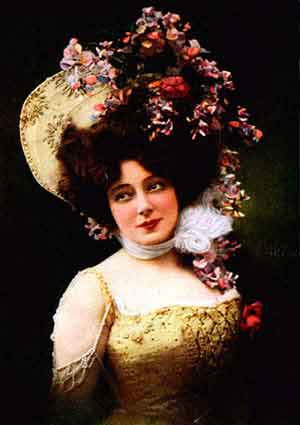 It is impossible to discuss Florenz Ziegfeld, Jr.'s development
as a showman without considering Anna Held's contribution to his life and
career. Ziegfeld got his taste in clothes, knowledge of stage presentation, and even the
idea for his Follies from her. She was one of the first celebrities to win
transatlantic fame, and a leading musical stage star for more than two
decades. It is no exaggeration to say that she was one of the most remarkable
women of her time.
It is impossible to discuss Florenz Ziegfeld, Jr.'s development
as a showman without considering Anna Held's contribution to his life and
career. Ziegfeld got his taste in clothes, knowledge of stage presentation, and even the
idea for his Follies from her. She was one of the first celebrities to win
transatlantic fame, and a leading musical stage star for more than two
decades. It is no exaggeration to say that she was one of the most remarkable
women of her time.
Although she later insisted that she was a native Parisian, Helene Anna Held was born in Warsaw, the daughter of a German Jewish glove maker and his French wife. Her "official" birthday was March 18, 1873, but some sources suggest she was born five to eight years sooner. When anti-Semitic pogroms swept Poland in 1881, the Held family fled to Paris. When her father's health faded (some sources suggest he was a heavy drinker), teenage Anna and her mother had to support themselves as sweat shop seamstresses. Anna occasionally sang in the streets to earn extra pennies.
To the Stage
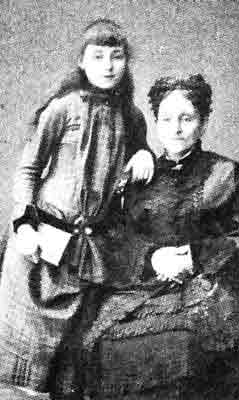 Anna
Held at age 15 with her mother.
Anna
Held at age 15 with her mother.
After her father's death in 1884, Anna and her mother went to live with relatives in London. There she made her professional stage debut in the legendary Yiddish theatre companies of Avram Goldfadn and actor-manager Jacob Adler. She returned to Paris, where her rolling eyes, eighteen inch waist and naughty songs made Held a major star in the finest cafes. She increased her fame by such shrewd gestures as riding horses astride (rather than side-saddle), and by being one of the first women to ride the newly invented bicycle and motorcar.
She had an affair with wealthy South American gambler Maximo Carrera, and they married barely in time to legitimize the birth of their daughter Liane sometime around 1895. The child was raised in a convent, and the uncaring parents both went back to their separate lives. Anna's primary benefit from this marriage was that it gave her the excuse to convert to Catholicism. While she cared little for religion, she was anxious to escape the stigma faced by Jews in most of Europe. It also made it easier for her to perpetuate the myth that she was a native born French woman – a claim she clung to long after the press had proven otherwise.
Ziegfeld
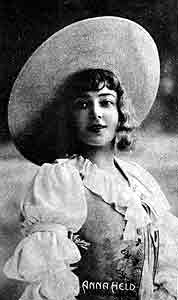 Held
in Paris, sometime around 1890.
Held
in Paris, sometime around 1890.
Anna resumed her career, touring Germany and England with success. She was appearing at London's Palace Music Hall in 1896 when the brash American producer Florenz Ziegfeld Jr. bribed his way into her dressing room. Ziegfeld wanted Held to appear in an upcoming Broadway production, and offered her the then-staggering sum of $1,500 a week. Anxious to get away from her husband's mounting gambling debts, Held was quite willing to make the trip. Thanks to Ziegfeld's masterful publicity (and his selective bribery of the press), Held's name and photo soon appeared in every newspaper and souvenir shop in New York. By the time she arrived in the U.S., she was a ready-made celebrity.
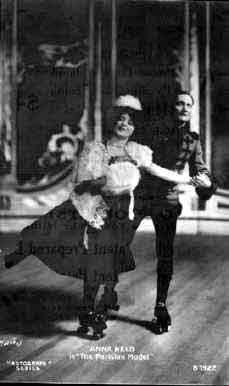 Held and an unidentified co-star roller-skate in
A Parlor Match.
Held and an unidentified co-star roller-skate in
A Parlor Match.
A Parlor Match (1896) was the story of a clever hobo who hoodwinks a gullible millionaire out of his valuables. At one point, the hobo uses a rigged "spirit cabinet," producing performing "ghosts" to prove that his victim's house is haunted. Held appeared as one of these phony phantoms, singing her popular hit, "Won't You Come and Play With Me?"
I wish you'd come and play with me,
For I have such a way with me,
A way with me, a way with me.
I have such a nice little way with me,
Do not think it wrong.
Her charming, suggestive delivery and outrageous French accent (the word "with" pronounced "wiz," etc.) made a tremendous hit with the opening night audience, and she had to sing several encores. After the premiere a wild group of admirers (possibly paid by Ziegfeld) unhooked Held's carriage from its horses and pulled her through the streets. So what if most critics were less than impressed by Held's performance? She was the talk of New York, and talk sold more tickets than reviews did.
Got Milk?
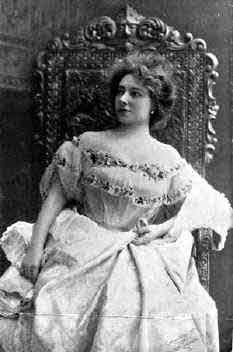 Whenever she was
photographed, Held preferred poses that showcased her petite waist.
Whenever she was
photographed, Held preferred poses that showcased her petite waist.
Always in search of a fresh publicity angle, Ziegfeld got an idea from the milky bath mixture Held used to condition her skin. He informed the press that Miss Held bathed in several gallons of fresh milk every day, and reinforced the story by saying he had returned one shipment from a local dairy because it had gone sour. The dairy owner sued Ziegfeld for libel and the hoax was eventually revealed – but Held's name made headlines every step of the way, and soon people all across the country were clamoring to see this semi-scandalous celebrity.
At its time, the milk bath incident made titillating headlines for weeks and supposedly started a brief fad. An auspicious beginning for Ziegfeld's aggressive publicity blitz for Anna Held as a daring European performer. "The name of the young woman became as well known in this country as the name of the President," the New York World declared a year after her arrival.
- Linda Mizejewski, Ziegfeld Girl: Image and Icon in Culture and Cinema (Durham, NC: Duke University Press, 1999), p. 41.
Over the next twelve years, Ziegfeld featured Held in seven Broadway musicals tailored to showcase her charms. Each ran in New York before going on tour (where most shows made their real profits at that time), but Held's first few shows were not the smash hits she and Ziegfeld had hoped for.
After living with Ziegfeld for over a year, Held finally wrangled a divorce from Maximo Carerra. At a dinner party in 1897, Flo and Anna announced to friends that they hereby considered themselves "married." Although they never bothered with a formal ceremony, their longstanding cohabitation made them common law spouses as of 1904. This spared Held any wrangling with the Catholic Church (which forbade both divorce and remarriage without a costly dispensation), and made it easier for Ziegfeld to keep his options open -- options he would exercise before long.