
Theatre in NYC: History - Part III
by John Kenrick
(Copyright 2003)
(All photographs are items from the author's private collection, and should nit be used without permission.)
Up to Union Square
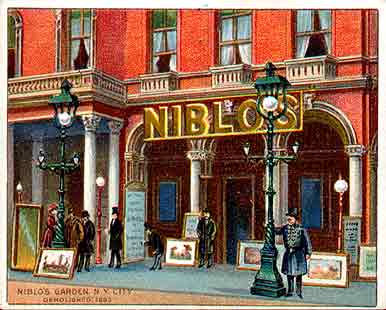 The
entrance to Niblo's Garden was depicted on this
mid-20th Century cigarette card.
The
entrance to Niblo's Garden was depicted on this
mid-20th Century cigarette card.
Niblo's Garden manager William Wheatley stumbled into theatrical history when he beefed up a weak melodrama with lavish sets and threw in a stranded French ballet company to create The Black Crook (1866). This landmark Broadway blockbuster ran for over a year and toured for decades, redefining the commercial potential of theatre in America. As for Niblo's Garden, it remained one of New York's most popular venues for several more decades, even as the city's center of theatrical activity moved more than a dozen blocks uptown.
Theatres came and went with alarming speed in those days. Built mostly of wood and lit primarily by flaming gaslight, the theatres of the late 1800s were infamous firetraps. Theatre managers and public officials paid little if any attention to fire safety laws. At least one fourth of the theatres built in New York during the 1870s were destroyed by fire. Most of these fires occurred late at night, when the buildings were empty, fueling speculation that at least a few theatre owners resorted to arson in order to collect on their fire insurance policies.
Such was definitely not the case on the evening of December 5, 1876, when a kerosene lamp set some scenery aflame during a sold-out holiday season performance at the Brooklyn Theatre. The packed audience panicked, and those in the balcony were fighting for access to the one narrow stairway when the building's roof and several internal walls collapsed. At least two hundred died -- it is likely that embarrassed officials fudged the final death toll. New fire laws were quickly passed, and although theatre fires remained commonplace for some years, to this day there has not been another audience casualty due to fire in a New York City theatre.
By the 1870s, "Broadway" and "theatre" were becoming synonymous, and the Union Square area near Broadway at 14th Street had become New York City's main theatre district. A central hub for public transportation, this highly accessible neighborhood offered theatres, restaurants and fashionable shops. Countless theatrical producers and booking agents worked in the neighborhood, but not always in offices. One veteran of the period described the sidewalk negotiations that took place in and around the square.
"The most prominent players, including the stars and their respective managers and agents, could be found parading the sidewalks, their date books in their hands. Those were the days of the barn-stormer, when the "fly by night" manager was in his element. All classes of showmen congregated here, and here the plans of the most important stage providers were matured for many years."
- Robert Grau, The Businessman in the Amusement World (New York: Broadway Publishing Co., 1910), p. 2.
Golden Years
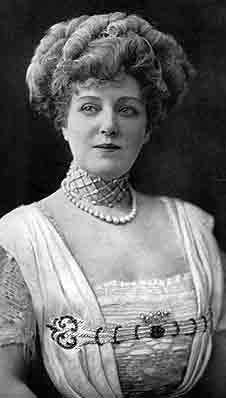 Lillian
Russell, one of the most memorable personalities of the 1890s.
Lillian
Russell, one of the most memorable personalities of the 1890s.
Tony Pastor opened the first vaudeville theatre one block East of the square in 1881. The greatest Broadway musical talents of the age worked in Union Square venues, including Lillian Russell and George M Cohan. The team of Ned Harrigan and Tony Hart presented a series of popular musicals at the Theatre Comique, a converted synagogue. Although well below Union Square, it was typical of the theatres in use in the 1880s –
"Inside, there was a smallish auditorium, attractively decorated in white, red and gold, with a seating capacity of 1,400. Conveniently abutting the orchestra level was a saloon; between the acts, thirsty patrons could obtain drinks by opening a window that connected the foyer with this establishment and yelling their orders through the gap. . . there were six evening performances a week, beginning at eight o'clock, and Wednesday and Saturday matinees, beginning at two."
- E.J. Kahn, The Merry Partners: The Age and Stage of Harrigan and Hart (New York: Random House, 1955), pp. 169-170.
As Manhattan's population continued to spread northward, new theatres appeared near Madison Square, the area surrounding the junction of Broadway and 23rd Street. In 1885, the old Lyceum (at Fourth Avenue near 24th Street) became the first New York theatre to be lit entirely by electricity -- with inventor Thomas Edison personally supervising the installation. By this time, theatergoing was a thoroughly ingrained part of most New Yorker's lives. The combination of a growing population, improving transportation and an ever-increasing influx of well-funded tourists kept the demand for respectable stage entertainment high.
During the crippling Blizzard of 1888, several theatres still played to packed houses. When the hurricane force winds and five-foot snow drifts left Tony Pastor with only a handful of customers in his Union Square vaudeville house, he invited in a few dozen politicos from neighboring Tammany Hall, and after the performance served the audience and performers free champagne and sandwiches. Uptown at the new Madison Square Garden, P.T. Barnum broke out champagne for the 200 customers who made it in for the opening night of his new circus. When it became clear that everyone would be snowed in for some time, the circus clowns took seats and applauded the improvised antics of several inebriated critics.
Union Square included the central offices for two massive show business empires. B.F. Keith and Edward Albee took over the Union Square Theatre in 1893, extending their vast New England-based vaudeville circuit into the heart of New York. Their booking office controlled most of the major vaudeville houses across the US. In 1896, theatre owners Marc Klaw and A.L. Erlanger formed the Theatrical Syndicate, which gave them monopolistic control of almost every legitimate theater in the country for the next sixteen years.
Times Square
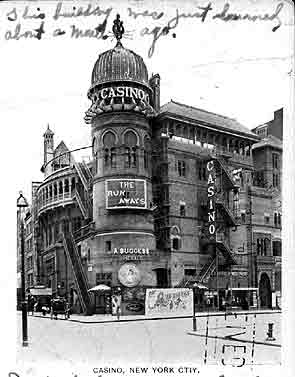 The Casino Theatre appears on a postcard dated
March 1905. The sender's inscription reads,
"This building was just burned about a month ago." It
was soon restored and remained in use for another quarter
century.
The Casino Theatre appears on a postcard dated
March 1905. The sender's inscription reads,
"This building was just burned about a month ago." It
was soon restored and remained in use for another quarter
century.
At the start of the 20th Century, America was in the full glory of its cultural adolescence, bursting with energy and optimism. New York City sustained thirty-three legitimate theatres, and demand was such that many more would soon be added. In 1904, New York opened its first subway rail lines, vastly increasing the number of people who could catch a Broadway show and still sleep in their own beds. Add in an ever-increasing numbers of tourists who came into the city by rail and steamship, and it was easy to see why Broadway could now support more productions and longer runs than ever before.
With the populated area of Manhattan stretching further to the North, new theatres sprang up to save ticket buyers the trip down to Union Square. (After a slow decline that stretched over eight decades, Union Square would enjoy a renaissance by the start of the 21st Century, once again becoming one of the city's most popular retail districts.) As the convergence point for several subway lines, the area known as Longacre Square around 42nd Street and Broadway (Manhattan's primary horse trading district, an named after London's carriage district) became a magnet for various businesses and a natural choice for a new theatre center. When the New York Times built an expanded publishing headquarters at this intersection in 1904, politicians on the City Council (always happy to appease a powerful newspaper) officially renamed the district Times Square. Although Manhattan's population would continue to expand northward in years to come, Times Square would remain New York's main theatre district.
In the early 1900s, Oscar Hammerstein I (grandfather of the great lyricist/librettist) and brothers Sam, Lee and Jacob Shubert built major theatres in the Times Square area, as did some independent impresarios. The Erlanger syndicate built several houses in the neighborhood, with the magnificent New Amsterdam Theatre on 42nd Street as their flagship house. Many theatres built in this period had rooftop gardens where audiences could enjoy outdoor performances on warm summer evenings. The first major hit to play the new theatre district was Florodora (1900 - NY 553), which opened at the exotic Casino Theatre.
Many great eateries thrived here in the early 20th Century, including elegant "lobster palaces" like Rector's and Shanley's, all featuring over-stuffed Victorian decor and pricey menus designed for multi-course feasting. The city's first theme restaurant was Murray's Roman Garden, where elaborate interiors recreated the atmosphere of an ancient villa, a columned temple, and Cleopatra's barge, all beneath a ceiling covered with twinkling electric stars. The rich, famous and ambitious went to these restaurants to see and be seen. An often-repeated anecdote one Broadway chorus girl bragging that she found a pearl in an oyster at Murray's, only to have a colleague reply, "That's nothing! Last night, I got a diamond necklace off an old lobster at Rector's."
These spectacular venues with their lavish menus and wine lists would thrive until Prohibition wiped out their liquor-based profit margins in the early 1920s. By providing inexpensive, booze-free menus for working class diners, Child's Restaurant and Horn & Hardart's Automat would serve Times Square until the 1970s.
During the first two decades of the 20th Century, the concrete traffic island between Broadway and Seventh Avenue at 47th Street became a popular hangout for unemployed vaudevillians and actors, earning it the nickname "the beach." There, out-of-work performers would exchange boasts and keep an ear cocked for any hints of available work. This same stretch of sidewalk now draws far larger crowds than ever as the location of the TKTS discount ticket booth.