
Theatre in NYC: History - Part IV
by John Kenrick
(Copyright 2003)
- Technology Advances
- Early Off-Broadway
- Best, Worst of Times
- Off-Broadway Flourishes
- Resurrection of 42nd Street
(All photographs are items from the author's private collection, and should not be used without permission.)
Technology Advances
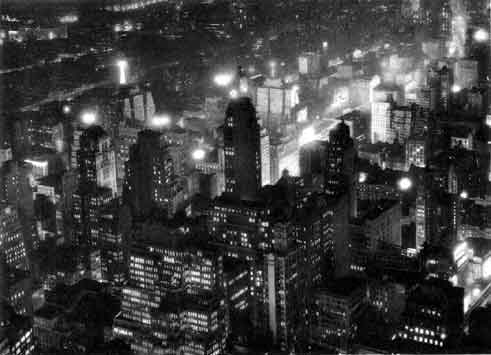 This postcard shows an aerial view of
Times Square in the 1930s with the distinctive shimmer of light that made it
"The Great White Way."
This postcard shows an aerial view of
Times Square in the 1930s with the distinctive shimmer of light that made it
"The Great White Way."
Gaslight was too weak to be used with colored filters, so theatre district advertising was fairly dull through the 1890s. Electric light was far brighter, making new effects possible. The first animated electric billboard appeared in Times Square in 1903, when Victor Herbert's musical The Red Mill installed a sign with carbon lights that imitated the revolving arms of a windmill. Soon every Broadway show had some kind of electrified signage. Colored bulbs burned out too quickly, so at first white lights were standard.
By 1905, the largest of these electric billboards -- called "spectaculars" -- were actually stopping traffic around Times Square. The nightly glow earned Broadway a new nickname: "The Great White Way." With the the introduction of neon lighting in 1927, elongated shapes and bright colors became part of the eye-popping mix.
Prohibition forced many great restaurants to close, undercutting their alcohol-based profits and forcing chefs to drop all classic dishes made with wine. The 1920s saw the rise of cafeterias, as well as large Chinese restaurants that had the advantage of cheap labor and menus that did not rely on wine-based sauces. These "chop suey" palaces could offer dinner with live dance music for 75 cents, and still turn a profit.
Through the early 20th Century, most Broadway producers treated their casts and crews like cattle. It was common practice to schedule extra performances on holidays without giving anyone extra pay. Producers also fired employees without notice, offered no pay during rehearsals, and usually forced actors to pay for their own costumes. These practices led to the formation of theatrical unions, which most producers initially tried to ignore. In August 1919, the Actors Equity Association demanded that all professional productions offer a standard contract. Producers scoffed at the idea, so the new union called for a strike. When the already unionized stage hands and musicians refused to cross the picket lines, every show in Broadway was soon forced shut down. After weeks of wrangling, the producers finally agreed to Equity's demands. Some producers continued to abuse the new contract, but the power of theatrical unions had been established. For better and for worse, that power has remained an ongoing fact of theatrical life ever since.
Early Off-Broadway
In the 19th and early 20th centuries, New York's theatrical world was not limited to the main theatre district. Vaudeville and burlesque venues thrived in all five boroughs of the city, and there was even a so-called "subway circuit" of legitimate theatres that brought Broadway tours to key neighborhoods. Now and then, a Broadway hit was launched from one of these outlying theatres. For example, in 1921 the all-black revue Shuffle Along premiered at the 63rd Street Music Hall and remained there for more than a year.
In the 1910s, smaller off-Broadway theatre groups set up shop in smaller downtown venues with the express purpose of developing and promoting experimental works. The Washington Square Players (later renamed the Theatre Guild), The Provincetown Players and The Neighborhood Playhouse were among the early pioneers in this field. Eva Le Gallienne headed a 14th Street repertory company in the 1920s, and the next decade saw the Group Theatre present a series of socially challenging dramas. It would be some time before musicals became a regular part of the off-Broadway scene.
Best of Times, Worst of Times
By the 1920s, the Shubert Brothers had crushed the Erlanger syndicate and established themselves as the most powerful figures in the American commercial theatre. The 1920s saw a final burst of new theatrical construction, with more than thirty new venues appearing in the Times Square area. Most of the theatres the Shuberts built in New York and elsewhere were designed by architect Herbert J. Krapp.
"Krapp quickly won favor with the Shuberts because of his ability to crowd as many seats as possible into a theater, even if the public amenities had to be sacrificed. Often he had to work with odd-shaped sites, but he always came up with a workable solution. A Krapp-designed house is compact, intimate, and economical; its acoustics are generally excellent; and its sightlines range from satisfactory to very good. The facades are generally eclectic in a style that might be best described as Krapp Conservative. Of the forty theatres built in the immediate Times Square area, Krapp's playhouses have proven to be the most enduring."
- Henderson, Theatre in America, p. 256.
Broadway's business peaked in the 1927-28 season, as more than 70 legitimate theatres housed well over 250 shows. The proliferation of theatres in Times Square created a unique opportunity for producers as well as ticket buyers.
"At theater time, when many of the theatergoers were wearing evening dress, the combination of streetcars and taxis made the traffic sluggish. Most people walked. Theatres were built close together because pedestrians were accustomed to shop from theater to theater. Out for a good time, they provided some sort of audience for the plays that were not hits. . . Theaters that had not sold out by six o'clock sent bunches of their tickets to Joe Leblang's shop to be sold at half price."
- Brooks Atkinson, Broadway (New York: Macmillan Publishing Co., 1974), p. 176.
Within a few years, the economic pressures of the Great Depression and the tremendous popularity of talking films took their toll. As audiences stayed home (assuming they still had homes), the 1930s saw a perilous drop in the number of new Broadway productions. When the Shuberts were forced to declare bankruptcy, Lee Shubert was the only man to bid when their theatrical empire was auctioned off. He bought back his properties at a fraction of their former value, and simultaneously left his hated brother Jacob a powerless co-figurehead.
Some lesser theatres were sold off and demolished, and still others were converted to use as film houses or radio studios, but Lee kept Broadway's key venues intact and in use. In so doing he preserved New York's place as the center of the American commercial theatre -- and kept commercial theatre from following vaudeville into extinction.
World War II eventually re-energized the American economy. Many great musicals appeared in the 1940s, particularly after Oklahoma (1943) redefined the genre. But theatre rents, union minimums and advertising costs rose, making it increasingly harder for shows to turn a profit. So even as the American musical enjoyed what many have called its "golden age," the number of Broadway productions continued to gradually decline. The decades that followed saw their share of hits, but an increasing number of young producers looked for a less expensive alternative to Broadway.
Off-Broadway Flourishes
Small downtown theatres in Greenwich Village and the Lower East Side had been home to experimental theatre since the 1920s. The environment changed in the 1950s as musicals became a regular part of the off-Broadway mix. An ongoing parade of profitable intimate revivals (Leave It to Jane), revues (Greenwich Village USA) and quirky new book shows (Little Mary Sunshine) began to prove that off-Broadway had unrealized commercial and artistic possibilities.
The Fantasticks opened in 1960, its forty-plus year run marking a time when successful musical productions could emerge far beyond the bounds of Broadway. From the tiny Cherry Lane Theatre (Godspell - 1971) to the massive Brooklyn Academy of Music (Candide - 1974 revival), hit musicals kept emerging all over the city.
Several small to midsize musicals conceived for off-Broadway rank among the most popular works ever written, including Little Shop of Horrors (1982) and Nunsense (1985). Broadway hits as diverse as Bring in Da' Noise, Bring in Da' Funk (1996) and Urinetown (2001) were born off-Broadway, and every season brings new, innovative works to New York's smaller venues.
Resurrection of 42nd Street
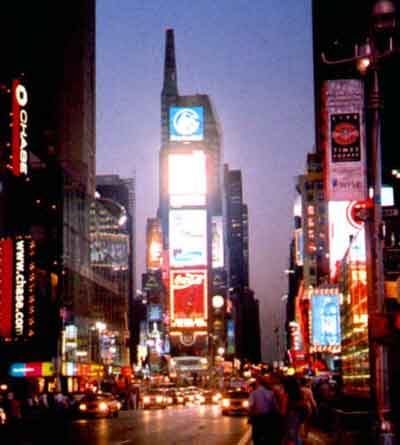 Once-squalid
Times Square now greets theatergoers with
bright lights and familiar chain restaurants.
Once-squalid
Times Square now greets theatergoers with
bright lights and familiar chain restaurants.
By the 1970s, Times Square was one of the grungiest and most dangerous neighborhoods in New York. The last quarter of the 20th Century saw the demolition of dozens of old Broadway theatres, and the construction of only four new ones. The once glamorous theatres along 42nd Street (including the New Amsterdam) were all in varying states of disrepair. Some showed pornography or kung fu films, while others were crudely converted into retail space. Many felt the decline of Times Square was irreversible.
"In 1975, the legendary entertainment and media district – whose name and glittering image still drew tens of millions of visitors each year – had degenerated in many places into a squalid, crime-ridden twilight zone of sex shops, strip clubs and seedy bars. New Yorkers themselves often took a kind of ironic civic pride in the fact that the crossroads of the world now looked more like Skid Row than the Great White Way, as prostitutes, drug addicts, alcoholics and swarms of men in search of sex patrolled 42nd Street and the storied side streets off Broadway and Times Square."
- Rick Burns & James Sanders with Lisa Ades, New York: An Illustrated History (New York: Alfred Knopf, 2003), p. 554.
The 1980s saw Broadway dominated by imported mega-musicals (Cats, Les Miserables), and the 1990s saw the rise of well-heeled producing corporations like Disney (Beauty and the Beast, Lion King). These hits brought more theatergoers to Times Square, proving that the district had fresh commercial potential. As several new high-rise hotels were built, and a series of major corporations (MTV, ABC, etc.) established a new presence in the neighborhood, tawdriness gave way to a renewed sense of high tech glamour.
"By the late 1990s, a new Times Square had emerged – cleaner, better lit, and more wholesome than it had been in half a century, and busier and more profitable than it had been in decades. Each night as the sun went down, the district was transformed into a glowing, shimmering diaphanous dish of light."
- Burns & Sanders, p. 554.
On the down side, theatrical production costs continued to rise, and so did the price of tickets. Orchestra seats that went for $8 in 1965 were $45 by 1985, and $100 by 2001 – a far steeper rise than the overall increase in the cost of living. Theatre attendees became increasingly old and increasingly well-heeled. With the young and the poor effectively shut out, the once popular pastime of theatre was becoming a subculture for the select few who could either afford to pay full price or insiders with access to complimentary tickets.
But New York's theatre district is once again a prime tourist attraction, and the theatre remains a key factor in the city's financial well-being. According to the League of Theatre Owners and Producers, Broadway shows currently sell one and a half billion dollars worth of tickets annually. Figure in hotels, restaurants and stores, and it is estimated that theatergoers contribute four and a half billion dollars to the local economy. Although skeptics may grumble about the future of New York City and the viability of commercial theatre, it appears that neither one is about to disappear.