
Dance in Stage Musicals
by John Kenrick
(Copyright 2003-2004)
- Ancient Beginnings
- Minstrelsy: Shuffle & Cake Walk
- Master Juba: Birth of Tap
- The Black Crook: Ballet
- Vaudeville
- Song & Dance Man: Cohan
- Vernon & Irene Castle
There is amazingly little in the way of published material discussing the development of dance in musical theatre. This essay cannot hope to make up for that inexplicable shortfall. Our goal is to offer a brief profile of how dance has become a key element in the musical story telling process, note important events and individuals, and quote some of the best scholarly works covering the subject.
Ancient Beginnings
The ancient Greeks had included songs in their stage dramas since the Fifth Century B.C. As the Roman Empire expanded in size and power, it borrowed many ideas from Grecian culture, including a passion for theatre. Roman theatre buffs of the Second Century B.C. delighted in the Greek-style comedies of Plautus. Because Roman theatres seated tens of thousands, their plays stressed spectacle and broad comedy. Along with integrated song and dialogue, these music-laced comedies included dance routines for major characters. To make the dance steps more audible, bits of metal called "scabilla" were nailed to the bottom of the performer's sandals -- the first tap shoes.
If you are looking for more on this, one of the few books to discuss the musical aspects of Greco-Roman theatre is Martin Flynn's Musical: A Grand Tour (New York: Schirmer Books, 1997).
Minstrelsy: Shuffle & Cakewalk
Thomas "Daddy" Rice sewed the seeds of minstrelsy when he blacked his face and performed "Jump, Jim Crow" in an exaggerated comic parody of African Americans -- well, at least a parody of the way white people thought blacks behaved. His dance routine was a combination of hardshoe (a heel-to-toe tap and spin technique that later evolved into tap) and the shuffle (loose-limbed steps that African American had developed as part of "levee dancing").
When the Virginia Minstrels staged the first full-length blackface revue in New York in 1843, they initiated a nationwide craze that lasted into the next century. In minstrel shows, white men blackened their faces with burnt cork to lampoon Negroes, performing songs and skits that sentimentalized the nightmare of slave life on Southern plantations. The most popular musical stage shows of the early and mid 19th Century, minstrelsy embodied racial hatred. Over time, both white and black performers donned blackface, and audiences of all colors loved it.
. . . blendings of black and white dances pervaded early minstrelsy and help account for its appearance of uniqueness. The normal direction of the adaptation, however, was from black to blackface, and the "borrowers" were white men who consciously learned from blacks.
- Robert C. Toll, Blacking Up: The Minstrel Show in 19th Century America (New York: Oxford University Press, 1974), p. 43.
From the beginning, dance was one of the key elements that white performers co-opted. In the tradition of Thomas Rice, most minstrel dance routines included hardshoe and the shuffle. While minstrel show dances were rooted in the folk traditions of the plantation, they also incorporated elements of Irish jigs and clog dancing. The clog arrived on American shores in the 1840s, performed as a "quick waltz" in 6/8 time by men wearing heavy wooden-soled shoes. Minstrel performers popularized many dance steps that became staples in musical theatre and film, including the buck and wing, the soft shoe, the shuffle and the cakewalk.
Master Juba: Grandfather of Tap
There is some controversy regarding the origins of tap dancing. Historian Tyler Anbinder suggests that tap was born in the dance halls of Manhattan's once-infamous "Five Points" district. Anbinder describes African American dancer William Henry Lane -- better known as "Master Juba" -- as "the key figure behind the emergence of tap." His original steps (a combination of African American folk dances and Irish jig steps) dazzled New York audiences, and a rave review from no less a visitor than Charles Dickens led to a London engagement.
When Lane performed in London in 1848, the British also found his combination of speed and grace astounding. "How could he tie his legs into such knots," asked the Illustrated London News, "and fling them about so recklessly, or make his feet twinkle until you lose sight of them altogether in his energy."
- Tyler Anbinder, Five Points (New York: Free Press, 2001, p. 173).
Of course, no one called Lane's dance style "tap" in his lifetime -- metal taps were not used on dance shoes until the early 20th Century, so the term "tap" first appeared at that time. Lane remained in London, where he died in 1852 at age 27. Happily, he has not been completely forgotten -- contemporary tap artist Savion Glover included a tribute to Lane in the 1995 Broadway hit Bring In Da Noise, Bring In Da Funk.
The Black Crook: Ballet Beginnings
When a fire at New York's posh Academy of Music left a Parisian ballet troupe with nowhere to perform, Broadway theatre manager Thomas Wheatley used the dancers (and their lavish sets) in a mediocre melodrama that he also peppered with several songs. The result was The Black Crook (1866), a five hour long mish-mosh that became an unprecedented hit.
The show's primary draws were the underdressed fairyland chorus and lead dancer Marie Bonafanti, all choreographed in semi-classical style by David Costa. Imagine (if you dare) a hundred fleshy ballerinas in skin-colored tights singing "The March of the Amazons" while dancing about in a moonlit grotto. In an age when women used bustles and hoop skirts to hide their physiques, this display was the most provocative thing on any respectable stage.
For decades to come, the bulk of the dancing on the American musical stage was left to the ladies of the ensemble. Whenever possible, those ladies danced while displaying their legs in tights. Aside from staging various revivals of The Black Crook, David Costa created a lavish ballet for the record-setting pantomime Humpty Dumpty (1868). Connection to the plot was of no importance -- all that mattered were the shapely legs of the dance ensemble.
This remained the norm in musical stage performance right through the end of the 19th Century, and was particularly true in burlesque, which went from women in tights playing sexually transgressive roles in the 1880s to strippers baring all (or practically all) in the 1930s.
The more things change, the more they stay the same. Then, audiences flocked to the hootchy-kootchy, the shimmy, and the striptease; today, audiences flock to the latest offering from the Jack Cole/Bob Fosse approach to earthly delights. Clearly the history of American stage dance constitutes a record of American social acceptance of that delight in the bodies of dancers. Throughout our history, enterprising managers (down to the dullest among them) realized that vulgar stage dance usually attracts the largest audience.
- Richard Kislan, Hoofing On Broadway: A History of Show Dancing (New York: Prentice Hall Press, 1987), p. xiv.
On the British musical stage, onetime dancer John D'Auban served as choreographer for most of the original productions of Gilbert and Sullivan's comic operas in the late 1800s. He was the first to move beyond inserted dance routines, choosing instead to design dances that fit characters and plots. His most acclaimed moments included the dances for "Never Mind the Why and Wherefore" for HMS Pinafore (1878), "Faint Heart Ne'er Won Fair Lady" in Iolanthe (1882), and "Three Little Maids" in The Mikado (1885).
Things took a step forward when John Tiller introduced precision dancing in the early 20th century. A British businessman whose interest in amateur theatre led him to decry the untrained dancers featured in most stage productions, Tiller founded a training school for chorus girls, and was soon providing groups of eight to sixteen trained dancers for London revues and musical comedies. He brought several troupes to the United States beginning in 1910, and their precision routines delighted audiences in vaudeville and on Broadway. American dance training programs soon appeared, and the Tiller tradition would live on in the work of dance directors like Ned Wayburn, Seymour Felix and Busby Berkeley.
Vaudeville
By reaching a coast to coast audience in an age before mass communication, vaudeville helped to shape trends in fashion – including a growing American interest in dance.
In all combinations, varieties and styles, dancers were a fixture on the vaudeville stage, most notably in the teens, when they helped popularize the latest dance steps. It was primarily from vaudevillians that Americans first learned the Pavlova Gavotte, the fox trot, the hesitation waltz, the maxixe, the toddle and the tango.
- Anthony Slide, The Encyclopedia of Vaudeville (Westport, CT: Greenwood Press, 1994), p. 119.
Hardshoe and the Irish clog dance developed into tap dance with the introduction of metal dance shoe taps sometime around 1910. Tap gained in popularity thanks to the efforts of Bill "Bojangles" Robinson and other vaudevillians. With no formal training, they learned by doing, creating steps and building a tradition as they brought this African American dance form nationwide exposure.
But it was not until the turn of the century that tap dancing really took off and became an established American art form. Then the entertainment world was opening up to include the whole country, and entertainment magnified the public's taste in humor, sentimentality, spectacle, music, and dance. It was a transition period from the innocent past into a more syncopated future – all set to a syncopated beat.
- Rusty E. Frank, Tap!: The Greatest Tap Dance Stars and Their Stories 1900-1955 (New York: Da Capo Press, 1994), p. 21.
Vaudeville had to provide enough entertainment to fill hundreds of stages per day for more than fifty years. In its unquenchable search for the unique, vaudeville spawned a breed of eccentric dancers who became known for their creative steps and extraordinary talents. The most famous of these was a diminutive Irish American who used his vaudeville-honed talents to conquer Broadway.
Song & Dance Man: George M. Cohan
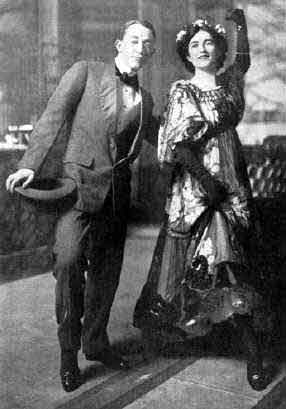 George
and first wife Ethel Levey kick up their heels in
Little Johnny Jones (1904).
George
and first wife Ethel Levey kick up their heels in
Little Johnny Jones (1904).
George M. Cohan grew up in vaudeville, becoming a master such dance forms as reel, the waltz clog, the buck and wing, and more. The spirit of vaudeville reached the legitimate musical stage when Cohan wrote, directed and starred in Little Johnny Jones (1904), a comic melodrama about an American jockey thwarting treachery while racing in England. While offering such memorable songs as "Give My Regards to Broadway" and "I'm a Yankee Doodle Dandy," Cohan danced with a spirited abandon that electrified audiences all across the United States. Throughout his long career, Cohan remained proud of his accomplishments as a dancer.
His singing voice was just a cut below ordinary . . . and his dancing was really only good in eccentric routines. But being a song and dance man was fun, and George valued that commodity highly. Even when he received wide praise for his acting in late years, his personal identification as a song and dance man was unremitting.
- John McCabe, George M. Cohan: The Man Who Owned Broadway (Garden City, NY: Doubleday and Company, 1973), p. 40.
Cohan shattered the long-standing Broadway convention that left most of dancing to the ladies of the ensemble -- an attitude that had prevailed since The Black Crook. The Library for the Performing Arts at Lincoln Center has a home movie of Cohan doing his famous "up the proscenium" run and flip step in his last musical, I'd Rather Be Right (1937). Although brief, this clip verifies that Cohan's dancing had an electrifying effect on audiences. Thanks to Cohan, men could dance on Broadway. Thanks to the talented Castles, men and women all across America soon took to the dance floors.
All the Rage: The Castles
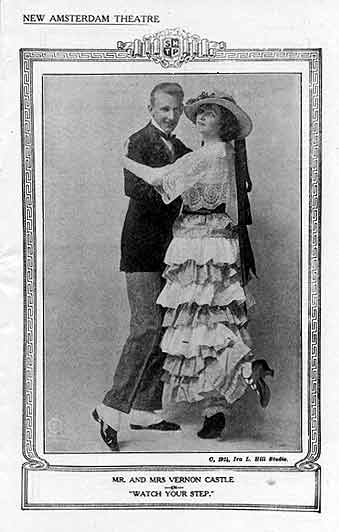 Vernon
and Irene Castle were all the rage in the 1910s, initiating various dance
and fashion crazes. Here they are seen in the original program for Watch
Your Step (1914) performing the popular "Castle
Walk."
Vernon
and Irene Castle were all the rage in the 1910s, initiating various dance
and fashion crazes. Here they are seen in the original program for Watch
Your Step (1914) performing the popular "Castle
Walk."
When the two lead characters in The Merry Widow (1904) waltzed to express their love for each other, it set off a fresh international craze for waltzing. That craze reached the United States when the Widow debuted on Broadway in 1907. It was only a matter of time before two American performers would bring all kinds of ballroom dancing to the musical stage -- and ignite a nationwide passion for dance in the process.
Dancers Vernon and Irene Castle met while they were appearing on Broadway in The Summer Widowers (1910). Married soon afterward, the slim, attractive couple became an international sensation, bringing a refreshing sense of unpretentious fun to the art of ballroom dancing. Their bouncy version of the one-step came to be known as "The Castle Walk." The Castles initiated several dance crazes, including the Grizzly Bear, Bunny Hug, Fox Trot, and the Maxixe. Most of these were refined version of African American dances, which the Castles developed with the help of their black musical director, James Reese Europe.
The American dances spawned in the craze of 1912-1914 had been too sensual, too African to gain universal acceptance . . . The Castles slowed the tempos, simplified the rhythms, restrained the gestures, and made the movements seem altogether healthy . . . But the Castles' appeal didn't pretend to be utilitarian -- it was purely emotional. Americans wanted to be swanky, and the Castles proved it was possible.
- Laurence Bergreen, As Thousands Cheer: The Life of Irving Berlin (New York: Viking, 1990), pp. 97-98.
The Castles reached their peak in 1914, co-starring on Broadway in Irving Berlin's Watch Your Step, opening a nationwide chain of dance schools, and running their own popular Times Square nightclub. All over the United States, couples danced the Castle dances -- and women enthusiastically copied Irene's fashions and hairstyles. Although Vernon's death in 1917 limited their partnership to seven brief years, the Castles had a tremendous effect on America's popular culture, and firmly established ballroom-style dance as a standard element in musical theatre.