
History of The Musical Stage
1920s IV: New Composers
by John Kenrick
(Copyright 1996, Revised 2020)
(The images below are thumbnails – click on them to see larger versions.)
Rodgers and Hart
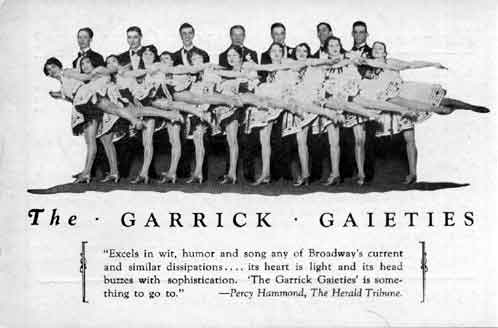 A publicity handout for Rodger's and
Hart's breakthrough Broadway hit, The Garrick Gaieties.
A publicity handout for Rodger's and
Hart's breakthrough Broadway hit, The Garrick Gaieties.
The Garrick Gaieties (1925 - 211 performances) was planned as a two-performance benefit for the prestigious but financially strapped Theatre Guild. Some catchy songs by composer Richard Rodgers and lyricist Lorenz Hart caused a sensation, and the run was extended to several sold-out months. The duo had been writing together for about a decade, but The Garrick Gaieties put them on the map and the bubbly song "Manhattan" became a tremendous pop hit. Rodgers and Hart then worked with librettist Herb Fields on several minor successes, several of which were produced by Herb's father, theatrical great Lew Fields.
Rodgers, Hart and Fields had been working on a book musical based on an actual incident that took place during the American Revolution. General George Washington asked a New York housewife to entertain a group of British commanders "by every means" – allowing the embattled American army time to make a strategic retreat from Manhattan. Filled with relatively gentle sexual innuendo, this project was rejected by producers until the success of the Gaieties. Dearest Enemy (1925 - 286 performances) received a lavish production, and made it clear that this new creative team was not just a flash in the pan.
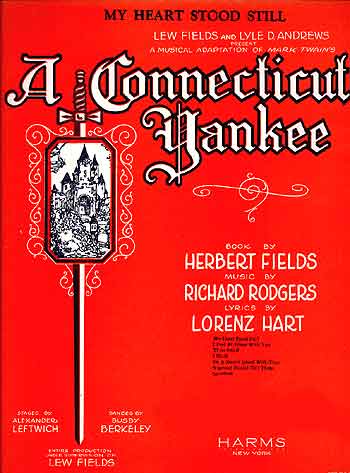 The original sheet music cover for
"My Heart Stood Still" one of the hit songs introduced in Rodgers
and Hart's A Connecticut Yankee.
The original sheet music cover for
"My Heart Stood Still" one of the hit songs introduced in Rodgers
and Hart's A Connecticut Yankee.
Rodgers, Hart and Fields achieved greater success with A Connecticut Yankee (1927 - 418 performances). Based on Mark Twain's tale of a modern American who is conked on the head and dreams that he has been transported to King Arthur's legendary court, it featured amusing combinations of neo-medieval speech and 1920s slang ("Methinks yon damsel is a lovely broad"). The score included "My Heart Stood Still" and the scintillating "Thou Swell." William Gaxton won acclaim in the central role, beginning his long reign as Broadway's most popular musical comedy leading man.
Rodgers and Hart's early shows were lighthearted romps, but some of their songs had surprising, bittersweet undertones. No lyricist ever eclipsed Larry Hart's gift for capturing the heartbreak of hopeless love. Since romantic frustration plagued his private life, this was not altogether surprising.
As the stock market crash of 1929 led to tough times on Broadway, Rodgers and Hart suffered a series of frustrating flops. When Paramount Pictures offered them a generous contract to create screen musicals, they took their talents out West. They would return to Broadway in the mid-1930s to create a string of outstanding musical comedy hits. (Their story continues in an upcoming chapter.)
Cole Porter
Composer-lyricist Cole Porter inherited a fortune and then married an even larger one, so he had little financial incentive to pursue a theatrical career. His remarkable talents first won attention at both Harvard and Yale. After the failure of Porter's first musical -- See America First (1916 - 15 performances) -- he set composing aside and enjoyed the high life in Europe for several years.
Things changed in the 1920s when Porter placed his career in the hands of agent Louis Schurr. Porter was soon working on a succession of worthwhile projects. The success of Paris (1928 - 195 performances) with its daring song hit "Let's Do It," led to to Porter's delightful musical comedy Fifty Million Frenchmen (1929 - 254 performances), featuring such provocative songs as "You've Got That Thing" and "You Do Something to Me." Porter's melodies ranged from bright to sensual, and his witty lyrics featured witty rhymes and daring sexual innuendo. The first Broadway lyricist to discuss sex openly in his songs, Porter would rise to greater fame in the 1930s.
The Gershwins
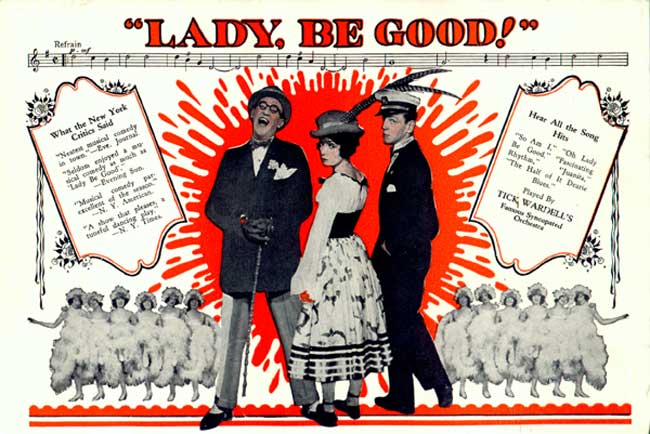 Fred and Adele Astaire
are featured on a publicity flyer for the Gershwin hit
Lady Be Good (1924).
Fred and Adele Astaire
are featured on a publicity flyer for the Gershwin hit
Lady Be Good (1924).
Those who say they "love Gershwin" sometimes forget that ther were two great songwriters by that name. Ira Gershwin's ingenious rhymes are just as important as his brother George Gershwin's unique blend of jazz and neo-classical melody.
Both men occasionally collaborated with others. George's rousing melody to "Swanee" (lyrics by Irving Caesar) won little attention in a mediocre Broadway revue, but then Al Jolson made it an international sensation by interpolating it into his long-running hit show Sinbad. George quickly became one of the hottest musical talents in New York, and he teamed with Ira on nine 1920s stage scores. Most of these shows were produced by the team of Alex Aarons and Vinton Freedley, including these memorable hits –
Lady Be Good (1924 - 330 performances) brought Broadway stardom to Fred Astaire and his sister Adele playing impoverished dancing siblings who try to masquerade their way into a fortune. The title tune and "Fascinating Rhythm" became major hits. The show and the Astaires triumphed again in London, where a sold out 326 performance 1926 run ended only because the theatre was slated for demolition.
Oh Kay! (1926 - 256 performances) was a comedy about a millionaire who doesn't realize that Prohibition rum runners are using his Long Island mansion as a smuggling station. It featured Gertrude Lawrence singing "Someone To Watch Over Me" and the catchy "Do, Do, Do."
Funny Face (1927 - 263 performances) featured Adele Astaire as a girl trying to get back her diary from her guardian (Fred), opening the way for a series of mishaps. The score included "S'Wonderful," "My One And Only," and the title tune.
The librettos to these shows were little more than amusing excuses to get from one number to another, something George and Ira would work to change in the next decade. For now, the effervescent songs mattered most.
Schwartz & Dietz
Composer Arthur Schwartz began writing specialty numbers for Broadway shows in the mid 1920s, but he got his first taste of top rank success when he collaborated with lyricist (and longtime MGM publicity director) Howard Dietz on the score for The Little Show (1929 - 321 performances). After beginning as a series of semi-improvised concerts, this was the first Broadway revue series to give wit precedence over spectacle.
Comedian Fred Allen won acclaim with his sardonic banter, torch singer Libby Hollman smoldered in "Moanin' Low," and future movie star Clifton Webb introduced "I Guess I'll Have to Change My Plan." Schwartz and Dietz would cement their reputations with several more intimate revues in the 1930s. There is more on this team in the pages ahead.
Berlin's Music Box Revues
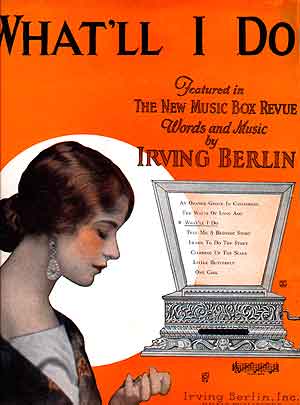 Irving Berlin's
"What'll I Do" was introduced by John Steel and future film
star Grace Moore in the 1923 Music Box Revue.
Irving Berlin's
"What'll I Do" was introduced by John Steel and future film
star Grace Moore in the 1923 Music Box Revue.
In 1921, Irving Berlin partnered with producer Sam Harris to build the handsome and relatively intimate Music Box Theater (originally 859 seats, it now holds 1,010). Berlin and Harris then enjoyed extraordinary success presenting four Music Box Revues (1921-1924) which featured scores by Berlin, sophisticated comedy, and lavish production values. The popular series introduced such hit songs as "Say It With Music," "Pack Up Your Sins and Go to the Devil" and "All Alone." Featured performers included Grace Moore, Charlotte Greenwood, Fanny Brice and the Brox Sisters.
We've saved three of the biggest Broadway events of the 1920s for last: Good News, Al Jolson, and Show Boat. And yes, Jolson was not just a performer – he was an event.