
History of Musical Film
The 1930s IV: Major Studios and Stars
by John Kenrick
(Copyright 1996; Revised 2020)
- Paramount: Bing Crosby & Mae West
- Goldwyn: Eddie Cantor
- Universal: Deanna Durbin
- 20th Century Fox: Three Blondes
- Disney: Feature Length Animation
- MGM: Upping The Game
(The images below are thumbnails – click on them to see larger versions.)
Every major Hollywood studio of the 1930s developed its own particular style of screen musical, and had its own bevy of musical stars under contract. It was almost as if each studio's executives felt their formula was a sort of talisman guaranteeing success. This did not leave room for much artistic innovation, but it resulted in a decade packed with enjoyable (if predictable) cinematic entertainment. Hollywood produced more feature length musicals during the 1930s than during any other decade. We already covered Busby Berkeley's Warner Brothers series and RKO's Astaire-Rogers films, Here is what the other studios were up to during these musical-packed years.
Paramount: Bing Crosby & Mae West
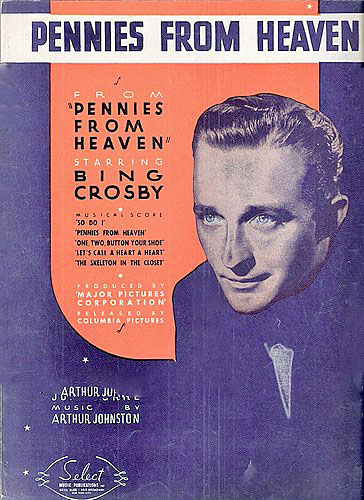 Bing
Crosby's velvety croon and affable screen presence made him one of the most
popular entertainers of the 20th century. He is seen here on the sheet music for
the title song from one of his many hit films, Pennies from
Heaven.
Bing
Crosby's velvety croon and affable screen presence made him one of the most
popular entertainers of the 20th century. He is seen here on the sheet music for
the title song from one of his many hit films, Pennies from
Heaven.
Founded in 1912 as Famous Players, Paramount was the oldest major American film studio. Under Adolph Zukor, who had a hand in managing the studio until his death in 1976, the stress was on great stars. The most successful studio of the silent era, it was bankrupt by 1933, yet managed to survive in large part thanks to three extremely popular stars. One was Marlene Dietrich, discussed elsewhere in these essays.
Paramount also created a series of wholesome musicals designed to showcase pop singer Bing Crosby. His film career began with featured roles in a series of minor Mack Sennett comedies. After Crosby's recordings and radio series took off in the early 1930s, Paramount featured him in The Big Broadcast (1932). When he delivered a winning performance in MGM's Going Hollywood (1933), Paramount decided never to loan him out again.
Crosby's Paramount vehicles included full musicals as well as comedies with a few interpolated songs. He earned Paramount millions with such titles as Mississippi (1935), Pennies From Heaven (1936) and Sing You Sinners (1938). Often mediocre, these films were popular thanks to Crosby's folksy, laid back screen persona, and his warm baritone crooning of many hit songs, including "Temptation," "Pennies From Heaven" and "Blue Hawaii." Crosby's best screen work lay ahead, so you'll find more on him in our coverage of 1940s screen musicals.
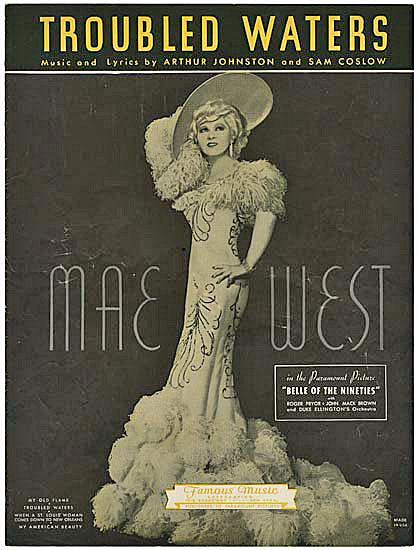 It
was not one of Mae West's most memorable songs, but her pose on the sheet music
cover for "Troubled Waters" captures the curvaceous, turn of the century screen
persona her fans adored.
It
was not one of Mae West's most memorable songs, but her pose on the sheet music
cover for "Troubled Waters" captures the curvaceous, turn of the century screen
persona her fans adored.
Mae West's films were not full-blown musicals, but her daring comedies usually featured the curvaceous comedienne crooning a suggestive song or two. Trained in vaudeville, West had achieved notoriety when her racy Broadway play Sex brought her a stint in jail. As a screenwriter, she continued to push accepted limits.
In She Done Him Wrong (1933), West played an 1890s Bowery saloon singer, and dared to sing "Frankie and Johnny," a well-known bawdy period ballad about a prostitute who murders her cheating male lover. Despite a bowdlerized lyric, the infamous song and West's racy wisecracks ("It was a toss up between whether I go in for diamonds or sing in the choir. The choir lost.") helped make the film a massive hit, and inspired the outcry which led to stricter enforcement of the Production Code.
Although West was the most highly salaried women in the world in 1935, the code became so restrictive that she stopped making films by 1943. But her nine comedies with music became lasting favorites.
Goldwyn: Eddie Cantor
When Samuel Goldwyn's studio merged with two others to create Metro-Goldwyn-Mayer, he was quickly tossed out by ruthless partners. Undaunted, he became Hollywood's first major independent producer. Celebrated for unintentionally hilarious misstatements, ("I don't think anybody should write his autobiography until after he's dead"), Goldwyn saw himself as Hollywood's equivalent of Broadway's Florenz Ziegfeld, going so far as to produce six screen musicals starring Follies comedian Eddie Cantor.
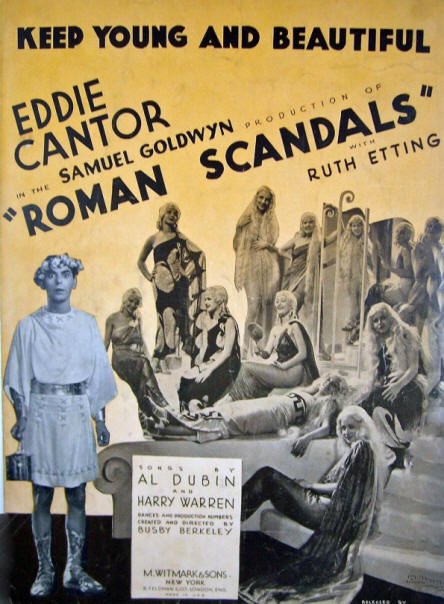 Eddie
Cantor took his "weakling unexpectedly finds romance" character into the ancient
past in Roman Scandals (1933), in
which he introduced the hit song "Keep Young and Beautiful."
Eddie
Cantor took his "weakling unexpectedly finds romance" character into the ancient
past in Roman Scandals (1933), in
which he introduced the hit song "Keep Young and Beautiful."
The highly profitable series of Goldwyn-Cantor screen musicals included Whoopee (1930), The Kid From Spain (1932), Roman Scandals (1933), Kid Millions (1934) and Strike Me Pink (1936). In accordance with the Hollywood star system, these films followed a set plot formula, with Cantor playing nervous weaklings who somehow outsmart tough bad guys and gets the girl, along the way offering such hit songs as "Makin' Whoopee," "My Baby Just Cares for Me" and "Keep Young and Beautiful." This series gave Broadway choreographer Busby Berkeley his first opportunity to work on film, developing the techniques he would later perfect at Warner Brothers.
Cantor & Goldwyn's creative partnership was a high point in both of their careers, but Cantor eased away from films in the 1940s, working primarily on radio. Goldwyn continued to make successful films into the 1950s, including a series of Cantor-esque musical comedies starring Danny Kaye -- more on this in the pages ahead.
Universal
Carl Laemmle founded Universal Studios in 1915, then passed it on to his son Carl Jr. in 1928. Dismissed by some as a "family" business, Universal is best remembered for making Hollywood's most stylish horror films, beginning with Lon Chaney's silent version of Phantom of the Opera (1925).
British director James Whale, who helmed the stylish Universal versions of Frankenstein (1931) and The Bride of Frankenstein (1935) gave the studio a landmark musical hit when he directed the finest screen version of the stage hit Show Boat (1936). Since Universal had no set formula for musical projects, Whale was granted a relatively free hand. He opted to treat a classic with extraordinary respect. Commissioning several new songs from Kern & Hammerstein, he left much of their stage score and the basic plot intact. Original Broadway stars Helen Morgan and Charles Winninger repeated their acclaimed performances, and Paul Robeson was on hand to sing the definitive "Ol' Man River."
Whale filmed the complex story of Show Boat with simple but frequently striking visual style. A critical and commercial success, Show Boat was a one-shot prestige project -- as a rule, Universal preferred to focus on cheaper projects. The gifted Whale never got to film another musical.
When MGM dropped unknown teenage Canadian soprano Deanna Durbin, Universal had the good sense to put this attractive, upbeat girl under contact and showcase her in a series of budget-conscious musical comedies that blended operatic selections with popular songs. Durbin's Three Smart Girls (1936), 100 Men and a Girl (1937), and Mad About Music (1938) proved so profitable that she was credited with saving cash-strapped Universal from financial ruin. A dedicated professional, Durbin would remain the studio's top musical star through the the mid-1940s. (There is more on her in the pages ahead).
20th Century Fox: Three Blondes
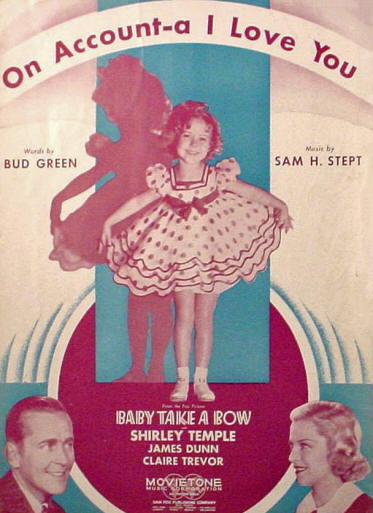 In 1934, the long-lived Fox Studio merged with the newly formed 20th Century
Pictures to form Twentieth Century Fox under
mogul Darryl F. Zanuk. His casting team had the luck to stumble upon the multi-talented tot
Shirley Temple. When
this irrepressible six year-old with blonde curls stole Fox's
otherwise forgettable Stand Up And Cheer (1934), Zanuk realized
that he had a pint-sized goldmine on his hands. Temple's acting and singing
seemed unstudied, she could dance with natural ease, and her on screen enthusiasm was irresistible. Loved by both
children and adults, her likeness soon appeared on lunch boxes, dolls and other collectibles.
In 1934, the long-lived Fox Studio merged with the newly formed 20th Century
Pictures to form Twentieth Century Fox under
mogul Darryl F. Zanuk. His casting team had the luck to stumble upon the multi-talented tot
Shirley Temple. When
this irrepressible six year-old with blonde curls stole Fox's
otherwise forgettable Stand Up And Cheer (1934), Zanuk realized
that he had a pint-sized goldmine on his hands. Temple's acting and singing
seemed unstudied, she could dance with natural ease, and her on screen enthusiasm was irresistible. Loved by both
children and adults, her likeness soon appeared on lunch boxes, dolls and other collectibles.
Most of Temple's films were not full-scale musicals, and almost all were done on the cheap, but several of the interpolated songs she performed became hits, including "Animal Crackers in My Soup" and "On The Good Ship Lollipop." Temple also gave the world the iconic image of herself and Bill "Bojangles" Robinson tap dancing in several films, including The Little Colonel (1935). This was the first interracial pairing to succeed in commercial film, effectively smashing a long-standing Hollywood color barrier. Temple's popularity faded as she grew older, but she has remained a lasting icon of Depression-era optimism.
Other Fox musicals from this period tended to follow a remarkably limited formula, putting attractive blonde leading ladies in distinctively American backstage love stories. Alice Faye became Fox's top adult musical star of the 1930s. This throaty-voiced blonde co-starred with Temple in Poor Little Rich Girl (1936), and went on to delight audiences in a series of showbiz-themed romances, including Sing Baby Sing (1936), In Old Chicago (1938), Alexander's Ragtime Band (1938) and Rose of Washington Square (1939). Faye's reign would continue into the 1940s – you can find more on her in the essays covering that decade.
Fox created a less likely musical star when it featured Olympic figure skating champion Sonja Henie in Once in a Million (1936). This shapely blonde could not act or sing, but her natural enthusiasm and skating ability delighted moviegoers. Placing the music and dramatics in the hands of stellar co-stars, Henie headlined a series of highly profitable screen musicals through the late 1940s. She also produced a series of popular skating spectacles that played in Broadway's 3,000 seat Center Theatre (the same space that now serves as Rockefeller Center's parking garage). Often ignored by film scholars, Henie's skating musicals were a popular Hollywood staple for more than a decade -- a noteworthy accomplishment in any era.
In a departure, Fox produced Music in the Air (1934), a surprisingly effective screen version of the Kern-Hammerstein stage hit. Former silent star Gloria Swanson got to show off a handsome soprano voice and deft comic timing playing an egotistical theatre diva, but with the Great Depression at its height, Fox made no attempt to follow up on this unusual charmer.
Disney
Walt Disney had been turning out animated short subjects for years, but industry experts scoffed at his plans for a full-length animated musical, questioning whether there was much of an audience for such a project. MGM mogul Louis B. Mayer refused to distribute the film, a decision which forced Disney to form his own studio.
Thanks to Disney's insistence on quality, Snow White and the Seven Dwarfs (1937) was as expensive to produce as a live-action film. However, Snow White's visual beauty, tuneful score and genuine sense of wonder made it a sensation with all age groups. Every number (including "Heigh-Ho" and "Some Day My Prince Will Come") was used to develop plot and character, and there was a polished balance of humor, color and sentiment. Other studios would occasionally dabble in feature-length animation, but none matched the Disney team's mastery of this format.
Disney seemed to overplay his hand with Fantasia (1940), an animated revue that blended classical music and stunning cartoon imagery and was initially rejected by the movie-going public. Over the years, Fantasia developed a cult following and is now recognized as a unique achievement. But the film's initial failure effected the future course of Disney's output.
As much a businessman as he was an artist, Disney thereafter stuck to straightforward animated book musicals. Almost all of these films became classics, introducing such Academy Award-winning songs as "When You Wish Upon a Star" (Pinocchio - 1940) and "Zip-a-Dee-Doo-Dah" (Song of the South - 1946). Disney remained the pre-eminent creator of animated musical features until his death in 1966.
MGM: The Lion's Roar
Metro-Goldwyn-Mayer was the only Hollywood studio that showed an annual profit through every year of the Great Depression. More than any other studio, MGM used audience reaction from sneak previews to re-shape and re-shoot its films. Studio head Louis B. Mayer (a former scrap metal dealer) blended a tyrannical managerial style with a shrewd eye for talent. His insistence on family entertainment and personal passion for great singers made musicals a big part of MGM's annual output. Mayer and production head Irving Thalberg managed over 6,000 employees in more than 150 professions, including many of the finest creative and performing talents available.
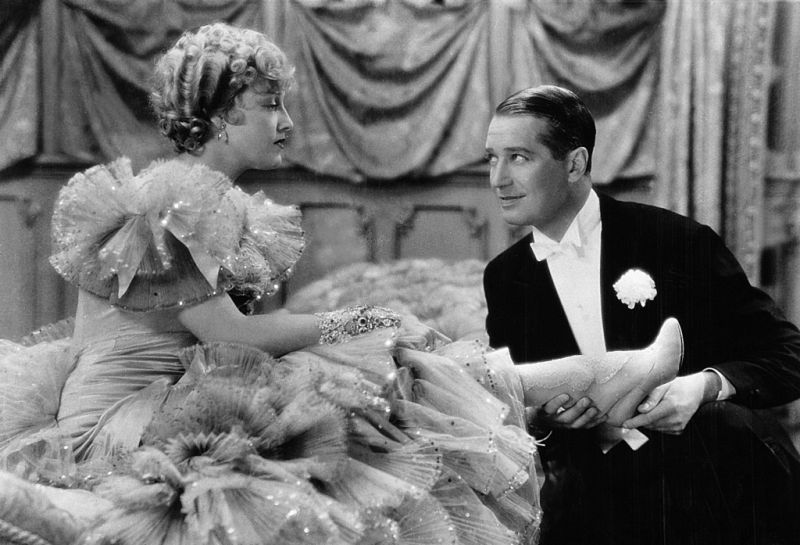 Inspired by Busby Berkeley's success at Warner Brothers,
Thalberg decided to film a lavish sound version of The Merry Widow
(1934). He hired Ernst Lubitsch to direct the already
established screen team
Maurice Chevalier and
Jeanette MacDonald.
Off screen the two stars disliked each other, but none of that showed on screen.
With a heavily revised plot and several new characters, the production amounted to a
total rethinking of Franz Lehar's
beloved stage operetta, filled with the sexy visual wit that was Lubitsch's
cinematic trademark. Thalberg made sure it was calibrated to appease the dreaded Production Code. New lyrics by Lorenz Hart certainly helped, and the film opened to critical raves.
Inspired by Busby Berkeley's success at Warner Brothers,
Thalberg decided to film a lavish sound version of The Merry Widow
(1934). He hired Ernst Lubitsch to direct the already
established screen team
Maurice Chevalier and
Jeanette MacDonald.
Off screen the two stars disliked each other, but none of that showed on screen.
With a heavily revised plot and several new characters, the production amounted to a
total rethinking of Franz Lehar's
beloved stage operetta, filled with the sexy visual wit that was Lubitsch's
cinematic trademark. Thalberg made sure it was calibrated to appease the dreaded Production Code. New lyrics by Lorenz Hart certainly helped, and the film opened to critical raves.
MGM placed creative control in the hands of its producers, all of whom had to answer to Louis B. Mayer. Thanks to this centralized system, Mayer carefully varied the studio's output, balancing expensive prestige projects with lower-cost fare.
For example, dancer Eleanor Powell was first showcased in the relatively inexpensive Born to Dance (1936), followed by more ambitious projects like Rosalie (1937) and three profitable installments of the Broadway Melody series. Powell's natural charm and sensational tap technique made her limitations as a singer and actress irrelevant. Her "Begin the Beguine" with Fred Astaire in Broadway Melody of 1940 is arguably the best tap duet Hollywood ever filmed. Powell retired in the 1940s to marry and raise a family, making a brief nightclub comeback in the 1950s.
More was going on at MGM -- enough to take the world all the way from the Canadian Rockies to somewhere over the rainbow . . .